
Author: Hamid Rehman

  • VAT on Tourism Services in UAE: Complete Guide for Tourism Businesses

    VAT on Tourism Services in UAE: Complete Guide for Tourism Businesses

    Tourism is one of the busiest sectors in the UAE, covering hotels, tour operators, desert safaris, yacht tours, attractions, travel agencies, theme parks, restaurants, transport providers, and retail businesses serving tourists. 

    Many tourism businesses sell mixed packages that include accommodation, transport, attraction tickets, meals, guided tours, entertainment, airport transfers, retail purchases, online bookings, and services for international customers.

    Because of this, VAT can be confusing. In the UAE, the VAT treatment of tourism services depends on the type of service, where the service is supplied, whether the business acts as an agent or principal, and whether any exemption or zero-rating applies.

    Does VAT Apply to Tourism Services in the UAE?

    Yes. In most cases, tourism services supplied in the UAE are subject to 5% VAT. This means tourists may still pay VAT on services they use during their visit, even if they are not UAE residents.

    VAT will generally apply to tourism-related services such as:

    • Dubai city tours
    • Desert safari packages
    • Yacht tours and leisure cruises
    • Theme park entry tickets
    • Museum and attraction tickets
    • Guided cultural tours
    • Hotel accommodation
    • Restaurant meals included in tourism packages
    • Spa and wellness experiences
    • Water sports and leisure activities
    • Travel agency service fees
    • Tourism event packages

    However, tourism services should not be treated as VAT-exempt automatically. The correct VAT treatment depends on:

    • The type of service being supplied
    • Where the service is supplied
    • Whether the business acts as an agent or principal
    • Whether any exemption or zero-rating rule applies

    Each tourism service should be reviewed separately before deciding the VAT treatment.

    VAT on Tour Packages in the UAE

    Tour packages in the UAE often include more than one service. A single package may include a hotel stay, airport transfer, desert safari, dhow cruise, theme park ticket, restaurant meal, guided tour, entertainment activity, and travel agency fee.

    Because a package can include different services, the VAT treatment should be checked carefully. Not every part of the package may have the same VAT treatment.

    VAT on tour packages usually depends on:

    • Where the tour services are performed
    • What services are included in the package
    • Whether the supplier sells the package in its own name
    • Whether the supplier acts only as an agent
    • Whether any part of the package is exempt or zero-rated

    If the tour is performed in the UAE, VAT will usually apply. For example, Dubai city tours, desert safaris, dhow cruises, and theme park visits are normally services supplied in the UAE.

    If the tour operator sells the package in its own name, VAT may apply to the full package value. However, if the business only acts as an agent for another supplier, VAT may apply only to the commission or service fee.

    For example, a UAE tour operator sells a Dubai holiday package that includes hotel accommodation, airport pickup, desert safari, and theme park tickets. Since these services are mainly supplied in the UAE, VAT will generally apply unless a specific exemption or zero-rating rule applies to one part of the package.

    Tourism businesses should not assume that one VAT treatment applies to the whole package without checking each component. Bundled packages should always be reviewed before issuing the invoice.

    VAT on Desert Safari, City Tours, and Tourist Activities

    Tourist activities in the UAE are usually performed inside the country. Because of this, they are generally part of the UAE VAT system. If the business is VAT-registered, it will usually need to charge 5% VAT on these services.

    This can apply to many tourism experiences, such as desert safari tours, Dubai city tours, Abu Dhabi city tours, heritage tours, dhow cruises, yacht tours, mountain tours, water sports, adventure tourism, cultural experiences, and entertainment events.

    Tourism ActivityVAT Treatment in UAE
    Desert safari toursUsually subject to 5% VAT if supplied in the UAE
    Dubai city toursUsually subject to 5% VAT
    Abu Dhabi city toursUsually subject to 5% VAT
    Heritage toursUsually subject to 5% VAT if performed in the UAE
    Dhow cruisesUsually subject to 5% VAT
    Yacht toursUsually subject to 5% VAT
    Mountain toursUsually subject to 5% VAT if performed in the UAE
    Water sportsUsually subject to 5% VAT
    Adventure tourismUsually subject to 5% VAT
    Cultural experiencesUsually subject to 5% VAT if performed in the UAE
    Entertainment eventsUsually subject to 5% VAT unless a specific rule applies

    For example, if a tourist books a desert safari in Dubai, the service is performed in the UAE. The tour operator should generally charge 5% VAT if it is registered for VAT.

    VAT on Travel Agency Services in the UAE

    Travel agencies in the UAE should check whether they are acting as an agent or as a principal. This is important because the VAT treatment can change based on the role of the agency.

    If the Travel Agency Acts as an Agent

    A travel agency acts as an agent when it only arranges services for another supplier. In this case, the customer is usually buying the main service from the hotel, airline, tour operator, or attraction provider. The travel agency earns a commission or charges a service fee.

    VAT may apply to:

    • Booking fees
    • Service charges
    • Commission income
    • Administrative fees
    • Processing fees

    For example, if a UAE travel agency arranges a hotel booking for a tourist and charges a separate service fee, VAT may apply to that service fee if the agency is VAT-registered.

    If the Travel Agency Acts as Principal

    A travel agency acts as principal when it sells the tour package in its own name. In this case, the customer is buying the package directly from the travel agency.

    VAT may apply to:

    • Full tour package value
    • Holiday package price
    • UAE excursion package
    • Combined hotel and activity package

    For example, if a UAE travel agency sells a Dubai holiday package under its own name, VAT may apply to the full selling price of the package.

    The correct VAT treatment depends on the contract, invoice, commercial model, and whether the agency is legally acting as an agent or principal. Travel agencies should review their booking terms and invoices carefully before deciding how VAT should be charged.

    VAT on Tourist Attractions and Entertainment Services

    Tourist attractions and entertainment services are a big part of the UAE tourism industry. These services are usually linked to the place where the attraction, venue, or event is located. So, if the attraction or event is in the UAE, the entry fee or ticket price will generally be subject to 5% VAT.

    This can apply to tourist attractions and entertainment services such as:

    • Theme parks
    • Museums
    • Cultural attractions
    • Observation decks
    • Heritage sites
    • Waterparks
    • Aquariums
    • Entertainment shows
    • Sporting events
    • Cultural events

    For example, if a tourist buys an entry ticket to a UAE theme park, museum, waterpark, aquarium, or observation deck, 5% VAT will generally apply unless a specific VAT treatment applies.

    Tourism businesses should also check whether they are selling the ticket as the main supplier or only arranging the booking for another provider. If the business sells the ticket in its own name, VAT may apply to the full ticket price. If it only acts as an agent, VAT may apply only to the booking fee or commission.

    For businesses selling attraction tickets or entertainment packages, using a VAT Calculator can help estimate the VAT amount before issuing invoices.

    VAT on Hotels and Tourism Accommodation

    Hotels and tourism accommodation are a major part of the UAE tourism sector. Many tourists visit the UAE for holidays, events, business trips, shopping, and family stays, so hotels and accommodation providers must apply VAT correctly.

    VAT will generally apply to tourism accommodation such as:

    • Hotel rooms
    • Resorts
    • Serviced apartments
    • Holiday accommodation
    • Hotel packages
    • Accommodation with breakfast
    • Accommodation with tours or transfers

    Hotel accommodation supplied in the UAE is generally subject to 5% VAT. This means if a tourist books a hotel room, resort stay, or serviced apartment in the UAE, VAT will usually be added to the taxable accommodation charges.

    For example, a tourist books a hotel room in Dubai for a 5-night holiday. The hotel should generally charge 5% VAT on the taxable room charges.

    Hotels may also charge other local fees, such as tourism fees, municipality fees, or service charges. These charges are separate from VAT and should not be confused with VAT. Tourism businesses should show these charges clearly on invoices so customers understand what they are paying for.

    VAT on Tourism Transport Services

    VAT on tourism transport services in the UAE needs careful review because not all transport services are treated the same. The VAT treatment can depend on the type of transport, where the journey starts, where it ends, and whether the transport is sold separately or as part of a tour package.

    Tourism transport may include:

    • Airport transfers
    • Private tourist vehicles
    • Luxury chauffeur services
    • Tour buses
    • Local sightseeing transport
    • Yacht transfers
    • Domestic tourism transport
    • International passenger transport

    International passenger transport may be zero-rated if the legal conditions are met. Local passenger transport may also be exempt in certain cases. However, this does not mean every transport service used in tourism is automatically exempt or zero-rated.

    For example, a regular local passenger transport service may be exempt, but a luxury private airport transfer included in a tourism package may need a different VAT review. In the same way, a tour bus used for sightseeing or a yacht transfer included in a leisure package should be checked separately.

    Tour operators should not treat all transport as exempt without reviewing the service properly. If a tourism business has complex transport arrangements or mixed tour packages, VAT Audit Services can help review whether VAT has been applied correctly.

    Private transfers, luxury vehicles, chauffeur services, sightseeing transport, yacht transfers, and transport included in bundled tour packages may need separate VAT analysis before issuing the invoice.

    VAT Refunds for Tourists in the UAE

    Tourists may claim VAT refunds in the UAE under the Tourist Refund Scheme, but this usually applies to eligible goods, not tourism services that have already been used or consumed in the UAE.

    Tourists usually cannot claim VAT refunds on services such as:

    • Hotel stays
    • Restaurant meals
    • Desert safari tours
    • Spa services
    • Entertainment services
    • Transport services
    • Theme park experiences already consumed in the UAE

    Tourists may be able to claim a VAT Refund on:

    • Eligible retail goods
    • Purchases from retailers registered under the Tourist Refund Scheme
    • Goods exported with the tourist when leaving the UAE

    This difference is important. A tourist may be able to claim VAT back on eligible shopping purchases, but they generally cannot claim VAT back on a hotel stay, restaurant bill, desert safari, spa treatment, or theme park visit. 

    Tourism businesses should explain this clearly to customers so there is no confusion between VAT refunds on tourist shopping and VAT charged on tourism services.

    VAT Registration for UAE Tourism Businesses

    Tourism businesses in the UAE may need to register for VAT if their taxable sales and imports cross the required limit. This can apply to businesses that sell tours, packages, tickets, transport, hotel-related services, or other tourist services.

    Tourism businesses that may need VAT registration include:

    • Tour operators
    • Travel agencies
    • Desert safari providers
    • Yacht tour companies
    • Tourist transport providers
    • Event tourism companies
    • Hotel package sellers
    • Tourist attraction operators
    • Retailers selling to tourists
    • Destination management companies

    A tourism business must register for VAT if its taxable supplies and imports exceed AED 375,000. A business may also register voluntarily if its taxable supplies, imports, or taxable expenses exceed AED 187,500.

    If a tourism business is not sure whether it has crossed the registration limit, it can speak with a VAT Registration Consultant to review its sales, tour packages, and VAT position.

    Once registered, the business must charge VAT where applicable, issue proper tax invoices, file VAT returns, and maintain proper records. This is important for tourism businesses because they often deal with advance bookings, online payments, deposits, cancellations, refunds, and mixed tour packages.

    Common VAT Mistakes Tourism Businesses Make in the UAE

    Tourism businesses in the UAE often deal with different services at the same time, such as tours, hotel bookings, transport, tickets, meals, and online payments. Because of this, VAT mistakes can happen if each service is not checked properly.

    Common VAT mistakes include:

    • Assuming tourists should not be charged VAT
    • Treating all tourism services as VAT-exempt
    • Treating all international customers as zero-rated
    • Charging VAT only on profit instead of the full taxable value
    • Not separating agency commission from principal package sales
    • Applying one VAT treatment to a mixed tourism package without review
    • Treating all transport services as exempt
    • Confusing VAT with tourism fees or municipality fees
    • Not issuing compliant tax invoices
    • Not keeping proper VAT records for bookings, deposits, cancellations, and refunds
    • Not reviewing online platform bookings correctly
    • Advertising “VAT-free tours” without a valid basis

    These mistakes can create problems during VAT return filing or an FTA review. If a tourism business has complex packages, past VAT errors, or unclear invoices, VAT Audit Services can help review the records and correct the VAT treatment.

    UAE Tourism VAT Examples

    Here are some simple examples to understand how VAT may apply to tourism services in the UAE.

    ExampleSituationGeneral VAT Treatment
    Desert safari in DubaiA VAT-registered tour operator sells a desert safari package to a tourist.Since the activity is performed in the UAE, the package will generally be subject to 5% VAT.
    Dubai city tourA tourist books a guided Dubai city tour.The tour takes place in the UAE, so VAT will generally apply.
    Travel agency commissionA UAE travel agency arranges a hotel booking and charges a separate service fee.VAT may apply to the agency’s service fee if the agency is VAT-registered.
    Hotel and tour packageA hotel sells a package including accommodation, breakfast, airport transfer, and a city tour.The hotel should review each component and check whether VAT applies to the full package or to separate elements.
    Tourist VAT refund on shoppingA tourist buys eligible goods from a registered UAE retailer and exports them when leaving the UAE.The tourist may be able to claim a VAT refund under the Tourist Refund Scheme.
    International flightA passenger takes an international flight starting or ending in the UAE.International passenger transport may be zero-rated if the required conditions are met.

    These examples show why tourism businesses should not apply one rule to every transaction. A desert safari, hotel package, agency commission, tourist shopping purchase, and international flight can all have different VAT treatment.

    VAT Checklist for UAE Tourism Businesses

    Tourism businesses should review VAT before selling tour packages, issuing invoices, or filing returns. This is especially important when a package includes different services such as transport, hotel stays, meals, tickets, and guided tours.

    VAT CheckWhat Tourism Businesses Should Review
    Identify the serviceCheck whether you are supplying a tour, hotel stay, transport, ticket, meal, event, or mixed package.
    Confirm the place of supplyCheck whether the service is supplied in the UAE or outside the UAE.
    Check the VAT treatmentDecide whether the supply is standard-rated, zero-rated, exempt, or outside the scope of UAE VAT.
    Review agent or principal roleConfirm whether the business is selling in its own name or only arranging the service for another supplier.
    Review mixed packagesCheck whether the package includes different services with different VAT treatments.
    Check transport typeConfirm whether the transport is local, international, private, or part of a tour package.
    Separate other feesKeep VAT separate from tourism fees, municipality fees, and service charges.
    Issue proper invoicesMake sure UAE tax invoices are correct and show VAT clearly where required.
    Keep VAT recordsMaintain records for bookings, deposits, cancellations, refunds, and customer payments.
    Review online bookingsCheck how VAT applies to bookings made through online platforms or third-party agents.
    Check input VAT recoveryReview whether VAT paid on business expenses can be recovered.
    Review tourist refund rulesRemember that tourist VAT refunds usually apply to eligible goods, not consumed tourism services.
    Get expert adviceTake professional VAT advice for complex tour packages or unclear VAT treatment.

    A clear checklist helps tourism businesses avoid common VAT mistakes. It also makes it easier to manage pricing, invoices, refunds, online bookings, and VAT return filing correctly.

    Conclusion

    VAT on tourism services in the UAE depends on the exact nature of the service being supplied. Most UAE-based tourism services, including tours, attractions, hotel stays, tourism activities, event packages, and travel agency services, are generally subject to 5% VAT.

    However, tourism businesses should not apply the same VAT treatment to every transaction. Transport services, international travel, agency commissions, mixed tour packages, online bookings, and tourist refund rules all need careful review.

    The key point is simple: a service is not VAT-free only because the customer is a tourist. UAE tourism businesses should check each service, issue proper invoices, keep clear records, and apply VAT correctly. If a business no longer meets the VAT registration requirements, it may also need to review whether VAT Deregistration UAE applies.

    Getting the VAT treatment right helps tourism businesses avoid errors, penalties, and customer confusion. It also makes pricing, invoicing, refunds, and VAT filing easier to manage.

    FAQs

    Is VAT applicable on tourism services in the UAE?

    Yes. Most tourism services performed in the UAE are generally subject to 5% VAT unless a specific exemption or zero-rating rule applies.

    Is VAT charged on desert safari tours in Dubai?

    Usually, yes. A desert safari performed in Dubai or anywhere else in the UAE will generally be subject to VAT if it is supplied by a VAT-registered business.

    Do tourists have to pay VAT in the UAE?

    Yes. Tourists generally pay VAT on taxable goods and services in the UAE. A customer is not exempt from VAT only because they are a tourist.

    Can tourists claim VAT back on UAE tour packages?

    Generally, no. The Tourist Refund Scheme usually applies to eligible goods bought from registered retailers. It does not usually apply to consumed services such as tours, hotel stays, restaurant meals, and entertainment services.

    Are travel agency commissions subject to VAT in UAE?

    Usually, yes. If the travel agency service is supplied in the UAE and the agency is VAT-registered, VAT may apply to the commission or service fee. The treatment depends on whether the agency acts as an agent or principal.

    Is VAT charged on UAE hotel packages?

    Generally, yes. Hotel accommodation and tourism packages supplied in the UAE are usually subject to VAT. However, mixed packages should be reviewed carefully because they may include accommodation, transport, meals, tickets, and other services.

    Is tourism transport exempt from VAT in UAE?

    Not always. Some local passenger transport may be exempt, and international passenger transport may be zero-rated if the required conditions are met. Private transfers, luxury transport, and transport included in tour packages may need separate VAT review.

    Are tourist attraction tickets subject to VAT in UAE?

    Generally, yes. Entry tickets for UAE attractions, entertainment venues, museums, theme parks, waterparks, and similar tourist activities are usually subject to 5% VAT unless a specific VAT treatment applies.

  • UAE Income Tax for Foreigners: Complete Guide For Expats

    UAE Income Tax for Foreigners: Complete Guide For Expats

    The UAE is known for having no personal income tax on salaries, which is why many professionals choose to live and work in cities like Dubai and Abu Dhabi.

    However, the tax system is changing for businesses and higher earners. A 9% corporate tax applies to profits above AED 375,000, and a 5% VAT is charged on most goods and services.

    Freelancers also need to keep track of their income to stay compliant with local regulations. In addition, foreigners may still have tax obligations in their home country depending on their residency status and tax agreements.

    To better understand UAE income tax for foreigners, let’s explore the guide below.

    Overview

    Foreigners in the UAE generally pay 0% personal income tax on salaries, investments, or rental income, making it a tax-free environment for individuals. There is no personal tax registration required. However, a 5% VAT applies to goods/services, and a 9% corporate tax applies to large business incomes. 

    What Types of Income Are Tax-Free in the UAE?

    The UAE remains a highly attractive location for professionals and investors. While new rules exist for businesses, most individual earnings remain free from direct taxation. You can manage your finances with more certainty when you know which categories of income stay in your pocket.

    Income TypeTax StatusNotes
    Salary0%No personal income tax
    Freelance IncomeDependsCorporate tax may apply
    Business Profits9%Above AED 375,000
    Dividends0%Generally tax-free
    Capital Gains0%In most cases
    Rental Income0%For individuals

    For freelancers, the UAE tax law treats your work as a business activity. If your annual revenue stays below AED 1 million, you do not need to register for corporate tax. However, if your profit exceeds AED 375,000, the 9% rate applies. 

    Most personal investments, such as dividends and capital gains, are not subject to income tax in Dubai. This allows you to grow your wealth without the burden of complex tax filings on your personal savings.

    Why the UAE Has No Personal Income Tax

    The UAE maintains a zero-percent personal income tax rate as a core part of its economic strategy. By allowing you to keep 100% of your earnings, the government encourages high-level talent and global investors to move to the country. 

    This model creates a vibrant domestic economy where residents spend their disposable income on local businesses, real estate, and services.

    Instead of taxing your paycheck, the government generates revenue through a diversified business-friendly model. This approach focuses on attracting foreign investment by offering 100% company ownership and world-class infrastructure. 

    The UAE uses its natural resource wealth and sovereign investments to fund public services like safety and transport without needing to tax its individual salaries.

    What Taxes Exist in the UAE Instead

    While your personal income remains tax-free, the UAE uses a modern tax system to maintain its high-quality infrastructure. You will encounter these primary costs as a resident or business owner:

    VAT (5%)

    A Value Added Tax applies to most everyday purchases. This consumption tax is standard across the country for goods and services.

    Corporate Tax (9%)

    If your business or freelance activity earns a net profit above AED 375,000, you must pay this flat rate. It ensures that large companies contribute to the national economy.

    Licensing and Government Fees

    To operate a business or live in the UAE, you pay for specific permits. These include trade license renewals, visa processing fees, and municipal housing fees attached to your utility bills.

    Does Corporate Tax Apply to Foreigners?

    Yes, corporate tax applies to you if you operate a commercial business or work as a licensed freelancer in the UAE. While your personal salary remains tax-free, the government treats your business earnings as a separate category. You must monitor your annual profits to determine if you owe the 9% rate under UAE tax law. 

    Many foreigners living in Dubai or Abu Dhabi mistake the lack of personal income tax for a total absence of tax. If you hold a trade license, you are part of the corporate tax system. This ensures that all commercial entities contribute to the infrastructure you use to run your business.

    Who Needs to Pay Corporate Tax?

    Specific groups must register and potentially pay tax based on their earnings. You fall into this category if you manage mainland businesses registered outside of a free zone. These entities must comply with the 9% tax on profits above AED 375,000. 

    Freelancers with licenses also face these rules because the government considers their income as business income. You must register once your annual revenue exceeds AED 1 million. Any company earning above the AED 375,000 threshold only pays the tax on the portion of net profit that exceeds that specific amount.

    Who Is Not Affected?

    Most individuals residing in the UAE will not be impacted by these changes. You are not affected by corporate income tax in the UAE if you are a salaried employee. Your monthly paycheck, bonuses, and housing allowances stay 100% tax-free. Individuals with no business activity also have no corporate tax obligations. 

    This means if you do not own a company or sell professional services, you do not need to worry about filings. Passive investors remain exempt as well. Your earnings from personal bank interest, stock dividends, or owning a home for personal use do not attract any tax.

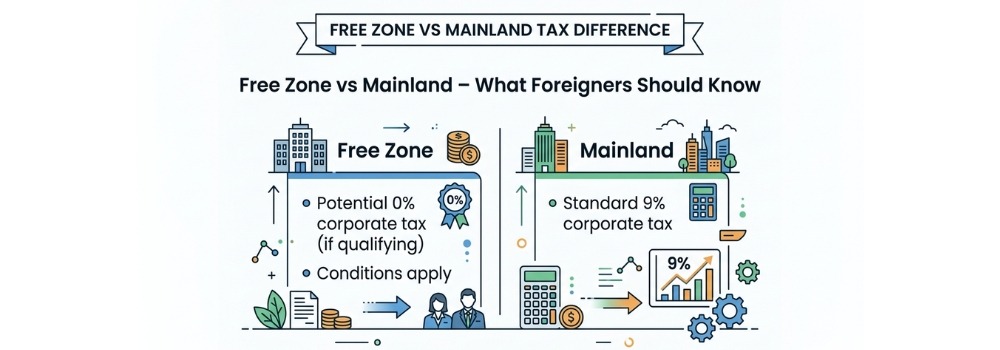
    Free Zone vs Mainland – What Foreigners Should Know

    Choosing between a Free Zone and a Mainland setup is a major decision for any expat. This choice now dictates your tax obligations and how you can trade within the country. While both options offer benefits, they operate under different sets of rules regarding corporate income tax in the UAE.

    Free Zone Tax Treatment

    Free Zones are popular because they offer the potential for a 0% corporate tax rate. However, this is no longer automatic. To qualify for the zero rate, your business must maintain “adequate substance” in the UAE. 

    This means you must have a physical office, enough qualified employees, and incur enough operating expenses within the zone.

    You only benefit from the 0% rate on “qualifying income.” This typically includes earnings from trading with other Free Zone entities or international clients outside the UAE. 

    If your Free Zone company earns money from the UAE mainland, that specific portion of income is usually taxed at the standard 9% rate. You must keep very clear financial records to separate these two types of income.

    Mainland Tax Treatment

    A Mainland license allows you to trade freely with any customer inside or outside the UAE. This flexibility is the main reason businesses choose this structure. From a tax perspective, Mainland companies follow the standard rule: you pay 0% tax on profits up to AED 375,000 and 9% on any profit above that amount.

    While the tax rate is higher once you cross the threshold, the compliance can be simpler. You do not have to worry about the complex “qualifying income” rules that Free Zone entities face. 

    You simply track your total net profit and pay the tax if you exceed the limit. This makes it a great choice for local shops, cafes, and service providers who deal mostly with customers inside the country.

    Free Zone Vs Mainland Tax Difference - UAE Income Tax for Foreigners

    How Foreigners Become Tax Residents in the UAE

    Tax residency is different from having a residency visa. While your visa allows you to live and work in the country, you only become a tax resident if you meet specific legal criteria. 

    Under UAE tax law, you are considered a tax resident if you are physically present in the UAE for at least 183 days during a consecutive 12-month period.

    There is also a shorter path for those with a valid residency permit. If you have a permanent home in the UAE or carry on a job or business here, you can qualify as a tax resident after only 90 days of physical presence. 

    The government also looks at your “centre of financial and personal interests.” This includes where your family lives, where you hold your bank accounts, and where your primary business activities take place.

    Why Tax Residency Is Important

    Proving your tax residency is vital for your global financial planning. When you obtain a Tax Residency Certificate (TRC) from the Federal Tax Authority, you gain a powerful tool to manage your international tax obligations.

    Avoid Double Taxation

    The UAE has signed double taxation agreements with over 100 countries. These treaties ensure you do not pay tax on the same income in two different jurisdictions. If your home country tries to tax your global income, your UAE tax residency status can protect your earnings.

    Access Tax Treaties

    Holding a TRC allows you to benefit from reduced tax rates on dividends, interest, and royalties earned outside the UAE. It acts as official proof to foreign tax authorities that you are a legitimate resident of the UAE tax system.

    Legal Tax Planning

    Establishing residency helps you structure your business and personal investments clearly. It provides a transparent framework for your finances, making it easier to open international bank accounts and comply with global reporting standards.

    Global Income and Double Taxation Explained

    While the UAE does not tax your personal income, your home country might still have a claim on your earnings. This depends entirely on your citizenship and the specific residency rules of your origin nation. You must understand how your home government views your “global income” to avoid unexpected tax bills.

    Double taxation occurs when two different countries both try to tax the same income. To prevent this, the UAE has signed over 100 Double Taxation Agreements (DTAs). 

    These treaties decide which country has the primary right to tax you. If you are a UAE tax resident, these agreements often protect your UAE-sourced salary from being taxed again by your home government.

    Real Examples

    The rules vary significantly depending on which passport you hold and where you were previously a resident.

    US Citizens Taxed Globally

    If you are a US citizen or a green card holder, the IRS taxes your worldwide income regardless of where you live. You must file a US tax return every year. 

    However, you can use the Foreign Earned Income Exclusion (FEIE) to exclude up to $132,900 of your UAE earnings from US tax in 2026. You may also need to file an FBAR if your UAE bank balances exceed $10,000 at any point.

    UK Tax Depends on Residency

    For British expats, tax liability depends on the Statutory Residence Test. You are generally safe from UK tax on your UAE salary if you spend fewer than 16 days in the UK during a tax year. 

    However, if you keep a home in the UK or visit for more than 90 days, you might trigger “automatic residency.” In that case, the UK could tax your global income.

    EU Rules Vary by Country

    Most European countries, like France or Germany, use a residency-based system. If you move your “center of life” to the UAE and stay for more than 183 days, you usually stop paying tax in your home country. 

    Be careful with specific exceptions; for example, Germany recently ended its tax treaty with the UAE. This means German expats must now follow strict domestic rules to prove they are no longer tax residents at home.

    How the UAE Helps Foreigners Avoid Double Tax

    The UAE has built a massive network of tax treaties to protect residents from being taxed twice on the same income. Currently, the country has signed agreements with over 100 nations. 

    These treaties are essential because they clarify which country has the legal right to tax specific types of income, such as salaries, dividends, or business profits.

    When you become a tax resident in the UAE, you can apply for a Tax Residency Certificate. This document acts as official proof for foreign tax authorities. It shows that you are subject to the UAE tax system, which allows you to trigger the protections found in these international agreements. 

    Without these treaties, many foreigners would face the risk of paying tax in the UAE on business profits and then paying again in their home country.

    Key Benefits of DTAs

    These agreements provide more than just a general shield. They offer specific financial and legal advantages for expats and international business owners.

    Reduced Foreign Tax Burden

    One of the most immediate benefits is the reduction of withholding taxes on income earned outside the UAE. 

    If you own shares in a company in your home country or earn interest from a foreign bank account, the tax treaty often lowers the rate that the foreign government can take. This ensures more of your global investment income stays with you.

    Legal Protection Against Double Taxation

     DTAs provide a clear legal framework that prevents tax disputes between countries. If two nations both claim you as a tax resident, the treaty includes “tie-breaker” rules to settle the issue. 

    These rules look at where you have a permanent home or where your personal and economic ties are strongest. This protection gives you peace of mind that your financial planning follows recognized global standards.

    Do Freelancers Pay Tax in the UAE?

    Working as a freelancer in the UAE offers a flexible way to earn, but it does come with specific tax responsibilities. 

    Whether or not you pay tax depends on how much you earn and the type of permit you hold. Under UAE tax law, the government views a freelancer as a natural person conducting a business activity. This means your professional earnings are not treated as a personal salary, but as business revenue.

    If your total revenue stays below AED 1 million in a calendar year, you are generally not required to register for corporate tax. However, once your gross income crosses this AED 1 million mark, you must register with the Federal Tax Authority

    Even after registering, you only start paying the 9% corporate income tax UAE rate if your net profit exceeds AED 375,000. This structure ensures that small-scale freelancers and those just starting do not face a heavy tax burden.

    Key Considerations

    Navigating the tax system as an independent worker requires staying organized with your documents and income tracking.

    Freelance License Requirement 

    To work legally as a freelancer in Dubai or Abu Dhabi, you must hold a valid freelance permit or trade license. This license is the foundation of your tax status. Without it, you cannot legally invoice clients within the UAE. 

    Your license also determines whether you fall under a Free Zone or Mainland jurisdiction, which affects your qualifying income status for tax exemptions. Since free zone license cost in Dubai varies by authority and business activity, your choice of jurisdiction can directly impact how much you spend to stay compliant.

    Corporate Tax Threshold

    You must remember the difference between revenue and profit. Revenue is the total money you collect, while profit is what remains after you subtract your business expenses. 

    You only pay the 9% tax on the portion of your profit that is above AED 375,000. If your expenses are high and your net profit stays below this number, your actual tax bill will be zero, though you may still need to file a tax return.

    Remote Work vs UAE-Based Income 

    If you live in the UAE but work remotely for a company located entirely outside the country, your tax situation may differ. 

    Individuals on a Remote Work Visa who are employees of a foreign company generally do not pay income tax in Dubai for foreigners because they are considered salaried employees of an overseas entity. 

    However, if you are a remote contractor running your own setup, the AED 1 million revenue rule still applies to you if you are a resident.

    Do You Need to Register for Tax in the UAE?

    Registration is a mandatory step for almost everyone conducting business in the Emirates, regardless of whether they actually end up paying the 9% tax. The Federal Tax Authority (FTA) uses the registration process to bring all commercial activity into the system, ensuring every entity is accounted for.

    Corporate Tax Registration for Businesses

    Every incorporated legal entity in the UAE, including Mainland companies, Free Zone establishments, and branches of foreign corporations, must register for Corporate Tax. This requirement applies even if the business is currently dormant or not yet generating a profit.

    For businesses incorporated or recognized on or after March 1, 2024, the registration must typically be completed within three months from the date of incorporation or establishment. 

    If you are a foreign company with a Permanent Establishment (PE) in the UAE, you generally have nine months from the date the PE was established to finalize your registration. Missing these windows can trigger a flat administrative penalty of AED 10,000.

    Federal Tax Authority (FTA) Compliance

    All tax-related activities are managed through the EmaraTax portal. This digital platform is where you apply for your Tax Registration Number (TRN), file your annual returns, and make payments.

    To stay compliant in 2026, you must ensure your registration details are accurate and reflect your current trade license. The FTA now uses automated systems to cross-reference your bank activity and license renewals. 

    If you operate multiple branches of the same legal entity, you only need one single registration under the head office. However, you must keep all your financial records and supporting documents for at least seven years to satisfy potential audit requirements.

    Registration May Be Required Even Below Threshold

    A common misconception is that you only need to register if your profits exceed AED 375,000. In reality, the threshold for registration is different from the threshold for payment.

    Juridical Persons (Companies)

    You must register regardless of your income level. Even if you earn zero profit, you are a “Taxable Person” under the law and must obtain a TRN.

    Natural Persons (Freelancers/Sole Proprietors)

    You only have a mandatory requirement to register if your total business turnover (gross revenue) exceeds AED 1 million within a calendar year. If you crossed this million-dirham mark in 2025, your hard deadline to register is March 31, 2026.

    Small Business Relief (SBR)

    If your revenue is below AED 3 million, you can elect for Small Business Relief to be treated as having no taxable income. However, this relief is not automatic; you must still register for tax and then “elect” for the relief when you file your annual return.

    What Happens If You Ignore UAE Tax Rules?

    Ignoring the UAE’s tax regulations in 2026 is no longer a simple procedural delay; the Federal Tax Authority (FTA) has moved into a mature enforcement phase. 

    Automated systems now cross-reference trade licenses and bank activities, meaning non-compliance is quickly detected. Failing to adhere to the rules can lead to immediate financial loss and long-term regulatory friction.

    Fines for Non-Registration

    If you fail to submit your Corporate Tax registration application within the timelines specified by the FTA, an administrative penalty of AED 10,000 is automatically imposed. This is a fixed, one-time fine per entity.

    However, there is a strategic relief mechanism available in 2026. Under the current Penalty Waiver Initiative, the FTA will waive (remit) this AED 10,000 fine if you meet one specific condition: you must file your first Corporate Tax return or annual declaration within seven months of the end of your first tax period. 

    For example, if your financial year ends on December 31, 2025, you must file by July 31, 2026, to have the registration penalty reversed. If you miss this secondary filing window, the penalty becomes permanently payable.

    Late Filing and Payment Penalties

    Starting April 14, 2026, a new harmonized penalty framework (Cabinet Decision No. 129 of 2025) takes effect, changing how late actions are billed.

    Late Filing

    If you miss your tax return deadline, you face a penalty of AED 500 per month for the first 12 months. After one year of delay, the fine increases to AED 1,000 per month. This applies even if you owe zero tax.

    Late Payment

    The previous system of compounding percentage-based fines has been replaced by a flat annualized rate of 14%. This interest is calculated monthly on any outstanding tax balance from the day following the due date.

    Inaccurate Returns

    Submitting an incorrect tax return now carries a AED 500 penalty for the first violation. This can be waived if you voluntarily disclose the error before the FTA discovers it, corrected doesn’t change the tax due.

    Legal and Financial Risks

    Beyond the immediate fines, continued non-compliance creates broader risks for your business operations:

    Audit Scrutiny

    Frequent penalties or late registrations act as “risk signals” that may trigger a full FTA audit. During an audit, failure to keep records for the required seven years can result in an additional AED 10,000 fine for the first offense.

    License Restrictions

    In severe cases of tax evasion or repeated failure to settle dues, the FTA has the authority to coordinate with licensing bodies to suspend trade licenses or restrict visa renewals for company directors.

    Reputational Impact

    As the UAE aligns with global tax standards, a clean tax record is increasingly required for opening corporate bank accounts, securing government contracts, or engaging in high-level business partnerships.

    Tax Situations for Different Types of Foreigners

    How the tax system affects you depends entirely on your residency status and how you earn your money. 

    The UAE government distinguishes between individual employment income and business revenue to ensure that professionals remain attracted to the region while commercial entities contribute to the economy.

    Professional CategoryPersonal Income TaxCorporate Tax StatusKey Condition for 2026
    Salaried Employee0%Not ApplicableNo tax on salary, bonuses, or housing allowances.
    Freelancer0%9% (on profits)Only register if gross revenue exceeds AED 1 million.
    Business Owner0%9% (on profits)Mandatory registration regardless of profit level.
    Remote Worker0%ExemptMust prove a monthly income of USD 3,500 from abroad.

    Understanding Your Specific Category

    If you are a Salaried Employee, your financial life remains simple and tax-free. You do not need to register with the Federal Tax Authority or file any returns. Your take-home pay is exactly what is stated in your contract, minus any voluntary pension or insurance contributions.

    For a Freelancer, the government treats you as a “Natural Person” in business. You only enter the tax system if your annual gross turnover crosses the AED 1 million mark. Even then, you only pay the 9% rate on the portion of your net profit that exceeds AED 375,000. 

    If you are a Business Owner with a registered company like an LLC, you must register for a Tax Registration Number immediately, even if your company is not yet making a profit.

    Remote Workers on a Virtual Work Visa enjoy a unique position. Since your income comes from an employer located outside the UAE, you generally face no tax within the country. 

    However, you must maintain your residency by spending enough time in the UAE to meet the 183-day rule if you want to claim UAE tax residency and protect your income from your home country’s tax authorities.

    How the UAE Compares Globally

    The primary reason professionals and investors flock to the United Arab Emirates is the highly competitive tax structure. While many developed nations rely heavily on personal income tax to fund public services, the UAE uses a business-friendly model that allows you to retain more of your hard-earned money.

    In 2026, the gap between the UAE and other major economies remains significant. Many Western countries have seen tax brackets shift upward to manage national debts, making the 0% personal income tax in cities like Dubai and Abu Dhabi even more attractive for high-earning expats.

    CountryPersonal Income Tax RateCorporate Tax RatePrimary Benefit
    UAE0%0% to 9%Keep 100% of your salary
    UKUp to 45%25%High personal tax brackets
    USAUp to 37%21%Global taxation for citizens
    EU (Avg)20% to 50%15% to 31%Progressive tax systems

    Understanding the Competitive Edge

    When you compare the income tax in Dubai for foreigners to the rates in the UK or the EU, the difference in take-home pay is substantial. For a professional earning the equivalent of $150,000, living in London or Paris could mean losing nearly half of that amount to income tax and social security. In the UAE, that same professional keeps the entire $150,000.

    The introduction of the 9% corporate income tax UAE rate still keeps the country at the lower end of the global spectrum. For example, the US corporate rate is more than double the UAE rate, and most EU nations have implemented a 15% global minimum tax. 

    By keeping the threshold for tax at AED 375,000, the UAE ensures that startups and small businesses can grow without the immediate burden of high taxation.

    A Strategic Choice for Expats

    Choosing to live and work in the UAE is often a long-term financial strategy. While you will encounter a 5% VAT and certain municipal fees, these consumption-based taxes are far lower than the combined income and property taxes found in other parts of the world. 

    This allows for faster wealth accumulation and more freedom in how you choose to spend or invest your capital.

    Pros and Cons of the UAE Tax System

    The UAE remains one of the most tax-efficient environments globally in 2026. However, the introduction of corporate tax and stricter VAT enforcement means that “tax-free” no longer means “compliance-free.” Understanding both the benefits and the obligations is key to a successful financial strategy.

    AdvantagesLimitations
    0% Personal Income Tax: No tax on your salary, bonuses, or personal investment dividends.5% VAT on Consumption: Most goods and services carry a Value Added Tax, increasing daily living costs.
    High Take-Home Pay: Compared to the UK or US, your net income is significantly higher for the same gross salary.Corporate Tax Compliance: Businesses and high-earning freelancers (over AED 1m revenue) must now register and file returns.
    Double Taxation Relief: A network of 100+ treaties protects your UAE earnings from being taxed by your home country.Five-Year Limit on Refunds: As of 2026, you must claim VAT refunds within five years or lose the credit permanently.
    Startup Friendly: Profits below AED 375,000 are taxed at 0%, supporting small business growth.Strict Penalties: Fines for late registration (AED 10,000) and late filing (AED 500/month) are strictly enforced in 2026.

    Advantages

    The biggest draw for expats is the absence of personal income tax. Whether you are a high-level executive or a remote worker, you keep 100% of your earnings. This allows for faster savings, easier debt repayment, and higher disposable income for investments. 

    Furthermore, the UAE does not tax capital gains, inheritance, or wealth for individuals, making it an ideal hub for wealth preservation.

    The business environment is also designed for growth. With Small Business Relief (SBR) available until the end of 2026, companies with revenue under AED 3 million can effectively pay 0% tax, provided they elect for this relief in their tax returns.

    Limitations

    The primary “con” for many is the VAT system. While 5% is low by global standards, it applies to everything from utility bills to dining out. In 2026, the Federal Tax Authority (FTA) also introduced tougher rules to combat tax evasion, meaning businesses must be much more diligent with their documentation to avoid losing their “input tax” credits.

    Another shift is the compliance burden. Even if you qualify for 0% tax (like a Free Zone company with qualifying income), you are still legally required to register with the FTA and file annual returns. Failing to do so can result in heavy administrative fines that wipe out your tax savings.

    Foreign Tax Obligations

    It is a common mistake to think that UAE tax residency settles all global obligations. If you are from a country that taxes based on citizenship (like the USA) or has complex residency tests (like the UK or Germany), you may still owe tax back home. 

    In 2026, several countries have tightened their “habitual abode” rules, meaning you must prove you have truly moved your life to the UAE to stop being taxed in your home jurisdiction.

    Recent Changes Foreigners Should Know (2023–2026)

    The transition from a “tax-free” to a “tax-compliant” environment is now complete. As of early 2026, the UAE has moved from the implementation phase into a strict enforcement era. While the 0% personal income tax remains the gold standard, the administrative rules surrounding business and residency have become significantly more detailed.

    Key UpdateStatus for 2026Impact on Foreigners
    Corporate TaxFully Active9% tax on profits over AED 375,000 for businesses and high-earning freelancers.
    Penalty ResetApril 14, 2026New 14% annual interest model for late payments; fixed fines for registration delays.
    Tax ResidencyEnhanced Checks183-day rule strictly monitored; 90-day rule available for those with “primary residence.”
    Audit PowerExpandedThe FTA now uses AI to cross-reference bank data with trade licenses and VAT filings.

    Steps for Foreigners to Stay Tax Compliant in 2026

    Maintaining tax compliance in the UAE requires active management of your residency status and business records. As the Federal Tax Authority (FTA) has moved into a mature enforcement phase, automated penalties are now common for those who miss registration or filing windows.

    Compliance ActionRequirement for 2026Deadline / Frequency
    Maintain ResidencySpend at least 183 days in the UAE for full tax residency.Annual tracking
    Track IncomeSeparate personal and business accounts for accurate reporting.Continuous
    Tax RegistrationObtain a TRN via EmaraTax if you meet the criteria.One-time (unless details change)
    Annual FilingSubmit a Corporate Tax return even if your tax is 0%.Within 9 months of the year-end

    Maintain Valid Residency and Documentation

    To benefit from the UAE’s 0% personal income tax and protect your global earnings from your home country, you must satisfy the physical presence requirements. 

    Most international tax treaties require you to spend at least 183 days in the UAE to be considered a tax resident. You should keep a log of your travel dates and maintain a valid Emirates ID. If you need to prove your status to a foreign government, you can apply for a Tax Residency Certificate through the FTA portal.

    Track All Income Sources Separately

    If you are a freelancer or a business owner, you must strictly separate your personal funds from your professional revenue. The FTA monitors total gross turnover to determine your tax obligations. 

    For “Natural Persons” (freelancers), you are only brought into the corporate tax framework if your total business revenue exceeds AED 1 million in a calendar year.

    Income such as your personal salary from a UAE employer, dividends from personal stock investments, and income from personal real estate rentals are generally excluded from this “Business Revenue” calculation. 

    However, all fees, commissions, and service payments earned through your professional activities must be included and tracked for your annual declaration.

    Register on the EmaraTax Portal

    Registration for Corporate Tax is mandatory for all legal entities and high-earning individuals. You must use the EmaraTax digital platform to apply for your Tax Registration Number (TRN). Even if you expect your taxable profit to stay below the AED 375,000 threshold, you are still required to register if you meet the turnover criteria.

    For freelancers whose business turnover crossed AED 1 million during the 2025 calendar year, the mandatory deadline to register is March 31, 2026. Missing this deadline results in an automatic administrative penalty of AED 10,000. 

    Once registered, you must file your return and settle any tax due within nine months of the end of your financial year. For most people using the standard calendar year, this deadline is September 30, 2026.

    Understand Home Country Tax Rules

    Living in the UAE does not automatically cancel your tax obligations in your country of origin. Some nations, like the United States, tax their citizens on worldwide income regardless of where they live. 

    US citizens must file an annual return and should explore the Foreign Earned Income Exclusion (FEIE) to minimize their US tax bill.

    For citizens of the UK, Canada, or EU nations, you must ensure you have formally “severed ties” according to your home country’s specific residency tests. 

    The UAE’s network of Double Taxation Agreements (DTA) provides a legal shield, but these protections often only apply once you have registered as a tax resident in the UAE and can provide the necessary documentation to your home tax authority.

    Who Should Pay Attention to UAE Tax Rules

    As of March 2026, the UAE’s tax environment has transitioned from an introductory phase into a strict enforcement era. While personal salary remains untaxed, the “Natural Person” rule for business activities means that many individuals now fall under the corporate tax umbrella. 

    These four groups face the highest risk of penalties if they do not manage their compliance actively.

    High-Income Expats

    If you are a high-earning professional, your biggest tax challenge in 2026 is not the UAE government, but your home country. Most developed nations use a residency-based tax system. 

    To protect your UAE salary from being taxed by your origin country, you must satisfy the “183-day rule” to prove you are a UAE tax resident. Without a valid Tax Residency Certificate (TRC) from the Federal Tax Authority (FTA), your home country may still view you as a taxpayer and demand a share of your earnings.

    Entrepreneurs and Business Owners

    If you have incorporated a company in the UAE, you are now a “Taxable Person” in the eyes of the law. Under the 2026 regulations, even dormant companies or those making zero profit must register for Corporate Tax. 

    The FTA has introduced automated checks that cross-reference trade licenses with tax records. If your company was incorporated after March 2024, you have exactly three months from your incorporation date to register. Missing this window results in a non-negotiable AED 10,000 administrative fine.

    Freelancers (Natural Persons)

    Freelancers must monitor their “Gross Turnover” (total money received before expenses) with extreme care. You are only subject to UAE corporate tax if your business revenue exceeds AED 1 million in a calendar year. 

    However, once you cross this million-dirham mark, the administrative burden increases. If your revenue in 2025 exceeded this threshold, your legal deadline to register for a Tax Registration Number (TRN) is March 31, 2026. 

    Failing to register by this date triggers the AED 10,000 fine, even if you owe no actual tax on your profits.

    Remote Workers and Digital Nomads

    Remote workers on a Virtual Work Visa generally enjoy a tax-free stay in the UAE as long as their income comes from a foreign employer. However, you must be careful not to create a “Permanent Establishment” (PE) within the UAE. In 2026, the FTA is more vigilant about remote workers who unintentionally cross the line into “conducting business.” 

    If you begin hiring local UAE-based contractors or lease a dedicated physical office space, the government may classify your remote setup as a local business, making your global income subject to the 9% UAE Corporate Tax.

    Who to Consult for Income Tax in the UAE as a Foreigner

    With practical experience in UAE tax compliance, HFA Consulting is among the trusted tax consultants in Dubai, helping businesses manage corporate tax requirements in 2026 with clear and structured support. It handles Federal Tax Authority compliance, ensures accurate corporate tax registration, and completes required filings on time, while structuring tax positions properly so businesses stay compliant and avoid penalties.

    Conclusion

    The 2026 tax environment in the UAE marks a definitive shift from a period of transition to one of active enforcement. While the country continues to offer a highly competitive 0% personal income tax structure, the introduction of more detailed corporate tax rules and a unified penalty framework means that compliance is now a critical business function. 

    For foreigners, freelancers, and entrepreneurs, success in this market requires moving away from reactive accounting toward real-time financial management, ensuring that all revenue thresholds and registration windows are monitored with precision.

    Ultimately, the goal of these updates is to foster a transparent and world-class economic hub that rewards organized and compliant entities. By staying informed of the latest Federal Tax 

    By following authority directives and maintaining diligent records, you can continue to leverage the UAE’s unique financial advantages while avoiding the risk of automated administrative fines. For those with complex cross-border interests or high-volume business activities, engaging with expert tax consultants in Dubai like HFA Consulting ensures that every filing is technically sound and aligned with current legislation.

    FAQS

    Do foreigners pay income tax in the UAE?

    No. There is 0% personal income tax on employment income for foreigners in the UAE. Your monthly salary, bonuses, and allowances are not taxed by the government, and there is no requirement for individuals to file personal tax returns on their wages.

    Is the UAE completely tax-free for expats?

    Not entirely. While there is no personal income tax, you will encounter a 5% Value Added Tax (VAT) on most goods and services. Additionally, there are indirect taxes like excise tax on specific products (sugary drinks, tobacco) and municipal fees on restaurant bills or house rentals.

    What is the tax rate in the UAE?

    For individuals, the rate is 0%. For businesses and certain freelance activities, a 9% corporate tax applies to net profits exceeding AED 375,000. If a business or freelancer earns less than this profit threshold, the rate remains 0%.

    Do freelancers pay tax in the UAE?

    It depends on your revenue. In 2026, freelancers are only subject to corporate tax if their annual gross turnover exceeds AED 1 million. If you cross this revenue mark, you must register with the Federal Tax Authority, but you still only pay the 9% tax on the portion of your profit above AED 375,000.

    Do I pay tax in my home country if I live in the UAE?

    This depends on your home country’s laws. Some nations, like the US, tax citizens on worldwide income regardless of where they live. Most other countries tax based on residency; you may still owe tax if you haven’t formally “severed ties” or if you spend too much time back home. The UAE’s network of Double Taxation Agreements helps prevent you from being taxed twice on the same income.