Author: Zeeshan Khan

  • Small Business Corporation Tax in the UAE: A Complete Guide

    Small Business Corporation Tax in the UAE: A Complete Guide

    As a small business owner in the UAE, understanding your tax obligations is not just a requirement; it’s a key factor in your long-term success. The UAE’s tax landscape has evolved recently, especially with the introduction of corporate tax and updates to the VAT system. 

    These changes present both challenges and opportunities, and having a clear grasp of your responsibilities can help you navigate this evolving framework efficiently.

    This guide is designed to help small business owners better understand their corporate tax obligations and explore available tax benefits.

    Whether you’re new to the UAE’s tax system or seeking to refine your approach, we’ll walk you through everything you need to know, ensuring that tax filing is as simple and beneficial as possible for your business.

    Tax Structure and Rates

    The UAE has introduced a progressive corporate tax structure that applies to businesses based on their annual profits. 

    Understanding this system is crucial for small business owners to manage their tax obligations effectively and plan for growth. Here’s a breakdown of the tax rates and how they work:

    0% Tax Rate for Profits ≤ AED 375,000

    One of the most attractive features of the UAE’s new tax system is the 0% tax rate for businesses with profits up to AED 375,000. 

    This is particularly beneficial for small businesses and startups that are in the early stages of growth or have relatively low earnings. 

    By exempting profits under this threshold, the UAE encourages entrepreneurship and supports the growth of smaller enterprises, giving them a solid foundation to build upon without the burden of corporate tax.

    9% Rate on Profits Exceeding AED 375,000

    Once a business’s profits exceed AED 375,000, it will be subject to a 9% tax rate on the profits above this threshold. This moderate tax rate allows small businesses to retain a significant portion of their profits, even as they scale. 

    The 9% rate is designed to strike a balance between contributing to the country’s economy and maintaining a competitive business environment that supports continued growth.

    15% Rate for Large Multinational Corporations (OECD Compliance)

    For large multinational corporations, the tax rate increases to 15%. This higher rate applies to businesses that meet the definition of “large corporations” under the UAE tax system, typically those with substantial global revenues and operations.

     The 15% tax rate also ensures that the UAE aligns with international tax standards, including OECD compliance, making the country an attractive location for foreign investments and multinational businesses.

    How the Tiered System Works with Examples

    Let’s break down how this tiered tax system works with an example:

    Example 1: Small Business with Profits ≤ AED 375,000

    • Profit: AED 300,000
    • Tax Rate: 0%
    • Tax Due: AED 0

    In this case, the small business is below the AED 375,000 threshold, so it is not required to pay any corporate tax. The business can use its full profits to reinvest or cover other operational expenses.

    Example 2: Small Business with Profits Exceeding AED 375,000

    • Profit: AED 500,000
    • Tax Rate: 0% on first AED 375,000, 9% on the remaining AED 125,000
    • Tax Calculation:
      • 0% tax on AED 375,000 = AED 0
      • 9% tax on AED 125,000 = AED 11,250
    • Total Tax Due: AED 11,250

    In this example, the business pays no tax on the first AED 375,000 of profits but is taxed at 9% for the remaining AED 125,000.

    Example 3: Large Multinational Corporation

    • Profit: AED 1,000,000
    • Tax Rate: 15% (for large corporations)
    • Tax Calculation:
      • 15% tax on AED 1,000,000 = AED 150,000
    • Total Tax Due: AED 150,000

    For large multinational corporations, the tax rate is 15% on all profits, resulting in a tax liability of AED 150,000 in this case.

    4. Step-by-Step Guide: How to File Your Business Taxes

    Filing your business taxes correctly is crucial to avoiding penalties and ensuring compliance with tax regulations. 

    The first step in the process is to ensure your books are well-prepared, which sets the foundation for a smooth filing. Here’s how to get your business finances ready for tax season.

    4.1 Prepare Your Books for Tax Season

    Preparing your books involves organizing your financial records and ensuring all transactions are recorded. 

    Bookkeeping is essential for Business Tax Filing. It ensures that your records are up-to-date and reduces the risk of errors that could lead to penalties.

    Importance of accurate bookkeeping before filing

    Accurate bookkeeping is essential for filing business taxes. It ensures that your financial records are complete, up-to-date, and compliant with tax regulations.

     Properly maintained books can also help identify potential deductions and reduce the risk of errors that could lead to penalties.

    Recording transactions accurately:

    To ensure your books are ready for tax season, you need to record all transactions with precision. Key aspects to focus on include:

    • Amount: Each transaction must include the exact amount involved.
    • Category: Classifying transactions into appropriate categories (e.g., revenue, expenses) helps streamline tax reporting.
    • Date: Correctly recording the date of each transaction ensures that they are properly accounted for in the correct tax period.
    • Description: Include a brief description for clarity, which will help when reviewing transactions later.

    Using accounting software vs. spreadsheets

    While some small businesses use spreadsheets to track transactions, accounting software offers several advantages:

    • Efficiency: Software automates calculations and reduces manual errors.
    • Integration: Many accounting software programs integrate with bank accounts, allowing for seamless reconciliation.
    • Tax Filing Features: Accounting software often includes built-in features for tax reporting and can generate necessary forms.

    However, spreadsheets can still be effective for small businesses if they are maintained properly and updated regularly.

    Bank and credit card reconciliation process

    Reconciliation ensures that your recorded transactions match your actual bank and credit card statements. This process involves:

    • Matching transactions: Check that each transaction in your records corresponds to a bank or credit card statement.
    • Identifying discrepancies: Investigate any differences, such as duplicate entries or missing transactions.
    • Finalizing balances: Once all discrepancies are resolved, ensure that your balance sheet and income statement are correct.

    Creating balance sheets and income statements

    Before filing taxes, ensure you have accurate balance sheets and income statements:

    • Balance Sheet: This shows the financial position of your business, listing assets, liabilities, and equity.
    • Income Statement: This summarizes your business’s revenue, expenses, and profits over a specific period.

    Both documents are crucial for understanding your business’s financial health and provide the necessary data to file taxes correctly.

    By carefully preparing your books with accurate records, effective reconciliation, and proper financial statements, you can ensure a smoother and more efficient tax filing process.

    Find the Right Tax Form for Your Business Structure

    When it comes to filing taxes in the UAE, selecting the correct tax form is an essential step in ensuring your business stays compliant. 

    Under the UAE’s unified federal tax regime, the form you choose will depend on a variety of factors, including your business structure, activity, and revenue. 

    The UAE tax system is designed to accommodate a wide range of business models, from small startups to large multinational corporations. Here’s an overview of the key factors that influence which tax form you should use.

    Overview of the UAE’s Unified Federal Tax Regime

    Filing taxes in the UAE requires selecting the right tax form based on your business structure, activity, and revenue. 

    The UAE’s unified federal tax regime accommodates various business types, from startups to multinational corporations. The key factors that influence your tax form include:

    Key Factors Affecting Tax Obligations

    A small business’s tax obligations in the UAE depend on factors like legal entity type, business activity, free zone status, annual revenue, and multinational operations. Understanding these helps determine the correct tax filing process and potential exemptions.

    1. Legal Entity Type

    The legal entity type of your business plays a crucial role in determining the correct tax form. 

    The UAE recognizes various business structures, including sole proprietorships, partnerships, limited liability companies (LLCs), and free zone companies. 

    Each structure has different reporting requirements and may be subject to different tax rates and exemptions.

    • LLCs and Partnerships are typically required to file taxes on their profits.
    • Sole Proprietorships may have different filing requirements, especially if they are considered as single-owner entities.

    Understanding your business structure helps you identify the specific forms and tax rates that apply to your company.

    2. Business Activity

    The nature of your business activity affects your tax obligations and the forms you need to file. For instance, certain sectors, such as financial services, oil and gas, and real estate, have specific tax treatments in the UAE. 

    Additionally, a tax consultant can help you navigate these specific tax treatments and ensure your filing is accurate.

    • VAT Registration: Businesses involved in VAT-related activities must file separate VAT returns.
    • Taxable vs. Exempt Activities: If your business engages in both taxable and exempt activities, your filing must reflect this mix, which may require extra documentation.

    Understanding the specifics of your business activity ensures proper tax filing and compliance.

    • VAT Registration: Businesses involved in VAT-related activities must file separate VAT returns.
    • Taxable vs. Exempt Activities: If your business engages in both taxable and exempt activities, your filing must reflect this mix, which may require extra documentation.

    Understanding the specifics of your business activity ensures proper tax filing and compliance.

    3. Free Zone Status

    Free zone businesses enjoy tax exemptions for a set number of years, but eligibility and filing forms vary by zone. Key points include:

    • Zone-Specific Regulations: Each free zone has its own tax rules and requirements.
    • Tax Exemptions: Free zone businesses often qualify for tax exemptions, but these depend on the specific zone.
    • Separate Filing Forms: Businesses in free zones may need to file separate forms based on their zone’s regulations.

    It’s crucial to understand your zone’s tax benefits and filing requirements for compliance.

    4. Annual Revenue Level

    Your business’s annual revenue is a key factor in determining which tax form you need to file, as it directly impacts the tax rate you will be subject to:

    • Profits ≤ AED 375,000: If your business’s profits are below this threshold, you will be exempt from corporate tax, meaning no tax is due on your earnings.
    • Profits > AED 375,000: If your business exceeds this threshold, you will be subject to a 9% corporate tax rate on the profits above AED 375,000.

    It is crucial to assess your business’s revenue level accurately to determine whether you qualify for the 0% tax rate or if you need to file under the 9% tax rate. 

    Keeping track of your financials and monitoring any changes in revenue throughout the year will ensure you remain compliant with the tax system and avoid penalties for misreporting or late filings. 

    This level of awareness allows small business owners to better plan for taxes and optimize their tax strategy.

    5. Multinational Company Status

    For businesses operating as multinational corporations, there are additional layers of tax reporting and compliance requirements:

    • OECD Compliance: Multinational companies must follow international tax standards, specifically the OECD’s guidelines, which aim to prevent tax avoidance and ensure fair taxation practices.
    • Detailed Tax Filing: These companies are required to submit more detailed tax forms that include global tax information, along with compliance for transfer pricing regulations, which govern the pricing of transactions between related business entities across borders.
    • 15% Corporate Tax: Large multinational companies are subject to a higher corporate tax rate of 15%. 

    This rate applies to businesses with substantial global operations and is meant to align with international tax practices.

    They may also need to provide additional disclosures about their subsidiaries or affiliates in other countries, further complicating the tax filing process.

    For multinational corporations, staying compliant with the UAE’s tax rules, as well as adhering to global standards, requires more complex and detailed tax returns. This ensures transparency and alignment with global efforts to curb tax evasion.

    Understanding Qualifying vs. Non-Qualifying Income

    An important distinction that businesses must understand is the difference between qualifying and non-qualifying income.

    • Qualifying Income refers to income that is exempt from tax under specific conditions, such as income generated from activities in free zones or income that falls within certain exemptions granted by the UAE government.
    • Non-Qualifying Income includes income generated from activities that are taxable under the UAE’s corporate tax system, such as revenue from domestic business activities or non-exempt income streams.

    Correctly categorizing your income is critical when filing taxes, as the tax treatment of your income will vary based on whether it qualifies for exemptions or is subject to taxation.

    Filing Your Taxes: A Step-by-Step Process

    Filing taxes for your business in the UAE involves a clear, step-by-step process to ensure everything is done correctly and on time. Below is an overview of the filing process, key deadlines, and important notes to help guide you through the tax filing procedure.

    Step-by-Step Filing Process:

    1. Obtain TRN from FTA (EmaraTax Portal)
      • The first step is to get your Tax Registration Number (TRN) from the Federal Tax Authority (FTA). You can obtain your TRN by registering your business on the EmaraTax portal, which is the official online platform for tax-related services in the UAE.
    2. Obtain a Valid Trade License
      • Ensure your business holds a valid trade license issued by the relevant UAE authority. Without this license, you cannot proceed with tax filings, as it’s a fundamental requirement for any business operating in the UAE.
    3. Calculate Net Profit/Loss for the Year
      • Review your financial records to calculate your net profit or loss for the year. This is an important step as the tax you owe is based on your net income after deducting allowable expenses.
    4. Deduct Allowable Expenses
      • Deduct any allowable business expenses from your total income, including costs such as rent, salaries, utilities, and other operational expenses. These deductions will reduce your taxable income and, therefore, the amount of tax you owe.
    5. Fill Out Corporate Tax Return Form
      • Complete the corporate tax return form provided by the FTA. The form requires you to report your business income, deductions, and other relevant details about your business activities for the tax year.
    6. Submit Online Through FTA E-Service Portal
      • After filling out the form, submit it online through the FTA e-service portal. This is the official channel for submitting tax returns in the UAE, and all businesses are required to use this platform for tax filings.
    7. Pay Taxes Before Deadline
      • Once your tax return is filed, make sure to pay the taxes owed before the deadline. Timely payment is crucial to avoid penalties or interest on overdue tax payments.

    Corporate Tax Registration Deadlines (By Entity Type)

    The Corporate Tax Registration Deadline may vary depending on the type of entity and the date the trade license was issued. Generally, businesses must file within 9 months from the end of their fiscal year. Failing to meet these dates can result in significant late-filing penalties.

    • Small Businesses and Startups: Tax filing is generally due within 9 months from the end of the fiscal year.
    • Large Corporations and Multinational Companies: Larger entities may have specific deadlines depending on their size, structure, and revenue, with certain multinational companies required to file sooner.

    Be sure to verify the deadlines based on your business structure and the fiscal year-end.

    Important Notes on Deadline Compliance

    • Late Filing Penalties: Failing to submit your tax return by the deadline can result in significant penalties and fines. It’s essential to mark your calendar with the due dates to ensure timely submission.
    • Late Payment Penalties: If you miss the payment deadline, interest on the outstanding tax amount will accrue, increasing your total liability. It’s crucial to settle the tax dues on time to avoid additional costs.
    • Keep Records: Ensure you maintain accurate and up-to-date financial records in case of any audits or inquiries from the FTA. This will also help in case of disputes regarding your filed tax return.

    By following these steps and meeting the deadlines, you can ensure smooth tax filing for your business in the UAE. 

    Staying compliant with tax regulations not only avoids penalties but also supports your business’s long-term growth and credibility.

    Common Mistakes Small Businesses Must Avoid

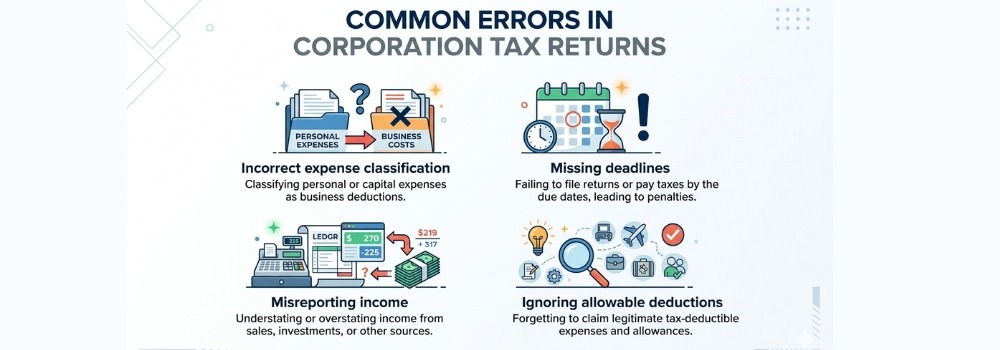
    Small business owners often make mistakes during the tax filing process that can lead to unnecessary penalties or missed opportunities for deductions. 

    Understanding these common mistakes and how to avoid them can help ensure compliance, save money, and streamline your tax filing process. 

    Below is a table outlining these errors and tips for preventing them.

    MistakeHow to Avoid
    Failing to Keep Accurate RecordsMaintain detailed records of transactions and use accounting software.
    Missing Tax DeadlinesSet calendar reminders for tax deadlines and plan ahead.
    Not Understanding Allowable DeductionsReview tax guidelines to ensure you’re claiming all eligible expenses.
    Incorrectly Categorizing IncomeDouble-check income classification and consult an accountant if needed.
    Not Separating Personal and Business FinancesKeep separate business bank accounts and credit cards.
    Overlooking VAT RequirementsMonitor your revenue and VAT thresholds to register and file on time.
    Not Seeking Professional Tax HelpConsult a tax professional to ensure accuracy in filings.
    Failing to Plan for TaxesSet aside a percentage of revenue for taxes throughout the year.
    Ignoring Changes in Tax LawsStay updated on tax law changes via professional advice or trusted sources.

    How HFA Consulting Supports Small Businesses with Tax Filing and Compliance

    HFA Consulting plays a crucial role in helping small businesses navigate the often complex tax filing and compliance landscape in the UAE. 

    With expert knowledge of the local tax laws, they provide guidance that ensures businesses remain fully compliant with tax regulations, avoid penalties, and streamline the filing process.

     Their proactive approach allows small businesses to stay focused on growth while ensuring their tax obligations are met efficiently.

    • Expert Guidance: HFA Consulting helps small businesses understand and adhere to the latest tax laws.
    • Efficient Tax Filing: They ensure businesses complete and submit tax filings accurately and on time.
    • Ongoing Support: Regular updates and assistance ensure businesses stay compliant even as tax regulations evolve.
    • Risk Mitigation: With HFA Consulting, businesses avoid common tax mistakes and penalties, ensuring smoother operations.

    Conclusion

    In conclusion, understanding and managing your small business’s tax responsibilities in the UAE is essential for long-term success and growth. With the introduction of corporate taxes and updates to VAT regulations, it’s crucial to stay informed about the latest changes and ensure compliance with the law. 

    By following the outlined steps, from preparing your books to filing taxes on time, small businesses can avoid penalties and maximize tax savings.

    With the right knowledge and support, tax season doesn’t have to be stressful. By leveraging available resources, such as expert guidance from consultants like HFA Consulting, small business owners can focus on what they do best, growing their business while ensuring their tax obligations are handled efficiently and effectively. 

    Staying proactive about tax planning and filing will ultimately help businesses thrive in the evolving UAE market.

    FAQS

    What is corporate tax relief for small businesses in the UAE?

    Corporate tax relief for small businesses in the UAE primarily comes from the 0% tax rate on profits up to AED 375,000. This allows small businesses to operate with minimal tax burden, promoting entrepreneurship and growth. Additionally, businesses operating in free zones may be eligible for tax exemptions or reduced tax rates for a set number of years, further easing the financial load on small businesses.

    What is a qualified small business corporation?

    A qualified small business corporation (QSBC) is typically a business that meets certain criteria under the UAE’s tax laws. These businesses must fall within specific revenue thresholds and must not be engaged in prohibited or non-qualifying activities. In the UAE, small businesses with annual profits below AED 375,000 are considered qualified, benefiting from the 0% corporate tax rate and potentially enjoying tax exemptions based on their legal structure and business activity.

    What is the tax advantage of a qualified small business corporation?

    The primary tax advantage of a qualified small business corporation in the UAE is the 0% corporate tax rate on profits up to AED 375,000. This exemption significantly reduces the tax burden for small businesses, allowing them to reinvest their earnings into growth and expansion. Additionally, businesses operating in free zones may benefit from further exemptions or preferential tax treatment, making the UAE an attractive location for small business operations.


  • VAT Late Payment Penalties in the UAE

    VAT Late Payment Penalties in the UAE

    The United Arab Emirates (UAE) operates under a well-established VAT (Value Added Tax) system, which requires businesses to comply with strict tax regulations. Since the introduction of VAT in 2018, businesses across the UAE have been required to collect and remit VAT on taxable goods and services.

     Compliance with VAT regulations is essential not only for smooth business operations but also to avoid the significant penalties that can arise from late payments.

    Timely VAT payment is crucial for businesses to maintain good standing with the Federal Tax Authority (FTA), the government body responsible for overseeing tax laws in the country. Late payment of VAT can lead to financial penalties, which are designed to encourage prompt compliance. 

    In this article, we will explore the consequences of late VAT payments in the UAE, how penalties are calculated, and why adhering to the deadlines set by the FTA is vital for businesses.

    Understanding the VAT Late Payment Penalty Framework

    The VAT late payment penalty framework in the UAE is structured to ensure businesses meet their tax deadlines. If VAT is not paid on time, the FTA imposes financial penalties. This penalty structure is designed to encourage timely payments and maintain tax discipline. 

    The first step in avoiding penalties is ensuring your business is properly registered. This involves understanding the VAT registration fees and providing the necessary documents for VAT registration. Failing to do so will not only make you subject to penalties but could also complicate your ability to claim a VAT refund if needed in the future. 

    What constitutes late payment in the UAE VAT regulations

    A late payment occurs when VAT is not paid by the specified deadline. The deadline typically falls at the end of each tax period, which could be either monthly or quarterly, depending on your business’s VAT registration. 

    If the payment is not made by this deadline, the business will incur penalties as set out by the Federal Tax Authority (FTA). Additionally, businesses should be mindful of the VAT return filing deadlines to avoid further complications. 

    The penalty regime structure

    The penalty regime for late VAT payment in the UAE is structured with escalating fines based on the delay’s length. A fixed penalty is applied once the deadline is missed, followed by daily penalties that accumulate over time. The longer the delay, the higher the penalty. 

    To avoid these, businesses must file returns on time and settle any due payments promptly. Tools like the UAE VAT calculator can assist in calculating the amount due, ensuring that businesses stay compliant and avoid financial repercussions. 

    Who is liable for penalties

    Any business registered for VAT in the UAE is liable for penalties if they fail to meet their payment deadlines. 

    This includes both small businesses and large corporations, as long as they are within the scope of VAT registration and have taxable supplies. The responsibility for the timely payment of VAT falls squarely on the business owner or their designated tax representative.

    Timeline for penalty application

    The penalties for late VAT payment are applied once the payment deadline has passed. A fixed penalty is imposed immediately after the due date, and daily penalties accrue thereafter if the payment is still not made. 

    Businesses are encouraged to make the payment as soon as possible to avoid further financial consequences.

    Key Deadlines and Compliance Requirements

    Understanding the key deadlines and compliance requirements is essential for businesses to avoid penalties and maintain good standing with the Federal Tax Authority (FTA). 

    These deadlines determine when VAT returns must be filed and when payments are due, ensuring businesses stay on track with their obligations. 

    Below are the key dates and differences businesses need to be aware of in the UAE VAT system.

    VAT return filing deadlines

    VAT return filing deadlines in the UAE depend on the business’s tax period, which could be monthly or quarterly. VAT returns are due within 28 days after the end of each tax period. 

    Returns must be submitted through the FTA online portal, where businesses must provide details about taxable supplies and input tax paid. 

    Failure to file VAT returns on time will result in penalties, even if VAT payments are made on time. Businesses unsure about filing can refer to VAT audit services for guidance.  

    • Filing Deadline: VAT returns are due 28 days after the end of each tax period.
    • Submission Method: Returns must be filed through the FTA online portal.
    • Details Required: Businesses need to provide information on taxable supplies and input tax paid.
    • Penalties: Failing to file on time will result in penalties, even if VAT payments are made on time.

    Payment deadlines

    The payment deadline for VAT in the UAE is the same as the VAT return filing deadline. VAT must be paid by the 28th day after the end of the tax period. 

    This means businesses must both file their returns and settle their VAT dues by this date. If the deadline is missed, businesses will be subject to late payment penalties, which can accumulate quickly over time.

    • Payment Deadline: VAT must be paid 28 days after the end of the tax period.
    • No Separate Deadlines: Filing and payment deadlines are the same.
    • Penalty for Late Payment: Missing the deadline will result in late payment penalties, which can increase over time.

    Monthly vs. quarterly filing differences

    The key difference between monthly and quarterly VAT filing is the frequency of tax reporting and payment. Businesses that have a higher volume of taxable supplies are generally required to file VAT returns monthly.

    For smaller businesses with lower turnover, quarterly filing is an option. While the filing deadlines remain the same (28 days after the end of the tax period), businesses with monthly filing obligations need to submit returns and payments more frequently than those with quarterly filing.

    AspectMonthly FilingQuarterly Filing
    Filing FrequencyMonthlyQuarterly
    Payment Deadline28 days after the end of each month28 days after the end of each quarter
    VAT Return Deadline28 days after the end of each month28 days after the end of each quarter
    Applicable ForBusinesses with higher taxable suppliesSmaller businesses with lower turnover

    Penalty Calculation and Rates

    Understanding how penalties are calculated for late VAT payment in the UAE is crucial for businesses to avoid unnecessary financial burden. The penalties are structured to incentivize timely tax payments and deter non-compliance. 

    Below, we will explore how penalties are calculated, the different penalty tiers or brackets, and provide some examples of how penalties apply in different scenarios.

    How penalties are calculated

    The penalty for late VAT payment in the UAE is based on the amount of tax due and the length of the delay. There are two main components to the penalty:

    1. A fixed penalty: Imposed immediately after the due date for failing to make the payment.
    2. Daily penalty: A percentage-based daily penalty that continues to accrue until the VAT payment is made.

    This tiered approach ensures that businesses face increasing financial consequences as the delay continues, making it important to pay VAT on time.

    Different penalty tiers/brackets

    The penalty structure is designed in tiers based on the duration of the delay. The penalties become more severe the longer the payment is overdue.

    • Fixed penalty: A fixed amount is charged as soon as the payment deadline is missed.
    • Daily penalty: A percentage-based daily penalty begins to apply once the payment is overdue by a certain number of days.

    The UAE VAT system follows this escalating penalty structure to encourage businesses to act quickly in paying their dues.

    Percentage-based penalty structure

    • First Tier (Fixed penalty): If the VAT is not paid by the due date, a fixed penalty is applied immediately.
    • Second Tier (Daily penalty): After the initial fixed penalty, the daily penalty starts to accumulate. This penalty is typically 4% of the unpaid VAT per month, or about 0.13% per day.

    This structure ensures that businesses have an incentive to settle their dues quickly to avoid compounding penalties.

    Examples of penalty calculations with scenarios

    To better understand how penalties are applied, let’s look at a couple of scenarios:

    • Scenario 1: A business has a VAT liability of AED 10,000. The payment is due on January 31, but is paid on February 15, 15 days late.
      • Fixed penalty: AED 500 (applied immediately on February 1)
      • Daily penalty: 0.13% per day for 15 days to AED 10,000 * 0.13% * 15 = AED 195
    • Total penalty: AED 500 + AED 195 = AED 695
    • Scenario 2: A business owes AED 20,000 in VAT, but the payment is delayed by 45 days (due on January 31, paid on March 17).
      • Fixed penalty: AED 500 (applied immediately on February 1)
      • Daily penalty: 0.13% per day for 45 days → AED 20,000 * 0.13% * 45 = AED 1,170
    • Total penalty: AED 500 + AED 1,170 = AED 1,670

    Circumstances That Trigger Penalties

    Penalties for late VAT payment in the UAE can be triggered by various circumstances. Understanding these triggers is essential for businesses to avoid unnecessary fines and ensure timely compliance. 

    Below, we will cover the standard late payment scenarios, partial payment situations, installment arrangements, defaults, and the consequences of repeated violations.

    Standard late payment scenarios

    The most common circumstance that triggers VAT penalties is failing to pay the full amount of VAT due by the specified deadline. A business is considered to be in violation if it does not pay the tax owed within the required timeframe. In such cases:

    • A fixed penalty is imposed immediately after the deadline has passed.
    • Daily penalty starts accruing after the fixed penalty and continues until the full payment is made.

    For instance, if VAT is due on the 31st of January and is not paid until mid-February, the business will be subject to penalties as soon as the deadline passes.

    Partial payment situations

    Partial payments can also lead to penalties, even if a portion of the VAT owed is paid on time. If a business pays only part of the VAT liability and the remaining balance is not paid by the deadline, penalties will apply on the outstanding amount.

    • Fixed penalty: Still applies when a partial payment is made, as the full amount has not been settled by the due date.
    • Daily penalty: The daily penalty is applied to the remaining unpaid balance until it is fully settled.

    For example, if a business owes AED 10,000 in VAT and only pays AED 5,000 by the due date, the remaining AED 5,000 will continue to accrue daily penalties until it is paid.

    Installment arrangements and defaults

    In some cases, businesses that are unable to pay their VAT liabilities in full by the deadline may request an installment arrangement with the Federal Tax Authority (FTA).
    This option allows businesses to pay the VAT in installments over an agreed period. However, if the business defaults on the agreed payments:

    • Penalties: Penalties will be applied to any overdue amounts.
    • Escalation: Failure to adhere to installment schedules can lead to escalated penalties, including additional fixed penalties and increased daily penalties.

    Installment arrangements are a way to manage VAT payments over time, but they must be followed precisely to avoid the consequences of non-compliance.

    Repeated violations and escalated penalties

    Repeated violations of VAT payment deadlines can result in progressively harsher penalties. The Federal Tax Authority (FTA) may escalate penalties for businesses that continually fail to comply with VAT payment deadlines.

    • Escalated fixed penalties: If a business has multiple late payment instances, the FTA may increase the initial fixed penalty amount for subsequent violations.
    • Higher daily penalties: The daily penalty rate may also increase over time for businesses with repeated late payments, compounding the financial burden.

    Repeated violations signal a pattern of non-compliance and can result in increased scrutiny by the FTA, potentially leading to more severe penalties or other legal actions.

    Conclusion

    VAT compliance is vital for businesses in the UAE to avoid penalties and maintain good standing with the Federal Tax Authority (FTA). Timely filing and payment are essential to avoid accumulating fines, as penalties can escalate quickly for late or partial payments. Understanding the penalty structure and key deadlines can help businesses stay on track.

    By ensuring full payments are made on time and adhering to filing deadlines, businesses can avoid unnecessary penalties and potential legal issues. For businesses that need expert guidance or assistance with registration, consulting a VAT Registration Consultant can help ensure compliance and a smooth VAT process. 

    Ultimately, consistent VAT compliance not only helps businesses avoid financial penalties but also contributes to their overall reputation and smooth operations in the UAE’s highly regulated market.

    FAQs

    What is the penalty for late payment of VAT in the UAE?

    In the UAE, the penalty for late payment of VAT is structured in two parts: a fixed penalty and a daily penalty. A fixed penalty is imposed immediately after the payment deadline passes, while a daily penalty starts accumulating at a rate of approximately 0.13% per day on the unpaid VAT amount until the payment is made in full.

    Is there a grace period for VAT?

    The UAE VAT system does not typically offer a grace period for VAT payments. Payments are expected to be made by the due date, which is usually 28 days after the end of the tax period. If the payment is not made by the deadline, penalties will apply. However, in exceptional circumstances, businesses may request installment arrangements, which must be adhered to in order to avoid penalties.

    Is there a penalty for a late VAT return?

    Yes, there is a penalty for late VAT returns. If a business fails to file its VAT return by the due date, a fixed penalty is applied immediately, and additional penalties may apply based on the number of days the return is overdue. Businesses should ensure that their VAT returns are filed on time to avoid these penalties.

  • UAE Corporate Tax Exemption

    UAE Corporate Tax Exemption

    In June 2023, the UAE introduced a 9% corporate tax rate, marking a shift in the country’s tax policy. However, not all businesses are subject to this tax. Certain entities, such as those operating in free zones or the oil and gas sector, may qualify for corporate tax exemptions. These exemptions are designed to encourage investment, foster economic growth, and support businesses in strategic sectors.

    Understanding the corporate tax exemptions available in the UAE is essential for companies looking to optimize their tax liabilities and remain compliant with local regulations. 

    This guide will explore the types of exemptions, the businesses that qualify, and the steps involved in applying for these exemptions, helping companies navigate the new tax landscape effectively.

    What Is a Corporate Tax Exemption in the UAE?

    A corporate tax exemption in the UAE refers to the legal provision that allows certain businesses or entities to be exempt from the 9% corporate tax rate introduced in June 2023. 

    While most companies are subject to this tax on their taxable profits, there are specific categories of businesses and sectors that can benefit from exemptions, reducing their tax liabilities. These exemptions are designed to encourage investment in certain industries and free zones, and support the country’s overall economic growth.

    The UAE offers corporate tax exemptions to attract foreign investment, foster innovation, and boost sectors like energy, technology, and non-profit organizations. 

    Exemptions are typically available to businesses operating in free zones, entities involved in specific sectors, or companies that meet certain criteria. This system ensures that companies operating in the UAE can benefit from tax relief based on their industry, business activity, and location.

    Who Qualifies for UAE Corporate Tax Exemption?

    The UAE offers corporate tax exemptions to specific categories of businesses and entities to promote economic growth, investment, and sector-specific development. 

    These exemptions play a crucial role in attracting foreign and domestic investments, especially in strategic sectors. Below is an in-depth breakdown of the entities that qualify for corporate tax exemption in the UAE:

    CategoryDescriptionEligibility Criteria
    Government EntitiesPublic sector organizations such as ministries, departments, and government-owned companies.Must be fully government-owned or operate on behalf of the government.
    Extractive BusinessesCompanies involved in the oil, gas, and mining sectors.Operate under contracts with the government, typically in the extractive sector.
    Non-Extractive Natural ResourcesBusinesses involved in agriculture, water management, forestry, and other non-extractive industries.Must be focused on sustainable development and contribute to food/water security or natural resource management.
    Qualifying Public Benefit Entities (QPBEs)Non-profit organizations focused on public services such as education, healthcare, and charity work.Must operate for public benefit and not distribute profits to individuals.
    Qualifying Investment FundsInvestment funds that pool resources to invest in various sectors.Must meet regulatory criteria and be registered under UAE law.
    Qualifying Free Zone Persons (QFZPs)Companies operating within designated free zones in the UAE.Must maintain operations within the free zone and comply with the specific free zone regulations.

    4.1 Government Entities

    Government entities in the UAE are generally exempt from corporate tax. These entities include departments, ministries, and public sector organizations that operate under government ownership. 

    The reason for granting this exemption is to allow the government to focus on national initiatives and public services without the burden of tax liabilities. Government entities may include:

    • Federal and local government departments
    • Public sector organizations (e.g., utilities, infrastructure providers)
    • Government-owned companies

    The exemption ensures that public funds can be used for public welfare, infrastructure development, and various governmental operations.

    4.2 Extractive Businesses

    Businesses involved in extractive industries, such as oil, gas, and mining companies, are granted corporate tax exemptions. These businesses are typically given full or partial exemptions based on their contracts with the UAE government. The rationale behind these exemptions includes:

    • The UAE’s reliance on oil and gas as major contributors to the national economy.
    • The importance of maintaining competitiveness in the global extractive industry market.
    • Encouraging continued investment in energy and natural resource exploration.

    These businesses often operate under specific agreements with the UAE government, which may include tax holidays or reduced tax rates depending on the terms of the agreement.

    4.3 Non-Extractive Natural Resource Businesses

    In addition to extractive businesses, non-extractive natural resource companies may also be eligible for corporate tax exemptions. This includes businesses involved in sectors like:

    • Agricultural production
    • Water resource management
    • Forestry and related industries

    These businesses are critical for the UAE’s economic diversification efforts and long-term sustainability. The exemptions support initiatives aimed at enhancing food security, managing water resources efficiently, and developing industries that contribute to environmental sustainability.

    4.4 Qualifying Public Benefit Entities (QPBEs)

    Certain entities that operate primarily for public benefit can qualify for corporate tax exemptions. These are typically non-profit organizations that provide services for the public good. Examples include:

    • Educational institutions (schools, universities, vocational training)
    • Healthcare organizations (hospitals, clinics, research institutions)
    • Charitable organizations (NGOs, foundations)

    To qualify as a Qualifying Public Benefit Entity (QPBE), the organization must:

    • Operate for charitable, social, or public purposes.
    • Not distribute profits to stakeholders or owners.
    • Meet specific criteria set by the Federal Tax Authority (FTA).

    Exemptions for these entities help support the delivery of essential services to the community while ensuring that their resources are allocated to their core mission rather than to tax obligations.

    4.5 Qualifying Investment Funds

    Qualifying Investment Funds (QIFs) are entities that pool investments from multiple investors for the purpose of asset management and investment. These funds can qualify for tax exemptions under the following conditions:

    • They must meet specific regulatory criteria set out by the UAE authorities.
    • They must be registered and operate according to UAE laws.
    • They are often designed to attract foreign capital into sectors that contribute to economic development.

    The UAE’s tax exemption for QIFs helps to make it an attractive hub for investment in the region, particularly in sectors like real estate, technology, and infrastructure.

    4.6 Qualifying Free Zone Persons (QFZPs)

    Entities operating within designated free zones in the UAE are eligible for corporate tax exemptions. The UAE has established numerous free zones to stimulate business activity, attract international companies, and boost various industries.

    To qualify for tax exemption, businesses must meet the following criteria:

    • They must operate in one of the designated free zones.
    • Their activities must align with the specific regulations and objectives of the zone.
    • They must maintain a majority of their operations within the free zone.

    Key benefits for companies in free zones include:

    • Tax holidays: Often ranging from 15 to 50 years.
    • 100% foreign ownership: Unlike mainland businesses, free zone companies are allowed to retain full ownership by foreign nationals.
    • Simplified regulatory processes: Reduced barriers to starting and operating a business.

    Documents Required to Apply for Corporate Tax Exemption in the UAE

    When applying for a corporate tax exemption in the UAE, businesses must submit specific documentation to ensure compliance with the regulations set by the Federal Tax Authority (FTA). 

    The required documents vary based on the type of exemption being sought. Below is a detailed breakdown of the necessary documents for different entities, ensuring a smooth application process.

    DocumentRequired ForDetails
    Valid Trade License / Certificate of IncorporationAll entities applying for tax exemptionVerifies that the business is legally registered and authorized to operate in the UAE.
    Memorandum and Articles of Association (MOA & AOA)All entities applying for tax exemptionOutlines the business structure, governance, and operations of the company.
    Proof of Government Ownership or MandateGovernment-Controlled Entities (GCEs)Provides evidence that the company is owned by or mandated by the UAE government.
    Audited Financial StatementsAll entities applying for tax exemptionIncludes the company’s income statement, balance sheet, and cash flow statement for financial evaluation.
    Public Benefit Registration CertificateQualifying Public Benefit Entities (QPBEs)Confirms that the entity operates for public good and meets the requirements of non-profit status.
    Fund Prospectus and Regulatory Approval LetterQualifying Investment FundsOutlines the investment strategy and confirms compliance with regulatory requirements.
    FTA Notification / Declaration LetterExtractive and Non-Extractive Natural Resource BusinessesConfirms eligibility for tax exemption based on business activities in natural resource sectors.

    1. Valid Trade License / Certificate of Incorporation

    The first and most essential document for applying for corporate tax exemption is a valid trade license or certificate of incorporation. This document confirms that the business is legally registered and authorized to operate in the UAE. 

    The trade license must be active, and the nature of business activities should align with the requirements for tax exemption.

    • For Free Zone Entities: The trade license must specify that the company operates within the free zone and is engaged in approved activities.
    • For Government Entities: A government mandate document or proof of government ownership will be required along with the trade license.

    2. Memorandum and Articles of Association (MOA)

    The Memorandum of Association (MOA) and Articles of Association (AOA) are foundational legal documents that outline the company’s structure, operations, and governance. 

    These documents are important to demonstrate that the business complies with UAE corporate laws and adheres to the regulatory framework that allows for tax exemptions.

    • The MOA must outline the business objectives, ownership structure, and governance practices.
    • The AOA specifies the rules that govern the company’s operations and the responsibilities of directors and shareholders.

    3. Proof of Government Ownership or Mandate (For GCEs)

    For Government-Controlled Entities (GCEs), which include government-owned companies and departments, proof of government ownership or mandate is required. 

    This document confirms that the business is owned by the government or operates on behalf of the government.

    • This may include ownership certificates or official government mandates.
    • In the case of government-owned companies, proof of incorporation under a government decree or ministerial order should be provided.

    4. Audited Financial Statements

    Audited financial statements are essential to prove the financial health and compliance of the business. These documents should include:

    • Income statement (showing revenues and expenses)
    • Balance sheet (detailing assets, liabilities, and equity)
    • Cash flow statement (reflecting the cash movement within the company)

    Audited financials help the FTA evaluate the company’s eligibility for tax exemption based on its financial performance. Companies that have not been in operation long may need to provide projections or interim financial reports.

    5. Public Benefit Registration Certificate (For QPBEs)

    For Qualifying Public Benefit Entities (QPBEs), which include non-profit organizations, a public benefit registration certificate is required. 

    This certificate proves that the entity has been registered as a non-profit and is operating for public benefit, such as providing educational, healthcare, or charitable services.

    • The certificate should clearly state the organization’s public benefit purpose and confirm its non-profit status.
    • QPBEs must also demonstrate that they reinvest all profits into their public benefit activities and do not distribute earnings to stakeholders.

    6. Fund Prospectus and Regulatory Approval Letter (For Investment Funds)

    Investment funds applying for corporate tax exemption must provide a fund prospectus and a regulatory approval letter. These documents show that the fund is legally established, its objectives, and that it complies with the UAE’s financial regulations.

    • The fund prospectus outlines the investment strategy, goals, and operational framework.
    • The regulatory approval letter confirms that the fund is registered with the UAE authorities and complies with applicable laws, such as those governed by the Securities and Commodities Authority (SCA).

    7. FTA Notification / Declaration Letter (For Extractive and Non-Extractive Businesses)

    Businesses in the extractive and non-extractive natural resource sectors must provide an FTA notification or declaration letter confirming their eligibility for a corporate tax exemption. 

    These letters verify that the business is actively involved in activities such as oil, gas, or mineral extraction, or other resource management activities that qualify for tax exemption under UAE law.

    • The letter from the FTA should confirm the business’s operational focus in the extractive or non-extractive natural resource sector.
    • This document may also specify any additional terms or conditions under which the business qualifies for the exemption.

    How to Apply for Corporate Tax Exemption in the UAE: Step-by-Step

    Applying for a corporate tax exemption in the UAE involves a structured process that requires businesses to meet specific eligibility criteria and submit relevant documentation. 

    Below is a step-by-step guide to help businesses navigate the application process and secure their exemption.

    StepActionDetails
    Step 1: Identify Exemption CategoryDetermine which exemption category applies to your business.Categories include government entities, extractive businesses, public benefit entities, etc.
    Step 2: Gather DocumentationCollect all required documentation, such as trade license, financial statements, and other proofs.Ensure all documents are current and aligned with the FTA’s requirements.
    Step 3: Log in to EmaraTax PortalAccess the EmaraTax portal and log in to your account.Complete the application form for corporate tax exemption.
    Step 4: Submit Application & DocumentsSubmit the completed application form and upload all supporting documents.Upload documents like trade license, MOA, audited financials, etc.
    Step 5: Await Review & ApprovalWait for the FTA review and approval (or Cabinet decision for QPBEs).The FTA reviews your application; additional documents may be requested.
    Step 6: Maintain Compliance Post-ExemptionStay compliant with UAE regulations and maintain ongoing tax records.Submit annual reports and maintain documentation to ensure continued exemption eligibility.

    Step 1: Identify Which Exemption Category Your Business Falls Under

    The first step in the application process is determining which corporate tax exemption category your business qualifies for. The UAE offers several exemptions, each with its own criteria and documentation requirements. These categories include:

    • Government-Controlled Entities (GCEs)
    • Extractive Businesses (oil, gas, mining)
    • Non-Extractive Natural Resource Businesses (agriculture, water management)
    • Qualifying Public Benefit Entities (QPBEs) (charities, non-profits)
    • Qualifying Investment Funds
    • Qualifying Free Zone Persons (QFZPs)

    Identifying the right category is essential to ensure you follow the correct process and submit the appropriate documentation.

    Step 2: Gather All Required Documentation

    Once you’ve identified the exemption category, gather the necessary documentation for submission. Each category requires different supporting documents, such as:

    • Trade license/certificate of incorporation
    • Memorandum and Articles of Association (MOA & AOA)
    • Proof of government ownership or mandate (for GCEs)
    • Audited financial statements
    • Public benefit registration certificate (for QPBEs)
    • Fund prospectus and regulatory approval letter (for investment funds)
    • FTA notification/declaration letter (for extractive/non-extractive businesses)

    Ensure that all documents are up-to-date and compliant with UAE regulations to avoid delays in the review process.

    Step 3: Log in to the EmaraTax Portal (Federal Tax Authority’s Online Platform)

    The EmaraTax portal is the official online platform for tax-related services in the UAE, operated by the Federal Tax Authority (FTA). To submit your corporate tax exemption application, follow these steps:

    1. Create or log into your FTA account: If you don’t already have an account, you will need to register on the EmaraTax portal.
    2. Navigate to the Corporate Tax Exemption Application: Once logged in, find the section related to tax exemptions and corporate tax.
    3. Fill out the application form: The portal will provide an application form where you’ll need to provide business details and choose the exemption category.

    Ensure you complete the form carefully, as errors or omissions can delay the process.

    Step 4: Submit the Exemption Application Along with Supporting Documents

    After filling out the application form on the EmaraTax portal, you will need to submit your supporting documents. Ensure that all documents are scanned clearly and correctly. Upload the following as required:

    • Trade license or incorporation certificate
    • MOA and AOA
    • Additional documents based on the exemption category

    Make sure the documents are formatted according to the FTA’s guidelines (usually PDF or JPEG format). Double-check that all files are properly uploaded before submitting.

    Step 5: Await FTA Review and Approval (or Cabinet Decision for QPBEs)

    Once your application and documents have been submitted, the FTA will begin its review process. The timeframe for approval can vary depending on the complexity of the exemption request. Generally, you can expect the following:

    • FTA Review: The FTA will review your application and documents, ensuring that everything meets the legal and regulatory requirements. This process typically takes a few weeks.
    • Cabinet Decision (for QPBEs): If applying as a Qualifying Public Benefit Entity (QPBE), the FTA will forward the application to the UAE Cabinet for a final decision. This process may take additional time, as Cabinet approval is required.

    During this period, the FTA may request further clarification or additional documents. 

    Having professional tax consultants represent your business can significantly speed up communication and ensure that any technical queries from the authority are handled professionally.

    Step 6: Maintain Ongoing Compliance, Records, and Annual Reporting Post-Exemption

    After receiving approval for your corporate tax exemption, it is important to stay compliant with the UAE tax laws and regulations. Here are the ongoing responsibilities:

    • Annual Reporting: Depending on the exemption category, businesses may need to submit annual reports to the FTA. Our team can handle your business tax filing requirements, ensuring that even exempt entities submit the necessary declarations correctly to maintain their status. 
    • Record Keeping: Maintain detailed records of financial transactions, contracts, and operational activities, as the FTA may conduct audits to ensure continued compliance.
    • Ongoing Compliance: Ensure that your business continues to meet the criteria for exemption. If there are significant changes in business activities, ownership structure, or sector focus, it may impact your eligibility for the exemption.

    By maintaining proper records and complying with reporting obligations, you can ensure your continued exemption status. 

    It is equally important to keep track of the UAE Corporate Tax Registration Deadlines to ensure your business is registered within the timeframe allocated by the FTA for your specific license month.

    Penalties for Non-Compliance

    Failure to comply with the corporate tax regulations in the UAE can lead to serious consequences for businesses. The Federal Tax Authority (FTA) has established a clear framework to penalize non-compliant companies, ensuring that tax obligations are met efficiently. 

    Below are the key penalties for non-compliance related to corporate tax registration, claiming exemptions without eligibility, FTA audits, and the administrative and financial penalties under the UAE Corporate Tax Law.

    Non-Compliance IssuePenaltiesDetails
    Operating Without Required Corporate Tax RegistrationFine or Business ClosureBusinesses can be fined daily for failing to register; in extreme cases, operations may be suspended.
    Incorrectly Claiming Exempt Status Without EligibilityRepayment of Taxes, Additional Fines, and PenaltiesBusinesses may need to repay taxes owed along with significant fines and interest.
    FTA Audit TriggersAdditional Taxes, Fines, Penalties, and Reputational DamageAudits can lead to repayment of unpaid taxes, along with fines and penalties for misreporting.
    Administrative and Financial PenaltiesAdministrative Fines, Financial Penalties, Late Fees, Interest ChargesNon-compliance with filing deadlines, failure to submit reports, or false information can result in fines.

    1. Operating Without Required Corporate Tax Registration

    Any business that is required to be registered for corporate tax under the UAE’s tax laws and fails to do so can face significant penalties.

    • Penalty for Non-Registration: Operating without the required corporate tax registration can lead to a fine or administrative penalty. Businesses that fail to register within the stipulated time frame risk being issued a penalty for each day they remain unregistered.
    • Key Consequences:
      • Fine: A fixed fine may be levied for failing to register, which can increase over time.
      • Business Closure: In extreme cases, businesses that persistently fail to comply may face suspension or closure orders.

    It is crucial for businesses to ensure that they are registered with the Federal Tax Authority (FTA) once the corporate tax regime becomes applicable to avoid these penalties.

    2. Incorrectly Claiming Exempt Status Without Eligibility

    Claiming an exemption from corporate tax when the business does not qualify for such an exemption is considered a serious violation under UAE tax law. This includes making false claims about qualifying for exemptions based on incorrect information.

    • Penalty for False Claims: The FTA may impose heavy penalties if a business falsely claims tax-exempt status. 

    If a business is audited and found to have incorrectly claimed an exemption, it will be required to pay the outstanding tax amount along with penalties and interest.

    • Key Consequences:
      • Repayment of Taxes: If it is determined that the business incorrectly claimed tax-exempt status, the company will need to pay the tax it should have paid, along with penalties.
      • Additional Fines: Depending on the severity of the misrepresentation, fines may be imposed, sometimes exceeding the amount of tax owed.

    These penalties serve as a deterrent against attempts to misuse the exemption provisions and ensure that only qualifying businesses benefit from tax exemptions.

    3. FTA Audit Triggers and Consequences

    The FTA has the authority to carry out tax audits on businesses to ensure compliance with corporate tax regulations. Certain factors may trigger an FTA audit, such as discrepancies in financial reporting, inconsistent tax filings, or if the FTA suspects that a business is not adhering to tax laws.

    • Audit Triggers:
      • Unusual financial activity or unexplained discrepancies in tax filings.
      • High-value transactions or complex tax structures that the FTA deems worth investigating.
      • Previous non-compliance or late filings.
    • Consequences of an FTA Audit:
      • Additional Taxes: If the audit reveals underreported or missed taxes, the business will be required to pay the additional tax owed.
      • Penalties: In addition to repaying the tax owed, businesses may face penalties for non-compliance, which can range from a fixed fine to a percentage of the unpaid tax.

    An audit can also result in reputational damage to businesses, as it may be seen as a sign of improper financial practices.

    4. Administrative and Financial Penalties under UAE Corporate Tax Law

    Under the UAE’s Corporate Tax Law, businesses that fail to comply with the regulations may be subject to both administrative and financial penalties. The nature of these penalties depends on the type and severity of the non-compliance.

    • Types of Penalties:
      • Administrative Penalties: These are fines imposed for procedural non-compliance, such as late registration, failure to submit required reports, or incomplete documentation.
      • Financial Penalties: These penalties involve fines that are calculated as a percentage of the unpaid taxes or based on the amount of underreporting discovered in audits.
    • Example Penalties:
      • Late Filing Penalties: A business that fails to file its corporate tax return by the due date may incur a penalty based on the number of days the filing is delayed.
      • Non-payment Penalties: If a business fails to pay its due taxes on time, it may face interest charges on the outstanding amount, which will accumulate daily.
      • Fines for Incorrect Information: Providing false or misleading information on tax returns, including underreporting income or inflating deductible expenses, can result in severe penalties.

    How HFA Tax Consultants Can Help

    Understanding corporate tax exemptions in the UAE can be complex, but with the right guidance, businesses can ensure compliance with the latest regulations while maximizing their tax benefits. 

    HFA Consulting specialize in providing expert advice and services to businesses seeking to qualify for corporate tax exemptions. Here’s how we can assist your business in managing the entire exemption process.

    1. Assess Whether Your Business Qualifies for Any Exemption Category

    Determining whether your business qualifies for a corporate tax exemption is the first crucial step. Our Corporate Tax Consultants will thoroughly review your business structure and operations to assess which exemption category, such as free zone entities or public benefit entities, applies to your situation. This ensures that your business maximizes its tax savings.

    2. Prepare and Submit the Exemption Application to the FTA

    Once we determine your eligibility, we will take care of preparing and submitting the exemption application to the Federal Tax Authority (FTA). Our experienced consultants ensure that all the required documentation is in place, including your trade license, audited financials, and proof of eligibility, so that your application is submitted without delay or issues.

    3. Conduct Free Zone Substance Reviews and Gap Analysis

    Operating within a free zone comes with its own set of compliance requirements. Our team conducts free zone substance reviews to ensure your business is meeting the necessary operational requirements. We perform a gap analysis to help identify areas of improvement, ensuring that you remain fully compliant with the FTA’s regulations.

    4. Provide Ongoing Compliance Management and Monitoring

    Tax compliance doesn’t end with the submission of an exemption application. Our services include ongoing compliance management, ensuring your business remains up to date with UAE corporate tax laws. We monitor any changes in regulations and provide proactive support to avoid penalties and maintain exemption status.

    Book a Free Consultation with a Certified UAE Tax Advisor

    If you’re unsure about your tax situation, HFA Tax Consultants offers a free consultation with a certified UAE tax advisor. During this session, we’ll evaluate your business’s tax obligations and discuss potential strategies to optimize your tax position.

    Summary

    Businesses in the UAE have the opportunity to benefit from corporate tax exemptions under certain conditions. Entities operating in free zones, government-controlled sectors, and public benefit organizations may qualify for these exemptions, reducing their tax liabilities. 

    To successfully claim these exemptions, companies must identify the correct exemption category, gather the required documentation, and submit an application to the Federal Tax Authority (FTA).

    At HFA Tax Consultants, we assist businesses throughout the exemption process, from assessing eligibility to preparing and submitting applications. We also conduct compliance reviews and offer ongoing support to ensure your business remains in line with UAE corporate tax laws. 

    Our services help businesses avoid penalties, maintain exemption status, and focus on their growth and success.

  • Dubai Import Tax: Rates, Exemptions, and Procedures (2026 Guide)

    Dubai Import Tax: Rates, Exemptions, and Procedures (2026 Guide)

    Dubai sits at the crossroads of three continents. Every year, hundreds of billions of dirhams worth of goods pass through Jebel Ali Port, Dubai International Airport, and dozens of specialized free zones. This flow is supported by a tax and customs framework that is transparent, predictable, and highly efficient.

    However, “business-friendly” does not mean there is nothing to know. If you are importing goods into Dubai in 2026, three separate charges could apply: Customs Duty, Value Added Tax (VAT), and Excise Tax. Getting these right means faster clearance and accurate pricing; getting them wrong triggers regulatory scrutiny and financial penalties.

    Key Takeaways

    • Customs Duty: Standard rate is 5% of the CIF (Cost, Insurance, Freight) value.
    • VAT: Charged at 5% on the CIF value plus any applicable customs duty.
    • Excise Tax: Features a Tiered Volumetric Model for sweetened drinks as of 2026.
    • HS Codes: Transitioning to 12-digit codes for enhanced accuracy.
    • Free Zones: Goods are not subject to duty or VAT until they enter the UAE mainland.

    What Is Dubai Import Tax?

    Import tax is the collective term for the mandatory charges levied by the government on goods brought into the UAE from abroad. In Dubai, this system is managed by two primary regulatory bodies: Dubai Customs, which oversees physical clearance and the collection of customs duties, and the Federal Tax Authority (FTA), which administers Value Added Tax (VAT) and Excise Tax across all seven emirates.

    Who is Liable to Pay?

    The responsibility to pay import taxes falls on any party bringing goods across the UAE border. This includes:

    • Registered Businesses: Companies importing raw materials, machinery, or finished inventory for local sale.
    • Commercial Traders: Wholesalers and e-commerce entities moving goods through Dubai for regional distribution.
    • Individuals: Private passengers or residents receiving international shipments. If personal items or gifts exceed the duty-free allowance (typically AED 300 for courier shipments), the individual recipient is liable for the applicable charges.

    The Purpose of Dubai’s Import Tax Framework

    The UAE’s taxation strategy is not merely about collection; it serves three strategic pillars:

    1. Revenue Diversification: It generates vital non-oil government revenue, supporting the UAE’s transition toward a sustainable, knowledge-based economy.
    2. Market Regulation: By enforcing the GCC Common Customs Tariff, Dubai ensures a fair and transparent playing field for international trade while protecting the integrity of the local market.
    3. Public Health & Industry Protection: Excise taxes act as a public health instrument by discouraging the consumption of harmful products. Simultaneously, certain tariffs and exemptions are designed to protect domestic industries and ensure the steady supply of essential goods.

    Components of Dubai’s Import Tax System

    This approach focuses on clarity and impact, ideal for a brand or a high-end service. It balances modern innovation with a grounded, reliable foundation to ensure lasting results. 

    Customs Duty 

    Customs duty is the fee levied by Dubai Customs on goods entering the UAE from outside the GCC. Calculated on the CIF value, the rates are standardized across the region but categorized by the nature of the product.

    Product CategoryDuty RateKey Examples
    Standard Goods5%Electronics, apparel, furniture, and auto parts.
    Alcoholic Beverages50%All types of spirits, wines, and beers.
    Tobacco Products100%Traditional tobacco and cigarettes (separate from Excise).
    Exempt / Essential0%Medicine, basic food staples, and books.

    Pro Tip: In 2026, the transition to 12-digit HS codes is mandatory. A minor classification error can lead to a “Customs Suspense” status, delaying your shipment by days.

    Value Added Tax (VAT) 

    VAT is a federal tax managed by the FTA. For imports, the 5% VAT is not just charged on the cost of the goods; it is charged on the “taxable base,” which includes the CIF value plus any customs and excise duties already applied.

    Key 2026 VAT Updates for Importers:

    • End of Self-Invoicing: As of January 1, 2026, businesses are no longer required to issue self-invoices for reverse charge imports. Instead, you must maintain robust digital records and proof of value for FTA audits.
    • 5-Year Refund Limit: A strict five-year hard deadline now applies to claiming input tax. Any VAT paid on imports that is not claimed within 5 years from the end of the tax period will be forfeited.
    • E-Invoicing Integration: All import VAT transactions must now be reconciled through the FTA’s centralized e-invoicing platform to ensure real-time compliance.

    Excise Tax 

    Excise tax is applied to “harmful” goods. The most significant change in 2026 is the shift from a flat tax on beverages to a Tiered Volumetric Model based on sugar density.

    Product CategoryExcise Rate2026 Specifics
    Tobacco & E-Cigarettes100%Includes all vaping devices and nicotine liquids.
    Energy Drinks100%Any drink containing stimulants like caffeine or taurine.
    High-Sugar DrinksAED 1.09 / LitreBeverages with 8g or more sugar per 100ml.
    Moderate-Sugar DrinksAED 0.79 / LitreBeverages with 5g to 8g sugar per 100ml.
    Low-Sugar / DietAED 0.00Beverages with less than 5g sugar per 100ml.

    Implication for Importers: Under the 2026 rules, carbonated drinks are no longer a separate category with a flat 50% rate. They are now taxed strictly based on their sugar content. Importers must provide certified lab analysis reports to qualify for the lower AED 0.79 or AED 0.00 tiers.

    How Is Dubai Import Tax Calculated?

    Calculating the total landed cost of an import in Dubai requires a step-by-step approach. Taxes are not simply added to the invoice price; they are calculated sequentially, where each tax builds upon the previous one.

    Understanding CIF Value

    The “Taxable Value” of any import into Dubai is its CIF Value. Even if you purchased goods on an FOB (Free on Board) or EXW (Ex-Works) basis, you must adjust the value for customs purposes to include the following three components:

    1. Cost: The actual transaction price paid for the goods as per the commercial invoice.
    2. Insurance: The cost of the insurance premium paid to cover the goods during their transit to the UAE.
    3. Freight: The total cost of transportation (sea, air, or land) from the point of origin to the arrival port in Dubai.

    Regulatory Note:Dubai Customs uses the CIF value because it represents the total value of the goods at the moment they enter the UAE’s economic zone. 

    If insurance or freight costs are missing from your documentation, customs authorities may apply a “benchmarked” percentage to estimate these costs.

    The Calculation Formula

    To find the total tax liability for 2026, theFederal Tax Authority (FTA) and Dubai Customs require a compounding calculation:

    1. Customs Duty = CIF Value × 5% (Standard Rate)
    2. Excise Tax (If applicable) = (CIF Value + Customs Duty) × Excise Rate
    3. VAT Base = CIF Value + Customs Duty + Excise Tax
    4. VAT (5%) = VAT Base × 5%

    Total Import Tax Payable = Customs Duty + Excise Tax + VAT

    Worked Example (Electronics Import)

    Suppose a business imports a shipment of laptops with the following details:

    • Invoice Value of Goods: AED 100,000
    • Shipping/Freight Costs: AED 4,000
    • Insurance Premium: AED 1,000
    StepComponentCalculationResult
    ADetermine CIF Value100,000 + 4,000 + 1,000AED 105,000
    BCustoms Duty (5%)105,000 × 0.05AED 5,250
    CExcise TaxNot applicable to electronicsAED 0
    DCalculate VAT Base105,000 (CIF) + 5,250 (Duty)AED 110,250
    EVAT (5%)110,250 × 0.05AED 5,512.50
    TotalTotal Tax Due5,250 + 5,512.50AED 10,762.50
    Strategic Considerations for 2026
    1. VAT Recovery: If your business is VAT-registered with the FTA, the AED 5,512.50 paid in the example above is generally recoverable as “Input Tax” on your next VAT return. However, the AED 5,250 Customs Duty is a non-recoverable cost and should be factored into your product’s margin.
    2. Digital MAKASA: As of early 2026, all such calculations and payments must be processed via the Dubai Trade Portal under the new Digital MAKASA initiative, which allows for real-time digital settlement of duties for direct imports.
    3. 12-Digit HS Code Alignment: Ensure your calculation uses the specific duty rate tied to the mandatory 12-digit HS code. Even standard electronics can occasionally fall under “dual-use” or restricted categories that carry different duty treatments.

    Dubai Import Tax Rates by Product Category

    Dubai’s tax system differentiates goods based on their impact on health, the economy, and local industry. Accurate classification using the Integrated Customs Tariff is essential to avoid overpayment or legal penalties.

    Tax Rate Summary Table (2026)

    CategoryCustoms DutyVAT RateExcise TaxExamples
    General Goods5%5%NoneElectronics, Apparel, Furniture
    Alcohol50%5%NoneSpirits, Wine, Beer
    Tobacco Products100%5%100%Cigarettes, Cigars, Raw Tobacco
    E-Smoking Devices5%5%100%Vapes, E-liquids, Heating Tools
    Energy Drinks5%5%100%Stimulant-based beverages
    High-Sugar Drinks5%5%AED 1.09/L>8g sugar per 100ml
    Essential Goods0%0% or 5%NoneMedicine, Basic Food Staples

    General Goods (5% Duty)

    Most commercial items, such as household appliances, textiles, and industrial spare parts, fall under the standard 5% rate. As of February 2026, all such goods must be declared using the new 12-digit HS Code system. 

    This provides “extreme accuracy” in categorization, which Dubai Customs uses to speed up the clearance process through the Mirsal 2 system.

    Alcoholic Beverages (50% Duty)

    Alcohol remains one of the highest-taxed categories. While the customs duty is a steep 50%, it is important to note that VAT (5%) is calculated on the total value after the duty is added.

    Tobacco and E-Smoking Devices (100% Excise)

    Tobacco carries a double layer of tax: 100% Customs Duty and 100% Excise Tax.

    • Vaping Products: Unlike traditional tobacco, electronic smoking devices typically attract the standard 5% customs duty but are hit with a 100% Excise Tax on both the hardware and the liquids.

    Sweetened Beverages (Tiered Volumetric Model)

    Effective January 1, 2026, the flat 50% excise tax on sugary drinks has been replaced. The new tax is calculated per litre:

    • Tier 1 (High Sugar): AED 1.09 per litre for drinks with 8g+ sugar per 100ml.
    • Tier 2 (Standard): AED 0.79 per litre for drinks with 5g to 8g sugar per 100ml.
    • Tier 3 (Low/No Sugar): AED 0 per litre for drinks with under 5g sugar.

    Prohibited and Restricted Goods

    Before importing, businesses must consult the Federal Tax Authority (FTA) and the Customs prohibited lists to ensure compliance.

    • Prohibited Goods: Items that are strictly banned from entry. Examples include forged currency, ivory, gambling tools, and publications that contradict Islamic teachings.
    • Restricted Goods: Items that require a “NOC” (No Objection Certificate) or permit from a specific ministry before they can be cleared.

    Free Zone Treatment (Duty Suspension)

    Dubai’s Free Zones (e.g., JAFZA, DAFZA, DMCC) operate as “Designated Zones” for tax purposes. This offers a major cash-flow advantage for international traders:

    1. Duty Suspension: Goods entering a Free Zone from abroad are not subject to customs duty or VAT immediately.
    2. Tax Trigger: Taxes only become payable if the goods move from the Free Zone into the UAE Mainland.
    3. Re-export Benefits: If goods are imported into a Free Zone and then exported to a country outside the GCC, they remain entirely tax-free.
    4. 2026 Compliance: Under Federal Decree-Law No. 16 of 2025, Designated Zones must maintain strict physical fencing and access controls. If a zone fails these “outside the state” conditions, it may lose its tax-free status, making all inventory subject to 5% VAT.

    Expert Insight: For businesses moving goods between two Designated Zones, you must maintain digitally indexed gate passes and transport logs. In 2026, the FTA considers these “critical audit artifacts.” 

    If you lack proof that the goods stayed outside the mainland, a 5% VAT charge plus a 14% annual interest penalty can be applied.

    Specific Exemptions and Relief Categories

    Dubai offers several strategic exemptions that go beyond basic commodities. These categories are designed to facilitate humanitarian work, support GCC economic integration, and assist residents relocating to the emirate.

    Goods for Re-export (Duty Suspension)

    Under the Re-export Suspension regime, goods brought into Dubai with the intention of being shipped to a third country (outside the GCC) are exempt from customs duties and VAT.

    • Mechanism: Importers must provide a “Security Deposit” or a bank guarantee equivalent to the duty amount.
    • Condition: The goods must be re-exported within a specified timeframe (typically 6 months, extendable under Customs Policy No. DCP20). Once the exit from the UAE border is verified digitally, the deposit is refunded.

    Personal Effects of Returning Nationals and Residents

    Relocating to Dubai is supported by a generous exemption for used household items.

    • Eligible Groups: UAE nationals returning after residing abroad and foreigners moving to Dubai for the first time for residency.
    • Key Requirements:
      • Items must be used and in quantities appropriate for furnishing a home.
      • New items (still in original packaging) are not exempt and will attract the 5% duty.
      • Importers must provide a detailed packing list and proof of previous residence abroad.

    Items for Diplomatic Missions and International Organizations

    In accordance with international treaties and the UAE Ministry of Foreign Affairs guidelines, imports by diplomatic missions, consulates, and recognized international organizations are duty-exempt.

    • Scope: Includes official furniture, equipment, and a limited quota of vehicles for diplomatic use.
    • Verification: Requires an official exemption certificate issued by the Ministry of Foreign Affairs.

    Education, Culture, and Literacy

    To support the UAE’s knowledge economy, specific cultural and educational materials are exempted from customs duties and, in many cases, are zero-rated for VAT.

    • Exempt Items: Printed books, newspapers, scientific journals, and children’s picture/drawing books.
    • Digital Distinction: Note that digital subscriptions or e-books may follow different VAT rules under the Electronic Services framework.

    GCC-Origin Goods (Unified Customs Union)

    As a member of the GCC Customs Union, goods produced within Saudi Arabia, Kuwait, Bahrain, Oman, or Qatar move into Dubai duty-free.

    • The Rule of Origin: To qualify, the goods must have a Certificate of Origin proving that at least 40% of the value-added occurred within a GCC state.

    Note: Simply shipping a foreign product (e.g., from China) through a GCC port does not grant this exemption; the product must be “Made in GCC.”

    Charitable and Humanitarian Imports

    Goods imported by registered charitable organizations for relief or non-profit purposes are exempt from customs duties.

    • Examples: Food supplies, clothing, and medical aid for disaster relief.
    • Procedure: The importing entity must be registered with the Community Development Authority (CDA) and obtain a specific “Duty Exemption Letter” for each shipment.

    2026 Compliance Summary Table: How to Claim

    Exemption TypeRequired DocumentPrimary Regulator
    Industrial InputsIndustrial Exemption PermitCDA 408 / IACAD
    Personal EffectsPacking List & Residence ProofDubai Customs
    GCC GoodsGCC Certificate of OriginExporting Country’s Chamber
    Charitable AidExemption Approval LetterCDA 408 / IACAD
    Pro Tip: Even for “0% Duty” items, a Customs Declaration must still be filed through theDubai Trade portal. Skipping the declaration for exempt goods is considered a technical violation and can lead to fines.

    Step-by-Step Import Tax Payment Procedure

    Navigating the clearance process requires precision. A single documentation error can lead to a “Customs Suspense” status, resulting in storage fees at the port. Following these steps ensures your shipment moves smoothly through the system.

    Register and Obtain a Customs Client Code

    Before any trade can begin, you must be a registered importer. Every business or individual engaging in commercial trade must apply for a Customs Client Code through the Dubai Customs portal. 

    This code is your digital identity in the Mirsal 2 system and is used to track all your imports, exports, and duty payments. For 2026, existing codes must be linked to a valid UAE Pass for enhanced security.

    Prepare Required Shipping Documents

    Accuracy at this stage is the primary factor in preventing delays. You must have your digital dossier ready, which includes:

    • Commercial Invoice: Must detail the unit price, total value, currency, and the mandatory 12-digit HS code.
    • Packing List: A breakdown of the weight, volume, and packaging type for each item.
    • Certificate of Origin: Crucial if you are claiming duty exemptions for GCC-made goods or under specific trade agreements.
    • Bill of Lading or Airway Bill: The contract of carriage provided by your shipping line or airline.
    • Import Permits: Necessary if you are bringing in restricted items like pharmaceuticals, food, or wireless equipment.

    Submit Customs Declaration via Dubai Trade Portal

    Once your documents are ready, you must file a Customs Declaration through the Dubai Trade portal. This is a centralized window that connects you to Dubai Customs and DP World. 

    During this submission, you will provide the CIF value of the goods. The system will automatically calculate the applicable Customs Duty, VAT, and Excise Tax based on the HS codes you provided.

    Pay Customs Duty, VAT, and Excise Tax

    After the declaration is submitted and reviewed, the total tax amount will be generated. Payments in 2026 are processed through the Digital MAKASA system, which allows for instant settlement via credit card, bank transfer, or a prepaid customs credit account.

    • VAT Treatment: If you are a VAT-registered business, you may use the “Postponed Accounting” method, where the 5% VAT is not paid at the port but is instead accounted for on your regular VAT return, provided you have prior FTA approval.

    Clearance and Release of Goods

    Once the payment is confirmed, the system generates a Customs Release Message. Your shipping agent or PRO can then present this to the port authorities to take physical possession of the goods. 

    In some cases, a physical inspection may be required if the shipment is flagged by the customs risk engine. Once cleared, the goods can be legally moved into the UAE mainland or your warehouse.

    Required Documents for Import Clearance

    Having your documentation ready and accurate is the difference between same-day clearance and costly port storage delays. Each document serves a specific regulatory purpose, verifying the value, origin, and safety of your shipment.

    The Essential Dossier

    • Commercial Invoice: This is the primary document for tax assessment. It must clearly state the transaction value, a detailed description of the goods, and the mandatory 12-digit HS Code. It should also specify the Incoterms (e.g., CIF, FOB) to ensure the taxable base is calculated correctly.
    • Certificate of Origin (COO): This document proves where the goods were manufactured. It is the only way to claim GCC-origin exemptions or benefits under international trade agreements. Without a valid COO, the standard 5% duty will be applied regardless of the item’s source.
    • Bill of Lading (Sea) / Airway Bill (Air): Issued by the carrier, this acts as both a receipt for the cargo and a contract of carriage. It must match the details on your invoice and packing list.
    • Packing List: A detailed breakdown of the shipment’s physical characteristics, including total weight, net weight, dimensions, and the type of packaging (e.g., pallets, crates). Customs officials use this for physical inspections.
    • Import Permit: Only required for Restricted Items. If you are importing food, plants, medicines, or chemicals, you must obtain prior approval from the relevant ministry (such as MOCCAE or MOHAP) and include the permit number in your digital filing.
    • VAT Registration Certificate: While your Customs Client Code is linked to your Tax Registration Number (TRN), having a copy of your Federal Tax Authority registration is necessary for the initial setup and for any manual reconciliation of VAT payments.
    • Insurance Certificate: To verify the CIF Value, you must provide proof of the insurance premium paid. If the shipment is not insured, Dubai Customs may apply a standard “notional” insurance value to the cost of the goods.

    Penalties for Non-Compliance

    Dubai’s customs and tax framework is built on trust, but it is reinforced by strict enforcement. The move toward AI-driven risk engines in 2026 means that discrepancies in value or classification are flagged almost instantly.

    Financial and Administrative Penalties

    • Late Declaration Fines: A penalty of AED 5 per day is applied for failing to declare goods upon arrival. While this is capped at AED 300, the secondary consequence is a lower “Compliance Rating,” which can lead to more frequent physical inspections of your future shipments.
    • Underreporting of Value: If the Dubai Customs valuation engine determines that the CIF value has been intentionally understated to avoid duty, fines can reach up to three times the value of the duty evaded. In severe cases, the goods may be confiscated.
    • Restricted Goods Without Permits: Attempting to clear food, medicine, or wireless equipment without the necessary “No Objection Certificate” (NOC) from the relevant ministry (e.g., MOHAP 408 or TDRA 408) will result in the shipment being blocked and a fine starting from AED 1,000 per violation.
    • Legal Consequences: Serious violations, such as importing Prohibited Goods (forged currency, banned publications, etc.) or habitual tax evasion, are treated as criminal offenses. This can lead to the permanent cancellation of your Customs Client Code, heavy judicial fines, and imprisonment.

    Free Zones and Import Tax Benefits

    Dubai’s Free Zones remain the most powerful tool for international traders. Under the Designated Zone status defined by the FTA, these areas are technically considered “outside the state” for tax purposes.

    Duty Suspension and Benefits

    • Tax Deferral: Goods entering a Free Zone like JAFZA, DMCC, or DAFZA are held in a state of Duty Suspension. You do not pay the 5% Customs Duty or 5% VAT as long as the goods remain within the zone.
    • When Duty Becomes Payable: Taxes only become due the moment goods leave the Free Zone to enter the UAE Mainland. This allows businesses to maintain large inventories without tying up capital in tax payments.
    • Re-export Efficiency: If goods are imported from Europe into a Dubai Free Zone and then re-exported to Africa, the trader pays 0% UAE tax, as the goods never officially entered the UAE’s domestic market.

    Popular Free Zones for Trade

    1. Jebel Ali Free Zone (JAFZA): Ideal for heavy industry and large-scale logistics due to its direct link to the world’s largest man-made harbor.
    2. Dubai Airport Freezone (DAFZA): Preferred for high-value, low-weight goods like electronics and pharmaceuticals that require fast air-freight clearance.
    3. Dubai Multi Commodities Centre (DMCC): The hub for precious metals (Gold/Diamond trade) and soft commodities like tea and coffee.

    How HFA Consulting Can Help

    The 2026 regulatory shift from the 12-digit HS code mandate to the Tiered Volumetric Excise model has made import compliance a high-stakes task. 

    A single error in documentation can result in “Customs Suspense,” costly port storage fees, or FTA audits. HFA Consulting provides the specialized expertise needed to ensure your supply chain remains uninterrupted and cost-effective.

    Customs Registration Assistance

    We fast-track your entry into the UAE market by managing the entire Customs Client Code registration process via Dubai Customs. 

    Our team ensures your code is correctly linked to your UAE Pass and Tax Registration Number (TRN), allowing for seamless digital clearance through the Mirsal 2 system.

    VAT Compliance for Importers

    Import VAT involves more than just payment; it requires strategic management. We assist businesses in:

    • Setting up Postponed VAT Accounting allows you to defer VAT payments at the port and account for them in your periodic returns.
    • Navigating the strict 5-year refund limit to ensure you never forfeit eligible input tax claims.
    • Reconciling import data between the Federal Tax Authority (FTA) and Dubai Customs portals.

    Documentation and HS Code Support

    Underreporting or misclassification is a primary cause of penalties. We provide a comprehensive audit of your shipping documents, including:

    • HS Code Verification: Mapping your products to the mandatory 12-digit codes for 2026.
    • Invoice Valuations: Ensuring your CIF values meet the “market value” benchmarks used by AI-driven customs scanning engines.
    • Permit Acquisition: Coordinating with MOHAP, MOCCAE, and TDRA for restricted goods.

    Advisory for Exemptions and Refunds

    Our tax consultants identify every opportunity for tax optimization. We provide advisory services for:

    • Industrial Exemptions: Helping manufacturers secure permits for duty-free machinery and raw material imports via the Ministry of Industry and Advanced Technology.
    • GCC Rule of Origin: Verifying Certificates of Origin to qualify for 0% duty movement.
    • Refund Management: Managing the security deposit and refund process for goods intended for Re-export.

    Optimize Your Trade Operations Today

    In Dubai’s fast-paced trade environment, compliance is a competitive advantage. HFA Consulting combines local regulatory depth with a digital-first approach to protect your margins and simplify your logistics.

    HFA Consulting to schedule a consultation with our trade and tax specialists and ensure your 2026 import strategy is built on solid regulatory ground.

    This final section synthesizes the critical 2026 mandates and serves as the definitive reference for importers.

    Conclusion

    As of 2026, Dubai has firmly transitioned into a digital-first trade hub. The move to mandatory 12-digit HS codes and the integration of the Digital MAKASA payment system mean that accuracy is no longer optional; it is a technical requirement for clearance.

    • The Layered Tax Model: Taxes are calculated sequentially (CIF + Duty + Excise = VAT Base).
    • Mandatory 12-Digit HS Codes: Phase 2 (started Feb 2026) makes these codes mandatory for all imports from Free Zones to the local market.
    • Volumetric Excise Tax: “Sugar Tax” is now calculated per litre rather than as a flat percentage.
    • 5-Year VAT Limit: The window to claim input tax on imports is now strictly capped at five years.

    In the current regulatory environment, Dubai Customs uses AI-driven cross-referencing to detect undervalued shipments and misclassified goods. A clean compliance record ensures you qualify for the Digital MAKASA fast-track, which allows for instant clearance without physical intervention.

    Consult an Expert: With the introduction of the Federal Decree-Law No. (16) of 2025, the penalties for tax evasion and documentation errors have significantly increased. We strongly recommend consulting with a certified UAE tax expert to audit your import dossier before the arrival of your vessel.

    FAQs

    How to calculate import tax in the UAE?

    The calculation follows a compounding formula:
    Customs Duty: 5% of the CIF value (Cost + Insurance + Freight).
    VAT: 5% of the total sum (CIF + Customs Duty + any applicable Excise Tax).

    What is the 12% import duty?

    There is no single “12% duty” in the UAE. This figure is a common misconception that usually refers to the effective tax rate when a 5% Customs Duty is added to 5% VAT, along with administrative fees and clearing charges. For most standard goods, the combined tax liability is approximately 10.25% of the CIF value.

    What is the VAT rate on imported goods in Dubai?

    The standard VAT rate is 5%. It is applied to the “Taxable Base,” which is the value of the goods plus the customs duty and excise tax paid at the point of entry.

    How do I pay the import tax in Dubai?

    All payments are handled digitally via the Dubai Trade Portal. You can use a credit card, bank transfer, or a prepaid “Credit Account” linked to your Customs Client Code. For direct imports in 2026, the Digital MAKASA initiative allows for real-time automated settlement.

  • How to Register for Corporate Tax in UAE

    How to Register for Corporate Tax in UAE

    The United Arab Emirates has taken a significant step in its economic evolution by introducing a federal Corporate Tax on business profits. Effective for financial years starting on or after June 1, 2023, this new regime implements a two-tiered structure: a 0% tax rate applies to profits up to AED 375,000, and a 9% standard rate for taxable income that exceeds this threshold.

    For nearly all businesses operating in the UAE, including those in Free Zones, navigating this shift means prioritizing compliance. The first and most critical action is official registration with the Federal Tax Authority (FTA). Completing this step on time is essential not only to avoid administrative penalties but also to ensure your business maintains its legal standing and credibility in the market.

    Let’s dive in and explore exactly how to register for corporate tax in the UAE.

    Who is Eligible for Corporate Tax Registration in UAE?

    The mandate to register for Corporate Tax is broad, covering virtually all entities operating within the UAE. It is essential to understand your entity’s classification to ensure you meet the Corporate tax registration deadline UAE.

    In simple terms, any person (juridical or natural) considered a ‘Taxable Person’ under the new law must register with the FTA, regardless of whether their income falls under the 0% or 9% bracket. This includes:

    1. Mainland Companies

    All businesses licensed and operating on the UAE mainland, such as Limited Liability Companies (LLCs), Public Joint Stock Companies (PJSCs), and sole establishments (if the turnover threshold is met by the natural person), are classified as resident juridical persons and are subject to mandatory Federal Tax Authority corporate tax registration.

    As you identify your corporate tax status, it is the perfect time to audit your overall tax footprint by reviewing the VAT registration requirement to ensure your business meets every mandatory threshold.

    2. Free Zone Entities (The Critical Distinction)

    Corporate tax registration for Free Zone companies UAE is mandatory, even if you anticipate qualifying for the 0% tax rate.

    • Registration is NOT Optional: Any company registered or incorporated in a UAE Free Zone must register on the EmaraTax corporate tax registration UAE portal to obtain a Corporate Tax Registration Number (CTRN).
    • The ‘Qualifying Income’ Rule: To benefit from the 0% tax rate, the Free Zone entity must meet strict criteria to be classified as a “Qualifying Free Zone Person.” This includes maintaining adequate substance, deriving ‘Qualifying Income,’ and adhering to the de minimis requirements. Failure to register or comply with these rules can result in the entire income being taxed at the standard 9% rate.

    3. Foreign Businesses with UAE Operations

    Non-resident juridical persons (foreign companies) may also be required to register if they have a sufficient presence or source of income in the UAE:

    • Permanent Establishment (PE): If the foreign company has a fixed or permanent place of business in the UAE (e.g., a local branch or office) through which it conducts business, it is subject to Corporate Tax and must complete the registration.
    • Taxable Nexus: Non-resident entities that earn income from immovable property in the UAE are also deemed to have a taxable nexus and must register.

    The key message remains clear: determining how to register for corporate tax in the UAE and securing a CTRN is a universal obligation for compliant businesses.

    Registration Requirements and Mandatory Deadlines

    The process of how to register for corporate tax in the UAE is governed by clear guidelines and crucial deadlines set by the Federal Tax Authority (FTA). Missing these dates can result in an administrative penalty of AED 10,000 under Cabinet Decision No. 10 of 2024.

    The Mandatory Corporate Tax Registration Deadline UAE

    The applicable deadline depends entirely on the type and establishment date of your entity.

    1. For Entities Established BEFORE March 1, 2024

    The deadline for these resident juridical persons is staggered based on the month your main trade license was issued (irrespective of the year):

    License Issuance MonthCorporate Tax Registration Deadline UAE
    January or FebruaryMay 31, 2024
    March or AprilJune 30, 2024
    MayJuly 31, 2024
    JuneAugust 31, 2024
    JulySeptember 30, 2024
    August or SeptemberOctober 31, 2024
    October or NovemberNovember 30, 2024
    DecemberDecember 31, 2024

    2. For Entities Established ON or AFTER March 1, 2024

    New companies, including newly established Free Zone companies, must submit their Federal Tax Authority corporate tax registration application within three months from the date of incorporation, establishment, or recognition.

    Key Documents Required for EmaraTax Registration

    To ensure a smooth application process on the EmaraTax corporate tax registration UAE platform, have the following documents ready (typically required in PDF format):

    CategoryRequired Document / InformationPurpose
    Business DetailsValid Trade License (copy of main and all branch licenses)Proof of legal existence and activity.
    Legal StructureMemorandum of Association (MoA) or Articles of Association (AoA), or Partnership AgreementDefines the entity’s structure and legal standing.
    Financial RecordsCompany’s Financial Year start and end datesEstablishes the first Tax Period for filing returns.
    Ownership DetailsEmirates ID/Passport copies of all owners/shareholders holding 25% or more of the shares.For FTA verification and records.
    Authorised SignatoryEmirates ID/Passport of the person signing the application & Proof of Authorisation (e.g., Board Resolution or Power of Attorney)Confirms the legal right to act on behalf of the company.
    Contact InfoOfficial Registered Address, P.O. Box, Email, and Phone NumberFor official FTA correspondence.

    It is essential to ensure that all details provided in the EmaraTax corporate tax registration UAE application, such as company name, license number, and shareholder names, match the corresponding official documents exactly.

    How to Register for Corporate Tax

    All taxable persons, whether a Free Zone company or a mainland entity, must complete the Federal Tax Authority corporate tax registration through the official platform. This simple, digitized process is conducted entirely via the EmaraTax corporate tax registration UAE portal. For expert guidance, consult a corporate tax consultant to ensure a smooth and compliant registration process.

    Here is the step-by-step guide on how to register for corporate tax in the UAE efficiently:

    Step 1: Accessing the EmaraTax Portal

    • Login/Sign Up: Navigate to the official EmaraTax portal.
      • Existing FTA Users (VAT/Excise): Log in using your existing credentials or UAE Pass. You will land on your Taxable Person dashboard.
      • New Users: If your business has no previous tax registration (VAT/Excise), you must first click ‘Sign Up’ and create a new user account.
    • Start Application: Once logged in, navigate to the Corporate Tax section on your dashboard and select the option to start a new Corporate Tax registration application.

    Step 2: Filling Out the Corporate Tax Registration Form

    The application is broken down into several sections to ensure accuracy. You must complete all mandatory fields to proceed:

    • Entity Details: Select the appropriate Entity Type (e.g., Legal Person – UAE Private Company, Qualifying Free Zone Person). Your selection determines what additional information you must provide.
    • Identification Details: Provide your main trade license details, including the number and trade name. Here, you must also add all business activities listed on your license and details of all owners/shareholders with 25% or more ownership.
    • Contact Details: Enter the official registered address, contact number, and email address for FTA communication.
    • Authorized Signatory: Provide details for the individual legally authorized to act on behalf of the company, including their ID and contact information.

    Step 3: Uploading Required Documents

    In the relevant sections, you will be required to upload the supporting documentation you prepared earlier.

    • Key Documents: Upload clear, valid copies of your Trade License, Emirates IDs, and Passports of owners/signatories, and the legal instrument authorizing the signatory (e.g., Memorandum of Association or Power of Attorney).
    • Format and Size: Ensure files are in the accepted format (usually PDF) and do not exceed the specified file size limit (e.g., 15 MB per file).

    Step 4: Review, Declaration, and Submission

    1. Review: Before finalizing, carefully review all the data you have entered across all sections of the application
    2. . Errors can lead to delays or rejection.
    3. Declaration: Read the final declaration, confirm the accuracy of all information, and digitally sign the application.
    4. Submission: Click ‘Submit’. You will receive an application reference number for tracking.

    The FTA typically takes up to 20 business days to review and approve a complete application.

    Receiving Your Corporate Tax Registration Number (CTRN)

    Upon successful approval, the FTA will notify you via email and update your EmaraTax dashboard. Your business will be assigned a unique Tax Registration Number (TRN), which is the official identifier for your entity across all tax regimes (VAT, Excise, and Corporate Tax). This number is the equivalent of a TIN (Tax Identification Number) used in many other jurisdictions and is crucial for all future tax filings.

    Compliance Obligations After Registration

    Obtaining your Corporate Tax Registration Number (CTRN) is just the start. The ongoing compliance obligations are crucial for maintaining good standing with the Federal Tax Authority (FTA) under the Corporate Tax Law UAE (Federal Decree-Law No. 47). 

    Managing your fiscal health requires a holistic approach; while you master corporate filings, ensuring you know how to file VAT in the UAE is equally vital for maintaining a clean compliance record with the FTA.

    Filing Corporate Tax Returns

    • Self-Assessment: UAE Corporate Tax is based on a self-assessment system, meaning the business is responsible for accurately calculating its own Taxable Income.
    • Filing Deadline: Businesses must file a single annual Corporate Tax return and pay any tax due within nine months from the end of their relevant Tax Period (financial year). For example, if your financial year ends on December 31, 2024, your filing deadline is September 30, 2025. This entire process is completed via the EmaraTax corporate tax registration UAE portal.

    Maintaining Financial Records

    • Mandatory Record-Keeping: You are required to maintain all accounting records, financial statements, and supporting documentation for a minimum of seven (7) years following the end of the relevant Tax Period.
    • IFRS Standards: Financial statements must be prepared according to International Financial Reporting Standards (IFRS) or relevant local accounting standards.

    Penalties for Late Registration or Non-Compliance

    The FTA enforces a strict regime of administrative penalties to ensure compliance.

    ViolationPenalty (AED)Note
    Late Corporate Tax RegistrationAED 10,000Imposed if registration is not completed by the Corporate tax registration deadline UAE.
    Late Filing of Tax ReturnAED 500 per month (for the first 12 months), increasing to AED 1,000 per month thereafter.Applies even if no tax is due.
    Failure to Keep RecordsAED 10,000 for the first violation, increasing to AED 20,000 for a repeat offense within 24 months.Essential for audit readiness.
    Late Payment of Tax DueA monthly penalty of 14% per annum on the unpaid amount, calculated from the day following the payment deadline.This penalty compounds monthly.
    Note: These penalties compound and can significantly impact your business if multiple violations occur.

    Special Cases and Considerations

    The application of Corporate Tax includes specific rules for certain business categories.

    Free Zone Companies and Qualifying Income

    While Corporate tax registration for Free Zone companies UAE is mandatory, the tax rate applied depends on meeting the criteria for a “Qualifying Free Zone Person” (QFZP):

    • 0% Rate: Applied to Qualifying Income, which generally includes income from transactions with other Free Zone persons, or income derived from ‘Qualifying Activities’ (like manufacturing, logistics, or holding activities).
    • 9% Rate: Applied to all non-qualifying income (e.g., income from mainland sales of non-qualifying goods) or if the Free Zone person fails to maintain adequate substance.
    • De Minimis Rule: A QFZP can lose its 0% status if its non-qualifying revenue exceeds the lower of 5% of total revenue or AED 5 million in a Tax Period.

    Small Businesses and Exemptions

    To support small enterprises, the UAE has introduced the Small Business Relief (SBR):

    • Eligibility: Resident businesses (excluding QFZPs) with annual revenue of AED 3 million or less can elect for SBR.
    • Benefit: If SBR is elected, the business is treated as having zero Taxable Income for that Tax Period, effectively resulting in 0% tax, simplifying their compliance. This relief is currently available for Tax Periods starting up to December 31, 2026.

    Foreign Companies Operating in the UAE

    Foreign companies that establish a Permanent Establishment (PE) in the UAE through a local branch or fixed place of business are subject to Corporate Tax on income attributable to that PE and must complete the registration process. Non-resident persons earning income from immovable property in the UAE are also subject to the tax.

    Benefits of Timely Registration

    The simple act of completing your Federal Tax Authority corporate tax registration by the designated date yields immediate and long-term benefits for your business:

    • Avoiding Penalties: The most immediate benefit is avoiding the fixed AED 10,000 penalty for late registration and the subsequent penalties for late filing or payment.
    • Legal Compliance: Timely registration ensures your business is fully compliant with the Corporate Tax Law UAE (Federal Decree-Law No. 47), protecting your trade license and preventing legal complications.
    • Enhanced Trust with Banks, Investors, and Partners: A valid CTRN demonstrates transparency and serious commitment to compliance. This status is increasingly required by financial institutions for opening bank accounts and is viewed favorably by potential investors and major partners.
    • Access to Reliefs: Only registered entities can avail themselves of beneficial tax treatments like the 0% threshold on the first AED 375,000 of profit or Small Business Relief. Beyond simple compliance, understanding the broader corporation tax advantages can help businesses structure their operations more efficiently within the UAE’s evolving economy.

    Who Can Help: Relying on Corporate Tax Experts

    Accurate registration is a important and one of critical compliance step with the Federal Tax Authority (FTA). Given the complexity of determining mandatory registration thresholds and the severe penalties for late submission, businesses should rely on FTA-certified and reputable tax experts. 

    These professionals, such as those at HFA Consulting, possess the specialized local knowledge to accurately interpret your legal obligations, verify your turnover against the prescribed thresholds, and ensure all necessary documentation is prepared precisely. Relying on certified tax agents guarantees your application is completed correctly through the EmaraTax portal, mitigating the risk of rejection, compliance failures, and the significant AED 10,000 penalty for late registration.

    Conclusion

    The implementation of the UAE Corporate Tax is a definitive step towards a mature, diversified economic framework. For every business operating in the Emirates, mastering how to register for corporate tax in the UAE is non-negotiable it is the foundation of your compliance journey.

    We have explored the mandatory requirements, the staggered deadlines for the Corporate tax registration deadline UAE, and the clear path through the EmaraTax corporate tax registration UAE portal. Whether you are a mainland company, a foreign entity with a Permanent Establishment, or seeking the 0% benefit as a Corporate tax registration for Free Zone companies UAE, registration is the first step to securing legal and financial stability.

    The single most important takeaway: Reinforce the importance of timely registration. Do not miss your deadline.

    Timely completion of your Federal Tax Authority corporate tax registration is your shield against administrative penalties and a demonstration of your commitment to the Corporate Tax Law UAE (Federal Decree-Law No. 47). Ensure your registration is submitted correctly and on time to avoid the AED 10,000 penalty and secure your business’s legal standing in the new era of UAE taxation.

    Frequently Asked Questions 

    Who needs to register for Corporate Tax in the UAE?

    All companies conducting business activities in the UAE are required to register. This includes mainland businesses, free zone entities (with conditions), and foreign companies with UAE-sourced income. Natural persons with annual turnover exceeding AED 1 million must also register.

    What documents do I need to submit for Corporate Tax registration?

    1. Valid trade license or business registration certificate
    2. Bank account details
    3. Personal ID (passport or Emirate ID)
    4. Proof of business location and contact info
    5. Financial statements or business plan (if available)

    Do I need accountant credentials or professional qualifications to register?

    No, you don’t need professional qualifications. However, it’s highly recommended to work with a qualified accountant or tax advisor for accurate registration and compliance.

    How much does Corporate Tax registration cost?

    Registration itself is free through the FTA’s EmaraTax portal. Professional service costs vary—typically AED 2,000 to AED 15,000+ annually depending on business complexity.

    How long does the registration process take?

    Typically 3-5 business days if all documents are complete. FTA may request additional information, extending timeline. You receive TRN electronically once approved.

  • How to Apply for a Tax Registration Number (TRN) in UAE: A Simple Guide

    How to Apply for a Tax Registration Number (TRN) in UAE: A Simple Guide

    If you’re running a business in the UAE or even planning to start one, understanding the Tax Registration Number (TRN) is not optional. It sits at the core of how your business interacts with the tax system, whether that’s issuing invoices, filing VAT returns, or dealing with corporate tax obligations.

    A TRN is issued by the Federal Tax Authority, and once assigned, it becomes your business’s official tax identity. Every transaction that involves VAT, every filing, and even supplier verification processes rely on this number.

    What makes this topic more critical today is the shift in the UAE’s tax landscape. With VAT already established and corporate tax now in effect, businesses that previously ignored compliance are now required to formalize their tax presence. That means understanding not just what a TRN is, but when you need it, how to apply for it correctly, and how to verify it to avoid operational risks.

    This guide is structured to go beyond surface-level explanations. Instead of just listing steps, it breaks down:

    • When a TRN is actually required (and when it’s not)
    • What documents and data does the Federal Tax Authority expect from you
    • Where most applications fail and how to avoid those mistakes
    • How to check and verify TRNs to protect your business from compliance issues

    By the end, you should have a clear, practical understanding of TRN from application to verification without needing to piece together information from multiple sources.

    What Is a UAE TRN ?

    A Tax Registration Number (TRN) in the UAE is a 15-digit unique identifier issued by the Federal Tax Authority to businesses and individuals registered for tax. It is used to track and manage all tax-related activities, including VAT filings and corporate tax compliance.

    Once issued, the TRN becomes the official tax identity of your business. It is not just a registration number; it is how the government links your financial transactions, filings, and obligations under the UAE tax system. 

    Whether you’re issuing invoices, claiming input VAT, or being audited, your TRN is the reference point.

    Where Is TRN Used?

    • Invoices:
      Every VAT-compliant invoice must include your TRN to validate the transaction and allow customers to claim input VAT.
    • VAT Returns:
      Your TRN is used when filing VAT returns to report output tax, input tax, and net payable amounts to the tax authority.
    • Business Verification:
      Companies use TRNs to verify suppliers and partners, ensuring they are registered and compliant, reducing fraud and risk exposure.

    Why TRN Matters Beyond Compliance

    Many businesses treat TRN as a one-time requirement, but in reality, it directly impacts:

    • Cash flow (through VAT recovery)
    • Credibility (verified, compliant business identity)
    • Audit readiness (traceable financial records)

    Without a valid TRN, you are not just non-compliant; you also limit your ability to operate efficiently within the UAE’s regulated business environment.

    What are the Eligibility Criteria for VAT Registration?

    Eligibility for VAT registration and obtaining a Tax Registration Number (TRN) in the UAE is determined by whether a business generates taxable supplies and meets the revenue thresholds defined by the Federal Tax Authority. Be mindful of the corporate tax registration deadline when planning your registration. 

    Eligibility is determined by whether a business generates taxable supplies in the UAE and meets the revenue thresholds defined by the Federal Tax Authority.

    At the core of the eligibility framework are mandatory and voluntary registration levels. For a deep dive into the legal requirements, you can review the official UAE Tax Legislation

    These thresholds are designed to ensure that businesses contributing significantly to the economy are formally integrated into the tax system, while also allowing smaller or growing businesses the flexibility to opt in when it benefits them operationally or financially.

    Understanding Mandatory vs Voluntary Registration

    A business is required to register for VAT when its taxable supplies exceed the mandatory registration threshold set by the tax authority. At this stage, registration becomes a legal obligation rather than a choice. The business is expected to:

    • Charge VAT on taxable sales
    • File periodic VAT returns
    • Maintain structured and audit-ready financial records

    On the other hand, businesses that cross the voluntary registration threshold but remain below the mandatory level may choose to register. This is often a strategic decision rather than a compliance requirement. Companies typically opt for voluntary registration when:

    • They incur high operational expenses and want to recover input VAT
    • They work with VAT-registered clients who expect compliant invoicing
    • They are preparing for growth and future mandatory registration
    Criteria TypeThreshold LevelRequirementBusiness Impact
    Mandatory RegistrationAbove the mandatory threshold defined by FTACompulsory VAT registration and TRN issuanceFull compliance required, VAT charging and filing
    Voluntary RegistrationAbove the voluntary threshold set by FTAOptional registrationInput VAT recovery and improved business credibility

    Who Actually Qualifies for TRN Registration?

    Eligibility is not limited to large enterprises. In practice, a broad spectrum of business structures falls within the VAT registration framework once they meet the applicable thresholds. This typically includes:

    • Mainland companies operating under commercial licenses
    • Free zone entities engaged in taxable activities
    • Businesses involved in import and export

    At the same time, independent professionals such as freelancers and consultants are increasingly part of the regulated ecosystem, particularly as service-based and digital businesses expand. E-commerce sellers, whether operating through marketplaces or their own platforms, are also included when their activities involve taxable supplies. These commonly cover:

    • Freelancers and independent consultants offering services
    • E-commerce sellers conducting online or marketplace transactions

    The determining factor is not the size or structure of the business, but whether it generates taxable revenue in the UAE and exceeds the relevant threshold set by the authority.

    Entity TypeEligibility for TRNKey Consideration
    Mainland CompaniesYesBased on taxable revenue
    Free Zone CompaniesYesDepends on taxable activity
    Freelancers & ConsultantsYesThreshold-based requirement
    E-commerce BusinessesYesIncludes online and marketplace sales
    Import/Export BusinessesYesVAT applicable to goods movement

    Clarifying Small Businesses, Freelancers, and Foreign Entities

    A common misconception is that small businesses and freelancers are automatically exempt from VAT registration. In reality, exemption is not based on business type but on whether the business crosses the applicable threshold. 

    This is an important consideration during business tax filing, as failing to meet the requirements could result in non-compliance.

    If a business operates below the mandatory level, registration is not required, but voluntary registration remains available and can be beneficial in certain cases, especially when:

    • The business wants to recover input VAT on expenses
    • It works with VAT-registered clients requiring compliant invoicing

    Freelancers often overlook their obligations, assuming that individual status excludes them from compliance. However, once their taxable income crosses the defined threshold, they are treated as taxable persons and must register accordingly. Even below that level, voluntary registration can strengthen their position by:

    • Improving credibility with clients
    • Creating a more structured financial record

    Foreign businesses introduce additional complexity. If a non-resident entity supplies taxable goods or services within the UAE, it may still be required to register for VAT and obtain a TRN depending on how the transaction is structured and whether a local tax obligation is triggered. This typically applies in cases where:

    • Goods are supplied within the UAE market
    • Services are rendered to UAE-based customers
    Business CategoryTRN RequirementPractical Insight
    Small BusinessesNot mandatory below the required levelVoluntary registration can support growth
    FreelancersMandatory once the threshold is crossedOften overlooked but fully applicable
    Foreign BusinessesCase-dependentBased on the UAE taxable activity

    Key Compliance Perspective

    To all intents and purposes, eligibility is not just about crossing a specific revenue figure; it represents the point at which a business becomes part of the UAE’s regulated tax framework. 

    Once that point is reached, obtaining a TRN becomes essential for maintaining compliance, ensuring smooth financial operations, and avoiding regulatory penalties.

    Businesses that understand these criteria early and act accordingly are better positioned to manage cash flow efficiently, maintain credibility in the market, and scale operations without facing compliance-related disruptions.

    Documents Required for TRN Registration (What the FTA Actually Verifies) 

    Submitting documentation for TRN registration is not just a checklist exercise. It is the stage where the Federal Tax Authority evaluates whether your business genuinely qualifies for VAT registration and whether your declared activity aligns with your financial and operational data.

    Many applications get delayed not because documents are missing, but because the data inside those documents does not align (for example, revenue figures not matching bank activity or business activity not matching the trade license).

    Each document category should be prepared with clarity. To ensure you are classifying your business correctly, refer to the FTA Public Clarifications, which provide detailed guidance on specific industries and tax treatments. 

    CategoryDocuments RequiredPurpose / Notes
    Business DocumentsTrade license copy, Memorandum of Association (if applicable)Confirms legal registration and defines business activity and ownership structure
    Identity DocumentsEmirates ID, Passport copies of owners/partnersVerifies identity and links individuals to the business
    Financial RecordsTurnover details (last 12 months), Expected revenue projections, Bank account detailsDetermines eligibility and validates financial activity
    Contact & Business InfoBusiness address, Contact details (email, phone), Business activity detailsEnsures business presence and accurate communication
    Optional (if applicable)Customs registration details, Import/export documentsRequired for businesses involved in cross-border trade

    1. Business Documents

    Business documents establish the legal existence and operational scope of your company. These are the first documents reviewed and often determine whether your application moves forward smoothly or goes into manual review.

    • Trade License Copy:
      This is the primary document that confirms your business is legally registered in the UAE. It specifies your approved business activities, jurisdiction (mainland or free zone), and license validity. 

    The activity mentioned here must exactly align with what you declare in your VAT application. For example, if your license shows “IT Services” but your application describes “E-commerce Trading,” the mismatch can trigger delays or rejection.

    • Memorandum of Association (MOA):
      The MOA outlines ownership structure, share distribution, and business scope. It helps the authority understand who controls the business and how decisions are structured. 

    This becomes particularly important in multi-partner companies where ownership percentages must match identity documents and financial records.

    In practice, businesses should ensure that:

    • License activity matches actual operations
    • Ownership details are consistent across all documents
    • Expired or outdated licenses are not submitted

    2. Identity Documents

    Identity documents are used to verify the individuals behind the business and ensure accountability in the tax system. These documents are cross-checked against business ownership and authorization details.

    • Emirates ID:
      Required for UAE residents involved in the business, including owners, directors, and authorized signatories. It validates residency status and links individuals to UAE regulatory systems.
    • Passport Copies (Owners/Partners):
      These are required for all stakeholders, including non-residents. The passport must be valid and clearly readable. Any mismatch between passport names and business records can cause verification issues.

    From a compliance perspective, it is important that:

    • Names are consistent across the passport, license, and application
    • Expired identity documents are avoided
    • Authorized signatory details are clearly defined

    3. Financial Records

    Financial documentation is the core justification for your VAT registration. This is where the authority determines whether your business actually meets the eligibility criteria.

    • Turnover Details (Last 12 Months):
      This includes total taxable supplies generated over the past year. It must be supported by invoices, bank statements, or accounting records. 

    If the declared turnover appears inconsistent with business size or activity, the authority may request additional clarification.

    • Expected Revenue Projections:
      For new or scaling businesses, projections help indicate whether the business is likely to cross the registration threshold. These should be realistic and based on actual contracts, pipeline, or business plans, not arbitrary estimates.
    • Bank Account Details:
      These are used to validate financial activity. The authority may review whether incoming transactions align with declared turnover and business activity.

    To avoid issues, businesses should ensure:

    • Financial data is consistent across all documents
    • Revenue figures are backed by actual records
    • Projections are logical and not exaggerated

    4. Contact & Business Information

    This section ensures that your business has a verifiable presence and communication channel within the UAE.

    • Business Address:
      This should reflect your registered office or actual place of business. Virtual or incomplete addresses may raise flags during verification.
    • Contact Details (Email & Phone):
      These are used for all official communication, including approval notifications, clarification requests, and compliance updates. Using an active and monitored email is critical.
    • Business Activity Description:
      This is where many applications fail. The description must clearly explain what your business does in practical terms and must align with your trade license and financial activity. Vague or overly broad descriptions often lead to follow-up queries.

    Best practice here includes:

    • Keeping descriptions specific and aligned with real operations
    • Ensuring consistency across the license, invoices, and application
    • Avoiding generic or copied activity descriptions

    5. Optional Documents (If Applicable)

    While labeled as optional, these documents become essential depending on your business model, especially for companies involved in cross-border or regulated activities.

    • Customs Registration Details:
      Required for businesses importing or exporting goods. This helps link VAT obligations with customs activity.
    • Import/Export Documentation:
      Includes shipping records, invoices, or logistics documents that prove goods movement. These are important for validating taxable supplies related to international trade.

    In scenarios involving goods movement, the absence of these documents can delay approval because the authority cannot verify the nature of transactions.

    Businesses that get this right typically experience faster approvals and fewer compliance complications later. If you’re unsure about the registration details, working with a tax agent can ensure your application meets all requirements. 

    How to Apply Tax Registration Number in UAE?

    Applying for a Tax Registration Number (TRN) in the UAE is completed through the EmaraTax portal, managed by the Federal Tax Authority. While the workflow is structured, most delays occur due to incomplete inputs or inconsistencies between documents and declared information. 

    Following a step-by-step approach with attention to detail ensures smoother approval.

    Step 1: Sign Up on the EmaraTax Portal

    The process begins by creating an account on the EmaraTax platform, which acts as your central system for all tax-related activities. This account will be used not only for registration but also for ongoing compliance, such as return filing and communication with the authority.

    During sign-up, you will need to provide:

    • A valid email address (used for all official communication)
    • Contact details, including phone number
    • Login credentials for secure access

    It is important to ensure that your email remains active and accessible, as approval notifications and any clarification requests will be sent there.

    Step 2: Start the VAT Registration Application

    Once logged in, you can initiate a VAT registration request from your dashboard. The application is divided into structured sections, each requiring specific business and financial inputs.

    At this stage, you will:

    • Select your type of registration (mandatory or voluntary)
    • Define your business activity category
    • Confirm whether your operations involve taxable supplies

    Choosing the correct business activity is critical, as it must align with your trade license and actual operations to avoid delays.

    Step 3: Provide Business and Financial Details

    This is the most detailed part of the application, where your business profile and financial eligibility are evaluated. The information entered here must be consistent with your supporting documents.

    You will be required to provide:

    • Legal business name and trade license details
    • Description of business activities
    • Revenue and turnover information
    • Import/export details (if applicable)
    • Bank account information linked to your business

    Accuracy is essential at this stage, as discrepancies between declared figures and actual financial records can lead to additional verification or rejection.

    Step 4: Review Your Application for Accuracy

    Before submission, the system allows you to review all entered data. This step plays a crucial role in avoiding delays caused by minor but impactful errors.

    During the review process, you should check:

    • Alignment between business activity and trade license
    • Accuracy of financial data and revenue figures
    • Completeness of uploaded documents
    • Correct spelling of names, emails, and contact details

    Taking time to validate each section reduces the chances of follow-up queries from the authority.

    Step 5: Submit Your Application to the FTA

    After completing the review, you can submit your application through the portal. The Federal Tax Authority will assess your submission and may either approve it or request additional clarification.

    Once submitted:

    • Your application enters the review phase
    • You may receive requests for additional documents (if needed)
    • Upon approval, your TRN and VAT certificates are issued

    The VAT certificate becomes your official proof of registration and is required for invoicing, tax filings, and compliance with UAE tax regulations.

    Practical Insight
    In practice, applications that are complete, consistent, and well-structured are processed faster. Businesses that ensure alignment between their legal, financial, and operational data typically avoid delays and reduce the risk of rejection.

    In most cases, TRN approval takes between 5 and 20 working days, depending on the completeness and accuracy of the submitted information.

    Common Mistakes to Avoid

    Even though the TRN application process is structured, most delays and rejections are not due to system issues; they are caused by avoidable errors in how businesses submit their information to the Federal Tax Authority. 

    Understanding these mistakes in advance can significantly reduce processing time and improve approval chances.

    Incorrect Business Activity Selection

    Selecting the wrong business activity is one of the most frequent issues. The activity you choose in the application must clearly match your trade license and actual operations. 

    If there is a mismatch, for example, declaring consultancy services while your license reflects trading, the authority may flag the application for manual review or request clarification.

    To avoid this:

    • Ensure your declared activity aligns exactly with your trade license
    • Use clear and specific descriptions rather than generic terms
    • Avoid selecting multiple unrelated activities without justification

    Missing or Inaccurate Financial Data

    Financial information is used to determine whether your business qualifies for VAT registration. Incomplete or inconsistent data, such as mismatched turnover figures or unrealistic projections, can raise concerns during evaluation.

    Common issues include:

    • Revenue figures do not match the supporting documents
    • Missing historical turnover details
    • Overestimated or unclear revenue projections

    Providing accurate and well-supported financial data ensures smoother verification and reduces follow-up queries.

    Incomplete Document Uploads

    Uploading documents is not just about attaching files; it is about ensuring that all required documents are complete, valid, and clearly readable. Missing pages, expired documents, or unclear scans can delay the review process.

    Typical problems include:

    • Missing supporting documents for financial claims
    • Expired trade licenses or identity documents
    • Poor-quality or unreadable file uploads

    Before submission, all documents should be reviewed for completeness and clarity.

    Wrong Contact Details

    Incorrect or inactive contact details can slow down the process significantly. The authority communicates through the contact information provided, and any error here can result in missed notifications or delayed responses.

    Common mistakes include:

    • Entering an inactive or incorrect email address
    • Providing outdated phone numbers
    • Using shared or unmonitored contact channels

    It is essential to provide accurate and regularly monitored contact details to ensure timely communication throughout the application process.

    Key Takeaway
    Most TRN application issues are preventable. Ensuring consistency across business activity, financial data, documents, and contact details can streamline the process and help you avoid unnecessary delays or rejection.

    UAE Tax Registration Number Check: How to Verify TRN

    Checking a UAE Tax Registration Number (TRN) is not just a formality. It is one of the simplest but most important compliance checks a business can perform before issuing invoices, processing VAT-related transactions, or dealing with a new supplier. 

    The Federal Tax Authority website includes a TRN verification function, and the search page states that the TRN entered must be 15 characters long, which is the format used for verification.

    StepActionWhat You Need to DoKey Insight / Risk
    Step 1Visit the FTA PortalGo to the official website of the Federal Tax Authority and access the TRN verification tool available within the portal.Always use the official portal; third-party tools may be outdated or unreliable.
    Step 2Enter the TRNInput the TRN exactly as provided. Ensure it is entered correctly without typos, missing digits, or extra spaces.Even a small error can result in an invalid response, so always copy from a reliable source, like invoices or certificates.
    Step 3Complete Verification PromptEnter the on-screen validation code (captcha) and run the verification check through the system.Without completing this step correctly, the system will not process your request.
    Step 4Validate Business DetailsReview the returned details and match them with the supplier or business you are dealing with, including trade name and documents.A valid TRN with mismatched business details is a major red flag and should not be ignored.
    Step 5Keep a RecordSave proof of verification, such as a screenshot, PDF, or internal note with date and reference.Important for audits, disputes, and vendor verification processes later.

    Step 1: Visit the FTA portal

    The verification process begins on the official Federal Tax Authority website. The FTA site includes a dedicated TRN verification function accessible from its portal and search pages, alongside other tax services such as VAT registration and status check. 

    This is the safest place to verify a number because it is the official government source rather than a third-party directory or consultant page.

    Step 2: Enter the TRN

    Once you open the TRN verification tool, enter the tax registration number exactly as provided. 

    The FTA verification page indicates that the TRN should be 15 characters long, so even a small typo, missing digit, or extra space can produce an invalid result. 

    In practical terms, this means businesses should copy the number carefully from the VAT certificate, invoice, or supplier record instead of entering it manually from memory.

    Step 3: Complete the verification prompt and run the check

    The FTA verification page also requires the user to complete the on-screen validation code before the query is processed. 

    After that, the system returns the verification result. If the number is not valid, the page shows an invalid-code style response; if it is valid, the tool returns the related TRN verification result.

    Step 4: Validate the business details

    Entering a TRN is only the first half of the check. The more important part is confirming that the result corresponds to the business you are actually dealing with. 

    If the number verifies, but the returned details do not match the supplier, service provider, or contracting entity in front of you, that is a red flag. 

    Businesses should compare the verification result against the counterparty’s invoice details, trade name, supporting tax documents, and commercial records before proceeding.

    Step 5: Keep a record of the verification

    For internal control purposes, it is advisable to keep evidence that the TRN was checked. This can include a dated screenshot, PDF capture, or internal note confirming when the verification was performed and which supplier or client it related to. 

    That record can be useful later if there is a dispute over invoicing, a vendor onboarding review, or a tax audit.

    Why TRN verification matters

    A deeper TRN check matters because it supports both commercial due diligence and tax compliance.

    It helps prevent fraud

    If a supplier shares a TRN that is invalid, mistyped, or unrelated to the business you are dealing with, that can indicate a documentation issue or a more serious fraud risk. 

    Verifying the TRN through the FTA portal helps reduce the chance of accepting questionable invoices or dealing with an unverified party. The FTA’s own tool is specifically designed for this validation step.

    It helps validate suppliers and service providers

    Supplier onboarding should not rely only on trade licenses or branded invoices. A verified TRN provides another layer of confirmation that the business is registered in the tax system. 

    This is especially important in B2B relationships where VAT treatment affects invoice accuracy, recoverability of input VAT, and overall transaction credibility.

    It supports compliance audits

    VAT registration in the UAE is tied to formal compliance duties, and the FTA states that businesses exceeding the mandatory threshold must register for VAT, while approved registrants receive their registration through official FTA services. 

    That makes TRN verification relevant during tax reviews, finance checks, and audit preparation, because it helps confirm that counterparties are operating within the formal tax framework.

    Practical guidance

    In practical use, TRN verification should be performed whenever you:

    • onboard a new supplier,
    • receive a high-value VAT invoice,
    • need to confirm a counterparty before payment,
    • or want to validate a business during a compliance review.

    That approach is stronger than checking the number only once. Businesses often change records, update tax status, or submit amendments, and the FTA has also emphasized the importance of keeping tax records updated. Regularly consulting a corporate tax consultant helps ensure ongoing compliance.

    How Can I Check My UAE Tax Registration Number?

    If you’ve already registered for VAT but cannot locate your TRN, there are multiple reliable ways to retrieve it without going through the full verification process again. 

    In most cases, your TRN is stored across official records and business documents linked to the Federal Tax Authority system.

    MethodWhere to CheckWhat You Need to DoKey Insight / Reliability
    FTA (EmaraTax) DashboardOfficial Federal Tax Authority portal (EmaraTax account)Log in to your account, go to the VAT profile or registration section, and open your VAT certificate or registration detailsMost reliable source; TRN is directly issued and stored by the authority
    FTA Email ConfirmationRegistered email linked to FTA accountCheck your inbox, review the approval email, and open the certificate attachment or provided linkOfficial proof of registration; useful for record-keeping and future reference
    Tax InvoicesIssued invoices or billing systemReview previously issued invoices and locate the TRN in the invoice header or tax sectionFastest operational method; TRN must appear on all VAT-compliant invoices
    Accounting / Internal RecordsAccounting software, ERP, or finance teamCheck your accounting system, contact your accountant, or review VAT returns and financial reportsReliable backup source; commonly used for compliance and filings

    Check via FTA (EmaraTax) Dashboard

    The most direct and authoritative way to find your TRN is through your EmaraTax account. Once your VAT registration is approved, your TRN is permanently linked to your profile.

    To retrieve it:

    • Log in to your EmaraTax account
    • Navigate to your VAT profile or registration section
    • Open your VAT certificate or registration details

    Your TRN will be clearly displayed on the certificate along with your business name and registration status. This is the most reliable source since it comes directly from the authority.

    Check Email Confirmation from FTA

    When your VAT registration is approved, the Federal Tax Authority sends an official confirmation email. This email typically includes your TRN or provides access to your VAT certificate.

    You should check:

    • Your registered email inbox
    • Spam or junk folders (in case the email was filtered)
    • Attachments or links to your VAT certificate

    Keeping this email saved is useful, as it serves as an official reference for your registration.

    Find TRN on Tax Invoices

    If your business has already started issuing VAT-compliant invoices, your TRN will be printed on every invoice. This is a regulatory requirement, as TRN must be included to validate VAT transactions.

    Look for your TRN:

    • On previously issued invoices
    • In invoice headers or tax sections
    • Within your billing or invoicing software

    This is often the quickest way to retrieve your TRN during day-to-day operations.

    Check with Your Accountant or Records

    If your tax filings are managed by an accountant or external firm, your TRN will be part of their records. Since it is required for VAT return filing and compliance, it is always stored within accounting systems.

    You can retrieve it by:

    • Checking your accounting software or ERP system
    • Contacting your accountant or finance team
    • Reviewing VAT return submissions or financial reports

    Practical Insight

    In most real-world cases, businesses don’t lose their TRN; they lose track of where it’s stored. The key is knowing that it exists across multiple touchpoints: your FTA dashboard, official emails, invoices, and accounting records. 

    Maintaining a centralized record of your TRN within your internal systems can save time and prevent operational delays.

    How to Find a Professional Tax Registration Number in the UAE

    Finding a professional Tax Registration Number (TRN) in the UAE, especially for freelancers and consultants, can be slightly different from traditional businesses.
    Unlike companies with structured finance teams, professionals often manage their own compliance, which means the TRN may be stored across multiple touchpoints linked to the Federal Tax Authority system.

    For professionals, the TRN is typically tied directly to their VAT registration profile and appears in official documents and financial records rather than a single centralized source.

    Where Freelancers and Consultants Can Find Their TRN

    Freelancers and independent consultants can retrieve their TRN from the following primary sources:

    • VAT Certificate:
      The most reliable source. Once VAT registration is approved, the TRN is clearly displayed on the VAT certificate issued through the FTA system. This document serves as official proof of registration and is commonly used for client verification.
    • Invoices Issued to Clients:
      If the freelancer or consultant is VAT-registered, their TRN must be included on all invoices. Checking previously issued invoices is often the quickest way to locate them.
    • Accounting or Invoicing Systems:
      Many professionals use accounting tools or invoicing software where the TRN is stored as part of business settings. It is typically embedded in invoice templates and financial reports.

    How Professionals Typically Store TRN Information

    Unlike larger businesses, freelancers and consultants may not maintain centralized compliance records. Instead, TRN information is usually stored in practical, operational systems such as:

    SourceWhere to CheckWhy It Matters
    VAT CertificateEmaraTax dashboard or saved documentOfficial and most accurate reference
    InvoicesBilling software or past issued invoicesRequired for VAT compliance
    Accounting SystemsERP, bookkeeping tools, or spreadsheetsUsed for tax filing and reporting

    Common Scenarios for Professionals

    In real-world use, professionals often need their TRN when:

    • Sharing details with new clients for invoicing
    • Filing VAT returns or working with an accountant
    • Verifying compliance during audits or financial reviews

    Because freelancers and consultants operate with leaner structures, it is recommended to store the TRN in a centralized and easily accessible location to avoid delays during transactions or compliance checks.

    Key Insight

    For professionals in the UAE, the TRN is not stored in one place; it is embedded across their working documents and systems. The VAT certificate remains the primary source, while invoices and accounting tools act as practical, day-to-day references. 

    Keeping these aligned ensures smoother operations and avoids unnecessary friction in client and compliance processes.

    Common TRN Issues That Delay Approval (and How to Fix Them Fast) 

    Even when the application process is followed correctly, businesses often face practical issues after or during TRN registration.

    Most of these problems are not system errors but result from data inconsistencies, incomplete submissions, or poor record management within the Federal Tax Authority framework. Understanding these issues and how to resolve them can save time and prevent compliance risks.

    TRN Not Issued

    One of the most common concerns is when a TRN is not issued after submitting the application. This usually happens when the authority is unable to validate the information provided or requires additional clarification.

    In such cases, businesses should:

    • Check their EmaraTax dashboard for application status updates
    • Review any notifications requesting additional documents or corrections
    • Ensure that business activity, financial data, and supporting documents are aligned

    If no update is visible, it is advisable to follow up through the official portal rather than resubmitting a new application, as duplicate submissions can cause further delays.

    Incorrect TRN

    An incorrect TRN, whether due to typing errors or using the wrong number, can lead to serious issues in invoicing and compliance. This is particularly risky when dealing with suppliers or issuing VAT invoices.

    To resolve this:

    • Verify the TRN through the official FTA verification tool
    • Cross-check it against the VAT certificate and official records
    • Update any incorrect TRN details in invoices or accounting systems immediately

    Using an incorrect TRN can result in invalid invoices and complications during audits, so corrections should be treated as a priority.

    Lost TRN

    Businesses sometimes lose access to their TRN, especially when internal records are not properly maintained or when there is a change in management or accounting systems.

    To retrieve a lost TRN:

    • Log in to the EmaraTax dashboard and access your VAT certificate
    • Check official email confirmations received after registration
    • Review past invoices or accounting records where the TRN is stored

    Since TRN is tied to your FTA profile, it can always be recovered through official records if access is maintained.

    Delayed Approval

    Delays in TRN approval are typically linked to verification issues rather than processing backlog. The authority may take additional time if the submitted information requires deeper review.

    Common causes of delay include:

    • Incomplete or unclear documentation
    • Mismatch between financial data and declared business activity
    • Missing supporting evidence for revenue claims

    To address delays:

    • Regularly monitor your application status in the EmaraTax portal
    • Respond promptly to any requests for clarification
    • Ensure all submitted documents are accurate, complete, and consistent
    Key Insight
    Most TRN-related issues are preventable. Businesses that maintain accurate records, ensure consistency across documents, and actively monitor their application status are far less likely to encounter delays or compliance problems. 
    Treating TRN management as an ongoing process, not a one-time task, helps ensure smooth operations and long-term compliance.

     Seeking regular Tax Consultant services can also help ensure that your TRN management is up-to-date and compliant with current regulations. Treating TRN management as an ongoing process, not a one-time task, helps ensure smooth operations and long-term compliance.

    Summary

    The Tax Registration Number (TRN) is a mandatory requirement for businesses operating within the UAE tax system once they cross the applicable VAT threshold. 

    It functions as the official identifier for all tax-related activities, including invoicing, VAT filings, and compliance verification.

    Once your business crosses the applicable threshold, obtaining a TRN is not optional; it becomes a legal obligation enforced by the Federal Tax Authority.

    From a practical standpoint, the entire process from usage application is centralized through the FTA’s EmaraTax system. This means businesses must ensure that their registration is accurate, their documentation is aligned, and their ongoing compliance is properly managed through the official portal.

    Just as important as obtaining a TRN is verifying it. Whether you are dealing with suppliers, issuing invoices, or preparing for audits, validating TRNs helps prevent fraud, ensures transaction accuracy, and keeps your business compliant with regulatory requirements. At HFA Consulting, we provide comprehensive services to ensure your TRN registration is correctly managed and verified.

    In simple terms, businesses should always focus on three fundamentals:

    • Ensure TRN registration is completed once the eligibility criteria are met
    • Apply and manage the process through the official FTA system
    • Regularly verify TRNs to maintain compliance and avoid risk

    These practices form the foundation of smooth tax operations and long-term regulatory compliance in the UAE.

    FAQs

    How do I find my tax registration number in the UAE?

    You can find your Tax Registration Number (TRN) through several reliable sources linked to the Federal Tax Authority system. The most direct method is logging into your EmaraTax account and accessing your VAT certificate, where the TRN is clearly displayed. 
    It can also be found in the official approval email sent after registration, on VAT-compliant invoices issued by your business, or within your accounting software and financial records. If your tax matters are handled by an accountant, they will also have your TRN as part of your VAT filing data.

    How to apply for a tax registration number TRN in the UAE?

    To apply for a TRN in the UAE, you need to register for VAT through the EmaraTax portal managed by the Federal Tax Authority. The process involves creating an account, completing the VAT registration application, and submitting business, financial, and identity documents. 
    After reviewing your application for accuracy, you submit it for approval. Once approved, your TRN is issued along with a VAT registration certificate, which becomes your official proof of tax registration.

    Do individuals have a tax number in the UAE?

    Individuals in the UAE do not automatically have a tax number. A TRN is only issued when an individual is registered for VAT as a taxable person, which typically applies to freelancers, consultants, or sole proprietors whose taxable income exceeds the required threshold. 
    If an individual is not engaged in taxable business activities or does not meet the registration criteria, they are not assigned a TRN

  • How to Verify VAT Number UAE?

    How to Verify VAT Number UAE?

    Ever looked at a new invoice and felt a slight nudge of doubt? In the UAE’s fast-paced market, a VAT number isn’t just a random string of digits on a page; it’s your shield. But here’s the problem: what happens if you pay a “tax” amount to a supplier who isn’t actually registered?

    You can’t claim that money back, and the FTA won’t be happy about it. That’s why you need to verify VAT number details before you hit “send” on that bank transfer. It’s not just about paperwork; it’s about protecting your cash flow from avoidable mistakes.

    What Is a VAT Number?

    At its heart, Value Added Tax (VAT) is a consumption tax that is added to the cost of goods and services at every step of the supply chain. Instead of being a one-time charge at the final sale, it is collected incrementally. 

    Businesses act as “tax collectors” for the government, picking up the 5% tax from their customers and passing it on to the Federal Tax Authority (FTA).

    A VAT number, or Tax Registration Number (TRN), is the unique 15-digit code that proves a business is part of this official system. It’s required for businesses that wish to issue tax invoices or claim back the VAT they’ve paid on their own expenses. Understanding vat registration UAE fees is essential when considering the cost of hiring a professional for registration.”

    Without this number, a company cannot legally charge you tax, and you cannot claim any tax credits from transactions with them.

    Why Verify a VAT Number?

    Protect Against Fraud

    Verify VAT numbers to ensure you’re not dealing with unregistered businesses or fraudulent entities. A fake VAT number can lead to compliance issues and financial loss.

    Ensure Legal Compliance

    As a buyer, you may need proof that your supplier is VAT-registered. This is especially important for B2B transactions and large purchases.

    Validate Invoices

    Check that invoices you receive have legitimate VAT registration numbers before processing payment or claiming input VAT credit.

    How to Verify a VAT Number in the UAE?

    Checking a tax ID should be simple, and in the UAE, the Federal Tax Authority (FTA) makes this process very easy. You can use the FTA’s official VAT number verification tool to confirm whether a business is VAT-registered. This process is entirely free and does not require you to log in.

    You just enter the 15-digit Tax Registration Number (TRN) found on your invoice, and the system will cross-reference it with the national database. If the number is valid, the business’s legal name will appear, confirming that they are authorized to collect tax.

    Step 1 — Access the FTA VAT Verification Tool

    1. Go to the official FTA VAT Verification Portal
    2. No login is required — the tool is free and open to the public
    3. Look for the “Verify VAT Registration” or “Check VAT Registration” section

    Step 2 — Enter the 15-Digit VAT Number (TRN)

    1. Locate the VAT number from the business’s invoice or registration document
    2. Enter the complete 15-digit TRN carefully
    3. Double-check for typos — even one wrong digit will fail verification
    4. Click “Search” or “Verify”

    Step 3 — Review the Results

    The system will show one of three outcomes:

    If Valid:

    • Business name appears
    • Registration date shown
    • Business address displayed
    • Status shows as “Active” or “Registered”

    If Invalid:

    • Error message displayed
    • System shows “No record found”
    • Check the number and try again

    If Suspended/Cancelled:

    • Status shows “Suspended” or “De-registered”
    • Do not conduct business with this entity

    Step 4 — Cross-Check Business Details

    1. Compare the business name from the verification result with the invoice or contract
    2. Check that the address matches
    3. Verify the registration date makes sense (not recently registered for large transactions)
    4. Flag any mismatches — they may indicate fraud or use of someone else’s TRN

    Why a VAT Number Might Not Verify

    Sometimes, you follow all the steps, and the system still gives you an “Invalid” result. Before you panic or accuse a supplier of being a fraud, it’s worth checking for a few common hiccups. Even the best vat verification tools can fail if the data going in isn’t perfect.

    Using the wrong country code

    The most frequent mistake is simply starting with the wrong prefix. If you are trying to verify VAT number UAE records but accidentally use a code from a different region, the system will hit a dead end. 

    Remember, the country code tells the database which national registry to search. If you’re dealing with a business in Dubai but your search tool is set to the UK or the EU, you won’t find a match. Always double-check those first two letters on the invoice to ensure you are looking in the right place.

    Missing or extra digits

    VAT numbers are long, and it is incredibly easy to miss a single digit or add an extra one by mistake. A standard VAT number verification check requires exactly 15 digits. If you enter 14 or 16, the system won’t even try to search; it will just tell you the format is wrong. 

    Many people also struggle with spaces or dashes. While some invoices print the number as “123-456-789,” most official portals want you to enter the string as one continuous line of numbers. If your check fails, try re-entering the digits slowly without any special characters.

    Recently registered businesses

    What happens if the company is brand new? If a business just received its registration from the Federal Tax Authority (FTA) yesterday, it might not show up in the public database immediately.

    There is often a “sync” period where it takes a few days for the internal government records to reflect on the public-facing VAT verification UAE tools. This is also common during the early stages after submitting the documents required for VAT registration in UAE, as processing and system updates take time.

    If a supplier insists they are registered but the system isn’t showing it, ask them for their official “VAT Registration Certificate.” This document is issued directly by the FTA and serves as legal proof of their status while the digital databases catch up. If the number still doesn’t appear after a week or two, that’s when you should start asking more serious questions about their tax status.

    What to Do If a VAT Number Is Invalid?

    It can be a bit of a shock when you run a check, and the system returns a “not found” or “invalid” message. Before you take any further steps, stop all VAT-related payments to that entity. 

    If the number isn’t active, you cannot legally reclaim the tax you pay them, and doing so could land you in hot water with the authorities.

    Contact the business immediately

    The first step is a simple conversation. Reach out to the supplier and let them know their TRN didn’t show up on the official portal. In many cases, it’s a simple clerical error, perhaps they sent an old invoice template with an expired number, or there was a typo in the digits.

    Ask them to provide their official VAT Registration Certificate. This is a government-issued document that proves their status. If they are hesitant to show it or give you excuses, treat it as a major red flag. 

    Legitimate businesses are always happy to prove their compliance to keep a partnership moving.

    Recheck the number manually

    Before assuming the worst, do a quick manual audit of the number they gave you. Does it have exactly 15 digits? Does it start with the correct digits for the region (like “100” in the UAE)? Sometimes, people accidentally include spaces, dashes, or the country code in the search box, which can cause the portal to fail.

    Try entering the digits again, one by one, into the FTA VAT number verify tool. If the supplier recently changed their legal name or restructured their company, the old number might have been canceled and replaced with a new one. A quick double-check can save everyone a lot of stress.

    Verify with the tax authority

    If the business insists they are registered but the portal still says otherwise, you can take the matter directly to the source. You can contact the Federal Tax Authority (FTA) via their helpline (800 82923) or their official email. Provide them with the TRN and the company name shown on the invoice.

    If you suspect that a business is deliberately using a fake number to collect extra money, you can report it through the FTA’s “RAQEEB” portal or their feedback channels. Reporting suspected fraud doesn’t just protect your business; it helps keep the entire market fair and transparent for everyone.

    Tools and Resources for VAT Verification

    You don’t have to do all the heavy lifting yourself. There are several digital tools designed to make VAT verification faster and more accurate, including a VAT calculator for quick calculations of tax liabilities.
    Depending on whether you are checking a single local supplier or auditing hundreds of international vendors, you can choose the resource that fits your workflow.

    Government tax portals

    The most reliable way to verify VAT number details is to go directly to the source. Official government websites are the only ones with real-time access to the national tax registry. 

    These portals are free, publicly accessible, and provide the “gold standard” of data for your compliance records.

    • UAE Federal Tax Authority (FTA): The FTA VAT number verify tool on the EmaraTax portal is your go-to for local checks. It’s simple, requires no login, and gives you an instant result.
    • ZATCA (Saudi Arabia): If you are doing business in KSA, the Zakat, Tax, and Customs Authority provides a similar lookup service to confirm tax registration status.
    • Other GCC Portals: Countries like Oman and Bahrain have dedicated VATIN lookup services on their official tax websites to help you stay compliant across the region.

    Who Are the Leading VAT Consultants in Dubai?

    When you’re dealing with the complexities of tax laws and the risk of invalid registrations, seeking professional advice is often the safest path. To ensure your business stays 100% compliant and audit-ready, it is highly recommended to reach out to reputable VAT consultants in Dubai

    Firms like HFA Consulting specialize in providing expert guidance on tax registration, invoice auditing, and the nuances of Federal Tax Authority regulations. 

    By working with seasoned professionals, you can move beyond simple manual checks and implement a strategic approach to tax management that protects your cash flow and builds long-term credibility in the UAE market.

    Conclusion

    Ultimately, taking a few moments to verify VAT number details is one of the most effective ways to shield your business from financial loss and legal complications. In a landscape where tax regulations are strictly enforced, ensuring that every partner is a legitimate entity isn’t just a “good idea”; it is a core part of professional responsibility. To keep your transactions safe, make it a habit to check every new invoice, maintain digital records of your VAT verification results, and never hesitate to ask for a registration certificate if the data seems unclear.

    By prioritizing these simple checks, you protect your cash flow, stay in the good books of the Federal Tax Authority, and build a reputation as a reliable, compliant business player.

    FAQs

    How can I check if a VAT number is valid?

    You can easily check a number by using official government portals, such as the EmaraTax portal in the UAE. You simply enter the 15-digit Tax Registration Number (TRN) into the FTA VAT number verify tool to see if the business name matches the invoice.

    Is VAT verification free?

    Yes, VAT verification is a free service provided by national tax authorities. Official government websites do not charge businesses or individuals to check the registration status of a company.

    How long does VAT verification take?

    The process is almost instant. Once you enter the digits and submit the search on an official portal, the system typically returns the validation results in a few seconds.

    Can a VAT number become invalid?

    Yes, a number can become invalid if a business deregisters, fails to file its tax returns, or is shut down by the authorities. This is why it is a best practice to verify VAT number details periodically for long-term suppliers, not just the first time you work with them.

    Is the FTA VAT Verification Tool Free?

    Yes, the verification tool is completely free and available to anyone. You do not need a subscription or FTA account.

    Can I Verify a VAT Number Without Logging In?

    Yes, the tool is publicly accessible. No login credentials required.

    What If a Business Doesn’t Have a VAT Number?

    Not all businesses are VAT-registered. Those with annual turnover below AED 375,000 are not required to register. However, if they claim to be VAT-registered, they must have a valid TRN.

  • Corporation Tax Return Filing in UAE Guide 2026

    Corporation Tax Return Filing in UAE Guide 2026

    Filing a corporation tax return is now a critical legal requirement for businesses operating in the Emirates. As the regulatory prospect matures in 2026, the Federal Tax Authority (FTA) has shifted its focus toward strict enforcement and audit readiness. 

    Many companies still struggle with complex deadlines, specific form requirements, and the nuances of qualifying income, making the filing process feel overwhelming.

    Missing a UAE corporate tax return deadline or submitting inaccurate information can trigger hefty administrative penalties and extra scrutiny from the authorities. This straightforward guide for 2026 walks you through everything you need to know: who has to file, the current tax rate, and the key steps to get your return submitted accurately and on time for full compliance.

    What Is a Corporation Tax Return in the UAE?

    A corporation tax return is a formal financial report that businesses must submit to the Federal Tax Authority (FTA) to declare their financial activities for a specific tax period. 

    Rather than just a summary of sales, this document provides a comprehensive look at a company’s profits, deductible expenses, and overall tax liability. It serves as the official record used by the government to verify that a business is contributing the correct amount based on the current corporation tax rate.

    In the UAE, most registered businesses, including those in Free Zones, must file a corporate tax return every year. Even if you owe nothing due to exemptions or thresholds, submitting one keeps you compliant and in good standing.

    This step promotes transparency, helps the Federal Tax Authority (FTA) track economic activity, and upholds the UAE’s tax standards.

    In addition to your corporation tax return, businesses must also stay compliant with VAT regulations. If you’re unsure about the VAT registration process, keep in mind that there are VAT registration UAE fees if you need professional help to navigate the registration process.

    Who Needs to File a UAE Corporation Tax Return?

    The scope of the UAE corporate tax regime is broad, covering nearly all legal entities operating in the country. Under UAE corporate tax regulations, a corporation tax return must be filed by the following entities:

    Corporations and Limited Liability Companies (LLCs)

    All juridical persons incorporated in the UAE, including mainland companies such as LLCs and PJSCs, are required to file a corporation tax return. This also applies to entities registered in different jurisdictions within the UAE, regardless of their size or revenue.

    Free Zone Businesses

    Free Zone entities, including those qualifying for the 0% corporate tax rate, are still required to file a UAE corporation tax return. Filing ensures compliance and confirms their eligibility for tax benefits under UAE regulations.

    Foreign Companies Operating Locally

    Non-resident legal entities must file a corporation tax return if they have a Permanent Establishment (PE) in the UAE, such as a branch or office, or if they derive income from UAE-based sources like real estate or business activities.

    Businesses with Taxable Profits

    Any business exceeding the tax-free threshold must declare its earnings. However, even businesses with profits below AED 375,000 or those qualifying for Small Business Relief (for revenues up to AED 3 million) are still legally obligated to file a return to confirm their tax status.

    Partnerships

    Partnerships may not always be taxed as separate legal entities, but they are still required to file relevant tax information. This ensures that income is properly reported and allocated to individual partners in line with UAE tax regulations.

    Non-Profit Organizations

    Certain non-profit organizations may be required to file a corporation tax return or submit informational filings to maintain their tax-exempt status and demonstrate compliance with Federal Tax Authority (FTA) requirements.

    Trusts and Estates

    Trusts and estates that generate business income or hold income-producing assets in the UAE may also fall under corporate tax filing obligations, depending on their structure and activities.

    Who Is Exempt from Filing a Corporation Tax Return in the UAE?

    In the UAE, certain entities are classified as exempt from corporate tax under Federal Tax Authority (FTA) regulations. These exemptions apply only to specific categories of entities and activities.

    Government Entities

    Federal and local government bodies, including ministries and public institutions, are exempt from corporate tax provided they do not engage in commercial business activities.

    Government-Controlled Entities

    Entities that are wholly owned and controlled by the government and carry out mandated activities may also qualify for exemption.

    Extractive and Natural Resource Businesses

    Businesses involved in the extraction of natural resources, such as oil and gas, are exempt from corporate tax, as they are subject to separate Emirate-level taxation.

    Qualifying Public Benefit Entities

    Charities, non-profit organizations, and other approved public benefit entities listed by the UAE authorities are exempt, provided they meet regulatory conditions.

    Qualifying Investment Funds

    Certain regulated investment funds may qualify for exemption if they meet the criteria set by the FTA.

    Pension and Social Security Funds

    Public and private pension funds, along with social security funds, are generally exempt from corporate tax.

    What Documents Are Required for a UAE Corporation Tax Return?

    To file a UAE corporation tax return accurately, businesses must prepare and maintain supporting financial and legal documents. These documents are used to calculate taxable income, justify deductions, and ensure compliance with Federal Tax Authority (FTA) requirements.

    Financial Statements

    Businesses must maintain proper financial records, including the profit and loss statement and balance sheet. These form the basis for calculating accounting profit, which is later adjusted to determine taxable income.

    General Ledger and Trial Balance

    Detailed accounting records such as the general ledger and trial balance are required to support the figures reported in the tax return. These documents provide a breakdown of income, expenses, and closing balances.

    Bank Statements

    Bank statements help verify cash flow, income receipts, and expense payments. They are essential for reconciling financial records and ensuring consistency between reported and actual transactions.

    Sales and Revenue Records

    All income reported in the return must be supported by documents such as sales invoices, contracts, and payment records. These confirm the nature and value of business transactions.

    Expense Invoices and Receipts

    Businesses must retain invoices and receipts for all claimed expenses. Only expenses that are clearly business-related and properly documented are allowed for tax purposes.

    Fixed Asset Register

    A record of company assets, including purchase value and depreciation, is required to support capital expenditure and any related tax adjustments.

    Payroll Records

    For businesses with employees, payroll records such as salary summaries, contracts, and WPS data are necessary to support staff-related expenses.

    Tax Adjustment Schedules

    Since UAE corporate tax is calculated after adjustments to accounting profit, businesses should maintain working papers for items such as non-deductible expenses, exempt income, and tax relief claims.

    Trade License and Legal Documents

    Key legal documents, including the trade license, memorandum of association, and Tax Registration Number (TRN), are required to verify the entity’s identity and compliance status.

    How to File a Corporation Tax Return in the UAE?

    Filing a UAE corporation tax return is completed online through the Federal Tax Authority (FTA) portal, known as EmaraTax. The process requires accurate financial data, proper documentation, and timely submission to avoid penalties.

    Step 1: Log in to the EmaraTax Portal

    Access your account on the EmaraTax portal using your registered credentials or UAE PASS. Ensure your business is already registered and has a valid Tax Registration Number (TRN).

    Step 2: Select the Relevant Tax Period

    Choose the correct financial year for which the corporation tax return is being filed. The selected period must match your company’s accounting records.

    Step 3: Enter Financial Information

    Input your financial data based on prepared statements, including:

    • Total revenue
    • Cost of goods sold
    • Operating expenses
    • Net accounting profit

    This forms the base for calculating taxable income.

    Step 4: Apply Tax Adjustments

    Adjust accounting profit to arrive at taxable income. This includes:

    • Removing non-deductible expenses
    • Accounting for exempt income
    • Applying reliefs such as Small Business Relief
    • Adjusting related-party transactions, where applicable

    Step 5: Review and Validate the Return

    Carefully review all entered data before submission. Ensure consistency between financial records, supporting documents, and reported figures to avoid errors or future audits.

    Step 6: Submit the Corporation Tax Return

    Once verified, submit the return through the EmaraTax portal. After submission, changes may require a formal correction process, so accuracy is essential.

    Step 7: Pay Any Tax Due

    If your taxable income exceeds the threshold, complete the tax payment through the portal’s available payment methods before the deadline to avoid penalties and interest.

    What Are the Penalties for Late Filing of Corporation Tax Return?

    Staying updated on the UAE corporate tax calendar is essential to avoid unnecessary financial strain. Businesses are required to file their corporate tax return within a specified period after the end of their financial year, making timely preparation critical for compliance.

    For companies operating on a standard financial year, this means planning ahead for key filing deadlines and ensuring all records are accurate and complete well in advance.

    It is also important to note that the deadline for filing the corporate tax return and the payment of tax typically fall on the same date. Delaying payment after submission can lead to penalties and additional charges.

    Below is a breakdown of typical filing timelines based on different financial year-ends:

    Risks of Late Filing

    The FTA has implemented a tiered penalty system to encourage timely submissions. These fines apply even if your business has zero taxable income or qualifies for a 0% corporation tax rate.

    Late Filing Penalties

    If you miss the deadline, a monthly fine of AED 500 is applied for the first 12 months. From the 13th month onwards, this increases to AED 1,000 per month. These charges accumulate automatically on the EmaraTax portal the day after the deadline passes.

    Late Payment Interest

    In addition to filing fines, any unpaid tax attracts a 14% per annum interest charge. This is calculated monthly on the outstanding balance, making a late filing of corporation tax return an expensive oversight for profitable firms.

    Failure to Register

    Before you can file, you must be registered. Missing the specific registration deadline assigned to your license issuance month carries a one-time penalty of AED 10,000.

    Record-Keeping Violations

    Businesses must keep all financial records for at least seven years. If an audit reveals that you have failed to maintain proper books, invoices, or balance sheets, the FTA can impose a fine of AED 10,000 per violation, which doubles for repeat offenses.

    Can You File a UAE Corporation Tax Return Online?

    In the UAE, the Federal Tax Authority (FTA) has moved away from traditional paper-based filings to a fully digital system. All registered businesses must submit their UAE corporate tax returns electronically via the EmaraTax portal. This all-in-one platform covers everything from registration to payments, keeping things centralized and available around the clock.

    The portal integrates with national digital identity systems like UAE PASS, allowing business owners to log in securely and manage their tax obligations without needing separate physical appointments. 

    This digital-first approach aligns with the nation’s goal of streamlining business operations and maintaining high standards of tax transparency.

    Benefits of Online Filing

    Switching to a digital filing system offers several practical advantages for businesses in 2026:

    Faster Processing

    Unlike manual submissions that require physical review, online returns are processed through automated workflows. This means your submission status is updated in real-time, and any potential issues are flagged early in the process.

    Reduced Errors

    The EmaraTax portal features built-in validation checks and auto-calculated fields. By fetching data directly from your profile, the system reduces the risk of manual entry errors, ensuring that the applied corporation tax rate and profit thresholds are calculated accurately based on the data provided.

    Easier Tracking

    One of the biggest advantages of the online system is the comprehensive digital history it maintains. You can access previous filings, view payment receipts, and track pending deadlines from a single dashboard. 

    This makes it much simpler to retrieve records during an audit and ensures you never lose track of your corporate tax return due date.

    What Are Common Errors in Corporation Tax Returns?

    As businesses in the UAE move through the 2026 tax cycle, the Federal Tax Authority (FTA) has increased its focus on accuracy. Filing a return that contains inaccuracies can be just as problematic as missing a deadline. Many businesses unintentionally trigger audits or penalties by failing to align their internal accounting with specific tax regulations.

    Identifying these common pitfalls early is the best way to maintain a clean compliance record:

    Incorrect Expense Classification

    A frequent mistake is the misclassification of business expenses. For example, while standard accounting might record all meals as business costs, the UAE tax law only allows a 50% deduction for entertainment expenses. 

    Additionally, personal expenses of owners or shareholders are strictly non-deductible. Mixing these up leads to an understated tax liability, which can result in a 1% monthly fine on the tax difference.

    Missing Deadlines

    The “nine-month rule” is non-negotiable. Whether it is a registration deadline based on your license issuance month or the final corporate tax return due date, timing is everything. 

    Many SMEs mistakenly wait until they have a taxable profit to register, but the law requires registration regardless of their earnings. Failing to register on time carries a heavy one-time penalty of AED 10,000.

    Misreporting Income

    Errors in revenue recognition can raise concerns with the FTA, especially when VAT filings don’t match the figures reported in your corporation tax return in the UAE.

    In 2026, the FTA uses automated systems to cross-check these figures. If your reported sales on VAT returns do not match the revenue on your tax return without a valid reconciliation, it significantly increases your risk of a tax audit.

    Ignoring Allowable Deductions

    On the flip side, some businesses overpay because they fail to claim legitimate reliefs. For instance, many are unaware they can carry forward tax losses from previous periods to offset up to 75% of current taxable income. 

    Others miss the “Small Business Relief,” which allows companies with revenue under AED 3 million to be treated as having no taxable income, provided they make the correct election in their return.

    What Happens If You File a Corporation Tax Return Late or Incorrectly?

    Compliance is a continuous obligation in the UAE, and the Federal Tax Authority (FTA) has established a clear framework to enforce it. In 2026, the updated penalty regime emphasizes self-correction and timely reporting.

    Whether your business owes tax or qualifies for a 0% rate, the failure to submit a UAE corporation tax return accurately and on time results in immediate consequences.

    Financial Penalties

    The FTA applies administrative fines for a variety of violations, regardless of your company’s profitability:

    Late Filing:

    If you miss the corporate tax return due date, you face a fine of AED 500 per month (or part thereof) for the first 12 months. This increases to AED 1,000 per month starting from the 13th month.

    Incorrect Tax Returns: 

    Submitting a return with errors triggers a fixed penalty of AED 500 for the first violation. If you do not correct the error via a Voluntary Disclosure before an audit, you may also face a percentage-based penalty on the tax difference.

    Late Registration: 

    If your business failed to register by its assigned deadline, a one-time penalty of AED 10,000 applies. While some first-time waivers exist for those who file their first return promptly, these are exceptions rather than the rule.

    Interest on Unpaid Tax

    Missing the payment deadline is particularly costly. In 2026, any unsettled tax amount attracts a flat 14% per annum interest rate, which is accrued monthly. 

    This interest starts the day after the payment is due and continues until the balance is fully settled. Unlike fixed fines, this cost grows the longer the debt remains unpaid, making it vital to settle your tax liability alongside your filing.

    Increased Audit Risk

    A history of late filing of corporation tax returns or frequent self-corrections serves as a major red flag for the FTA. 

    In the current tax environment, the authority uses automated data-matching to flag inconsistencies between VAT returns, customs records, and corporate tax filings.

    Automated Flags: 

    Mismatches in reported revenue or unusually high deductions can trigger a formal tax audit.

    Audit Scrutiny: 

    Once an audit begins, the FTA may request records for the last seven years. If your documentation is found to be incomplete or missing, additional fines of AED 10,000 per violation (rising to AED 20,000 for repeats) can be imposed.

    Loss of Relief: 

    For Free Zone entities, failing to file accurately can lead to the retroactive loss of the 0% tax rate for five years, forcing all income to be taxed at the standard 9% rate plus interest.

    What Expenses Can Be Claimed in a Corporation Tax Return?

    One of the most effective ways to manage your tax liability is by identifying all “allowable” expenses. According to Article 28 of the UAE Corporate Tax Law, an expense is generally deductible if it is incurred wholly and exclusively for business purposes and is not capital in nature.

    Here are the primary categories of deductible expenses for 2026:

    Business Operating Costs

    Day-to-day operational expenses are fully deductible. This includes rent for office or warehouse space, utility bills (electricity, water, and internet), insurance premiums, and marketing or advertising costs aimed at generating business revenue.

    Salaries and Wages

    Payments made to employees, including basic salaries, allowances, bonuses, and other incentives, are deductible. However, if you are a business owner or a “Connected Person,” your salary must reflect the fair market value. 

    Paying yourself an excessively high salary to reduce company profit can lead to the FTA disallowing the excess portion.

    Office Expenses

    General administrative costs such as office supplies, software subscriptions, and maintenance fees can be claimed. Additionally, professional fees paid for legal, accounting, and tax consultancy services are allowable, provided they relate directly to your business operations.

    Depreciation (Where Applicable)

    You cannot deduct the full cost of a major asset (like a vehicle or machinery) in the year you buy it. Instead, you claim “depreciation” or capital allowances over the asset’s useful life. This allows you to gradually recover the investment cost while reflecting the asset’s wear and tear in your tax return.

    What Cannot Be Claimed?

    The FTA maintains a strict list of “disallowed” or “non-deductible” expenses. Including these in your return can result in adjustments and penalties during an audit.

    Personal Expenses

    Any expenditure that is personal in nature, such as family holidays, private school fees, or household groceries, cannot be claimed, even if paid from a business bank account. 

    If an expense has both personal and business elements (like a mobile phone plan or a personal vehicle used for deliveries), you must clearly allocate and only claim the business portion.

    Non-Business Costs

    Expenses that do not contribute to the generation of taxable income are disallowed. This includes:

    • Fines and Penalties: Government fines, traffic violations, and late-filing penalties are not deductible as they result from legal non-compliance.
    • Entertainment Restrictions: While staff-only events are generally 100% deductible, expenses for entertaining clients, suppliers, or shareholders are only 50% deductible.
    • Bribes and Illegal Payments: Any payment that violates UAE law is strictly non-deductible.
    • Corporate Tax Payments: The actual amount of UAE Corporate Tax paid to the FTA is not a deductible expense.

    What Are the Best Practices for Corporation Tax Compliance in the UAE?

    Maintaining compliance in 2026 requires a shift from simple registration to active, data-driven management. 

    As the Federal Tax Authority (FTA) implements more advanced monitoring tools, following a set of established best practices is the most effective way to protect your business from penalties and audits.

    Maintain Accurate Records

    The cornerstone of a successful tax strategy is rigorous documentation. Under the current law, all businesses must retain their financial records, including invoices, bank statements, and contracts, for at least seven years. 

    In 2026, the FTA emphasized that these records must be capable of proving the figures reported in your tax return even years after the fact. If you carry forward a tax loss, for example, you must keep the original evidence from the year that the loss occurred until it is fully utilized.

    Use Accounting Software

    Moving away from manual spreadsheets is no longer just a recommendation; it is a necessity for modern compliance. Using FTA-accredited accounting software ensures that your financial data is structured correctly for tax reporting. 

    These systems can automate the calculation of taxable income, track the AED 3 million revenue threshold for Small Business Relief, and generate the required audit files (FAF) instantly. 

    Starting in mid-2026, the rollout of electronic invoicing (e-invoicing) will further integrate your accounting software directly with the FTA’s systems for real-time reporting.

    Work with Tax Professionals

    Tax laws in the UAE are maturing, and the introduction of complex rules like Transfer Pricing and the 15% Domestic Minimum Top-up Tax for large multinationals has made expert advice invaluable. 

    A registered tax agent or consultant can help you identify legitimate deductions, ensure your related-party transactions are at “arm’s length,” and assist with Voluntary Disclosures if you discover an error. 

    Their goal is to ensure your “self-assessment” is accurate, reducing the likelihood of a formal audit.

    Monitor Deadlines

    The “9-month rule” is the most critical timeline to track. You must both file your return and settle any tax payable within nine months of your financial year-end. For example, if your financial year ends on December 31, 2025, your final deadline is September 30, 2026.

    Should You Hire a Professional for UAE Corporation Tax Return Filing?

    Expert Tax Advisors HFA Consulting provides reliable corporate tax support for businesses operating in the UAE. As trusted corporate tax consultants in Dubai, we help you manage registration, filings, and ongoing compliance with complete confidence.

    Our team ensures your business is structured correctly, your tax obligations are clearly defined, and all documentation is prepared in line with Federal Tax Authority requirements. From handling Free Zone eligibility to managing transfer pricing, we take care of every detail with precision.

    Helps Reduce Errors

    Professional consultants act as a final gatekeeper, reviewing your financial records to catch common mistakes such as misclassified personal expenses or missed tax-exempt income. 

    By ensuring your accounting profit is correctly adjusted into taxable income, they help you avoid the fines associated with incorrect filings.

    Ensures Compliance

    Tax laws are not static; they change with new cabinet decisions and administrative guides. A dedicated firm keeps your business ahead of these changes by implementing future-proof compliance roadmaps.

    This proactive strategy ensures you are not just filing a return, but maintaining a clean financial record that signals reliability to both the authorities and potential investors.

    Saves Time

    Business owners shouldn’t waste time decoding complex tax guides when they could be driving growth. By outsourcing the entire tax process from initial registration and grouping to hitting submit, you free up your schedule for core operations.

    Pros take care of gathering data and dealing with the FTA, so your UAE corporation tax return is accurate, timely, and stress-free.

    Conclusion

    Adhering to the 2026 regulations for your corporation tax return is no longer just a matter of annual paperwork; it is a fundamental part of maintaining a sustainable business in the UAE. By understanding the core requirements, from calculating taxable profit to meeting the strict nine-month filing window, you protect your company from unnecessary financial strain. 

    While the 9% corporation tax rate is competitive, the penalties for non-compliance are significant, making it vital to stay proactive with your documentation and digital filings.

    As the Federal Tax Authority continues to enhance its oversight through the EmaraTax portal, the most successful businesses will be those that prioritize transparency and accurate record-keeping. 

    Whether you are a startup navigating your first tax cycle or a large enterprise managing complex cross-border transactions, staying informed of your corporate tax return due date and seeking professional guidance when necessary are the best ways to ensure long-term stability. Strategic tax planning today will safeguard your business reputation and financial health for years to come.

    FAQS

    What is a corporation tax return?

    A corporation tax return is an annual filing submitted to the Federal Tax Authority (FTA) through the EmaraTax portal. It reports a business’s revenue, expenses, and tax adjustments to calculate the final corporate tax liability.

    Who needs to file a corporation tax return in the UAE?

    Most legal entities in the UAE must file a corporation tax return, including mainland companies, Free Zone businesses, and foreign entities with UAE operations. Even businesses with 0% tax liability are generally required to file to confirm their status.

    When is corporation tax due in the UAE?

    A UAE corporation tax return must be filed within 9 months after the end of the financial year. For example, if your financial year ends on December 31, 2025, the filing and payment deadline is September 30, 2026.

    How is corporation tax calculated in the UAE?

    Corporation tax is calculated by adjusting accounting profit for non-deductible expenses and exempt income. A 9% tax rate applies only to taxable profit exceeding AED 375,000.

    Can I file a UAE corporation tax return myself?

    Yes, businesses can file their corporation tax return through the EmaraTax portal using UAE PASS. However, due to complex tax adjustments and compliance risks, many businesses choose professional support to avoid errors.

    What happens if I miss the corporation tax deadline?

    Late filing results in penalties starting at AED 500 per month, increasing to AED 1,000 after 12 months. In addition, unpaid tax is subject to 14% annual interest, and the risk of an FTA audit increases significantly.

  • How to Start a Business in Abu Dhabi UAE – Complete 2026 Guide

    How to Start a Business in Abu Dhabi UAE – Complete 2026 Guide

    Dreaming of launching a successful new business? Abu Dhabi is the perfect place to make that dream a reality.

    As the capital of the UAE, this city is quickly becoming one of the world’s most welcoming and dynamic environments for entrepreneurs. Why? It offers a powerful combination of a stable economy, an incredibly supportive government, and massive growth opportunities across many sectors, from technology to tourism. The leaders here are committed to making starting a business in Abu Dhabi a straightforward and rewarding process.

    They have worked hard to make business setup in Abu Dhabi easier than ever before.

    In this simple, easy-to-read guide, we will break down the entire process for you. You will learn the exact steps needed for company formation in Abu Dhabi, so you can confidently turn your great idea into a fully licensed and operating business in the capital!

    Which Business Jurisdiction is Best in Abu Dhabi?

    When you look at how to start a business in Abu Dhabi, the first big choice is deciding where to set it up. This decision, choosing your jurisdiction, affects who your customers can be and the rules you follow. Many entrepreneurs also rely on professional business setup services to make the right choice and avoid costly mistakes.

    Abu Dhabi gives you three main choices, each with unique benefits for your company setup in Abu Dhabi.

    A. Mainland Company

    This is the traditional setup, licensed by the Abu Dhabi Department of Economic Development (ADDED).

    What it is: A Mainland company gives you the most freedom. You can trade and operate anywhere in the UAE, directly serving local customers, opening retail shops, and bidding for local government contracts.

    When to Choose It:

    • Suitable for: Businesses that need to operate across the UAE, such as opening retail shops, offering local services (like maintenance, consulting, or health), or taking on contracting work (like construction or events).
    • Key Benefit: Unrestricted access to the entire UAE market. Recent changes mean foreign investors can now hold 100% ownership in most business activities.

    Most mainland companies require a physical presence, such as an office or retail space, depending on the nature of the business.

    B. Free Zone Company

    Free Zones are special economic areas designed specifically to attract foreign investment (like Masdar City or TwoFour54).

    What it is: Free Zones offer a streamlined, faster company formation in Abu Dhabi. They are perfect for companies focusing on international trade or those that want minimal local bureaucracy.

    When to Choose It:

    • Best for: International trading, startups, e-commerce, and professional consultants who mostly deal with clients outside the UAE.
    • Key Benefit: 100% foreign ownership is guaranteed, you can take all your profits home (repatriation of capital), and you get simplified setup and flexible office options (like flexi-desks) to keep costs low.

    C. ADGM (Abu Dhabi Global Market)

    ADGM is not a regular Free Zone; it is Abu Dhabi’s highly respected International Financial Centre.

    What it is: Located on Al Maryah Island, ADGM has its own set of commercial laws based directly on English Common Law. This familiar, strong legal system is highly valued by global investors for its security and stability.

    When to Choose It:

    • Best for: Financial services (banks, fintech, investment funds), wealth management, holding companies, and large global businesses.
    • Key Benefit: It provides an internationally recognised legal framework and strong, independent regulation, making your company registration in Abu Dhabi highly credible worldwide.

    What Are the Steps to Start a Business in Abu Dhabi?

    Now that you understand the best location for your company, the next step is to follow the exact process for setting up your business in Abu Dhabi. The process is simple and streamlined, allowing you to move from idea to a fully licensed business in a short time.

    StepActionFocus
    1Choose Your Business ActivityDefine exactly what your company will do (e.g., IT Consulting, Retail Trade, Marketing Services). This choice decides the type of license you need and influences costs.
    2Select the Appropriate JurisdictionAs discussed earlier, choose between Mainland (for local UAE trade), a Free Zone (for 100% ownership and global trade), or ADGM (for financial services).
    3Decide on the Legal StructureThis defines your company’s ownership. The most popular choice for company formation in Abu Dhabi is the Limited Liability Company (LLC) or a Sole Establishment.
    4Reserve a Trade NameChoose a unique name for your business. You apply for approval through ADDED (for Mainland) or the Free Zone Authority. The name must follow local naming rules.
    5Obtain Initial ApprovalsSubmit your application and core documents (passport copies, proposed activity, and trade name) for Initial Approval. This is the government’s official “No Objection” to you proceeding with your new business setup in Abu Dhabi.
    6Secure Office or WorkspaceYou must have a registered address. This means getting a tenancy contract for an office, shop, or a dedicated flexi-desk (common in Free Zones). This contract often needs to be registered with the relevant authority.
    7Apply for a Trade LicenseSubmit all final documents (Initial Approval, notarized Memorandum of Association/Legal Service Agent agreement, and office lease) and pay the final fees. Once complete, you receive your official Trade License, completing your Abu Dhabi company registration!

    Securing your license is the gateway to the UAE market, but long-term success requires immediate attention to fiscal responsibility. As you finalize your registration, understanding the VAT registration requirement in UAE ensures your business remains compliant from its very first transaction.
    8Complete Post-Licensing StepsYour company is now legal, but you still need to: Open a corporate bank account and complete visa and immigration steps to get residency permits for yourself and your employees.

    Once your doors are open, the focus shifts from setup to scalability. Implementing basic bookkeeping for small business early on simplifies your future audits and makes the eventual process of how to file VAT in the UAE a seamless part of your monthly routine.

    How Long Does It Take to Start a Business in Abu Dhabi?

    The time required depends on your business type and jurisdiction:

    • Free Zone setup: 3 to 7 working days
    • Mainland setup: 5 to 10 working days
    • ADGM setup: 10+ days (due to regulatory approvals)

    👉 Delays usually happen due to incomplete documentation or approval requirements.

    Which Business License Do You Need in Abu Dhabi?

    When you apply for your trade license, the final step in your company registration in Abu Dhabi, it will fall into one of three main categories. Your business activity determines the type of license you get.

    A. Commercial License

    What it is: The most common type of license. It allows a business to buy and sell goods and services.

    Who Needs It:

    • Trading Companies: Businesses involved in the import, export, wholesale, and retail sale of physical goods (e.g., electronics, clothing, food products).
    • Retail Businesses: Shops, supermarkets, and e-commerce companies that sell directly to the public.
    • General Activities: This license also covers some service activities like real estate, contracting, and transport.

    Key takeaway: If you are dealing with buying and selling products, you will need a Commercial License to complete your business setup in Abu Dhabi.

    B. Professional License

    What it is: This license is for individuals or firms that provide services based on intellectual ability, professional skill, or academic training.

    Who Needs It:

    • Consultants: Management, marketing, IT, HR, and strategy consultants.
    • Service Providers: Accountants, lawyers, auditing firms, and design agencies.
    • Specialized Professionals: Professionals in the healthcare sector (like clinics and hospitals) or educational services.

    Key takeaway: If your business is selling expertise, knowledge, or advice (not physical products), you need a Professional License.

    Note : For service-based firms, your intellectual capital is your greatest asset. Protecting that growth involves mastering operational details refer to our guide on payroll processing steps to ensure your talent pool is managed with the same precision as your business strategy.

    C. Industrial License

    What it is: This license is mandatory for any business involved in manufacturing, production, or processing.

    Who Needs It:

    • Manufacturers: Companies that turn raw materials into finished or semi-finished products (e.g., food processing, textile production, metal fabrication).
    • Factories and Assembly Lines: Any operation that uses machinery to produce, process, or assemble goods.

    Key takeaway: This license is required if your new business setup in Abu Dhabi involves setting up a factory or workshop, usually located in a designated industrial zone.

    Choosing the correct license is essential to ensure you are legally compliant when you register a company in Abu Dhabi.

    How Much Does It Cost to Start a Business in Abu Dhabi?

    Planning for the financial side is crucial for starting a business in Abu Dhabi. Here is a concise overview of the estimated cost ranges, which depend heavily on your chosen structure (Mainland vs. Free Zone).

    While initial setup costs are an investment in your future, navigating the new tax landscape is what protects your profit margins. We recommend staying ahead of the curve by learning how to register for corporate tax in the UAE to leverage every available incentive for new business or ventures.

    Cost CategoryKey Items IncludedEstimated Annual Range (AED)
    Core Government FeesLicense Fee, Initial Approval, Trade Name Reservation.AED 6,000 – AED 30,000+
    Office/Location CostFlexi-Desk (Shared Space) or Small Dedicated Office.AED 10,000 – AED 60,000+
    Visa & ImmigrationEstablishment Card, Investor/Employee Visa Stamping (Per Person).AED 4,000 – AED 8,000 per visa
    Legal/NotaryDrafting and notarizing the Memorandum of Association (MOA).AED 1,000 – AED 3,000

    First-Year Estimate: A small Free Zone setup (license + flexi-desk + one visa) often starts from AED 25,000 – AED 40,000. Mainland costs are typically higher due to office registration requirements.

    What Documents Are Required to Start a Business in Abu Dhabi?

    To ensure a smooth registration of a company in Abu Dhabi, you need to prepare the core documents. While the full list can vary by jurisdiction, here are the essential items for your company formation in Abu Dhabi:

    DocumentRequired FromPurpose
    Passport CopiesAll shareholders, managers, and directors.Identity verification and legal status.
    Visa/Entry StatusOwner/Shareholders.Confirms residency status (or need for new visa).
    Business ActivityThe company.Defines the license type (Commercial, Professional, etc.).
    Company Name OptionsThe company.For Trade Name Reservation (min. 3 names).
    MOA (Legal Contract)All partners/owners.Defines ownership, shares, and must be notarized.
    Lease ContractThe company.Provides the required physical office or workspace address.

    Mainland vs. Free Zone vs. ADGM: A Simple Comparison

    Choosing the right type of license is the most important decision when you start a business in Abu Dhabi. This table clearly compares the three main options to help you see which one fits your goals.

    FeatureMainland CompanyFree Zone CompanyADGM (Abu Dhabi Global Market)
    Ownership100% Foreign Ownership for most activities.100% Foreign Ownership guaranteed.100% Foreign Ownership guaranteed.
    Market AccessFull Access to the entire UAE local market.International focus; limited direct Mainland selling.International focus; operates under its own jurisdiction.
    Setup ComplexityMedium (ADDED approvals).Simple and fast.Higher (Specific English Common Law).
    Office Req.Mandatory physical office.Flexible (Flexi-Desk okay).Mandatory office within ADGM.
    Ideal UseRetail, local Services, Government Contracts.Startups, Consultants, International Trading.Financial Services, Holding Companies.

    Why Hire a Business Setup Company in Abu Dhabi?

    The path to opening a company in Abu Dhabi involves licensing, paperwork, and government approvals so that your registration for corporate tax in UAE goes frictionless. You can manage it alone, but hiring a professional setup partner is the fastest way to save time and reduce stress.

    Business Setup Services provides expert guidance and acts as your official guide, managing the entire process for you.

    Here are the key benefits of using an expert for your company formation in Abu Dhabi:

    • Expert Guidance: They know all the rules and will advise you on the cheapest, fastest path (Mainland vs. Free Zone).
    • Speed & Efficiency: They submit documents directly to the right departments, minimizing delays and processing your license quickly.
    • Error-Free Paperwork: They ensure all documents are correct the first time, keeping your company in Abu Dhabi’s process on track.
    • Complete Support: They handle everything: visas, bank account assistance, and ongoing support for renewals.
    • Focus on Growth: By outsourcing the administrative load, you are free to focus on starting a business in Abu Dhabi and finding your first customers.

    Using a trusted Business setup company in Abu Dhabi simplifies a complex legal procedure into a simple, hassle-free experience.

    Conclusion

    You now have the full roadmap for how to start a business in Abu Dhabi. This dynamic city, with its strong economy and commitment to foreign investment, is truly one of the best places in the world to launch and grow your venture.

    Remember the key steps: choose your market access (Mainland, Free Zone, or ADGM), define your license type (Commercial, Professional, or Industrial), and follow the simple steps for Abu Dhabi company registration.

    The journey to a new business setup in Abu Dhabi doesn’t have to be complicated. By trusting the process and seeking help, you can turn your vision into reality fast. For a seamless and error-free launch, consider working with a specialist. Firms like HFA Consulting are experts in company formation in Abu Dhabi, helping you navigate everything from document notarization to securing your investor visa.

    FAQs

    Which small business is best in Abu Dhabi?

    The best small business in Abu Dhabi depends on your budget, skills, and target market. However, some of the most profitable and in-demand options include:
    1. E-commerce business – Low startup cost and high demand, especially for niche products
    2. Consulting services – IT, marketing, HR, and business consulting are in strong demand
    3. Food and beverage – Cafes, cloud kitchens, and takeaway concepts perform well
    4. Real estate services – Property management and brokerage opportunities are growing
    5. Tourism and travel services – Tour operators and transport services benefit from steady tourist flow
    6. Digital services – Social media management, web development, and content creation.
    👉 Quick insight:
    If you are a beginner or startup, service-based or online businesses (like consulting or e-commerce) are usually the best choice because they require lower investment and are easier to set up in Free Zones.

    Can a foreigner start a business in Abu Dhabi?

    Yes, foreigners can start and fully own a business in Abu Dhabi across most sectors. Free Zones allow 100% foreign ownership by default, while many Mainland activities also permit full ownership without requiring a local sponsor. The process involves selecting a business activity, choosing the right jurisdiction, and obtaining the necessary approvals and trade license. Foreign investors can also apply for residency visas once their company is registered, making it easier to operate and manage the business locally.

    How long does it take to start a business in Abu Dhabi?

    Business setup in Abu Dhabi usually takes 3 to 10 working days, depending on the jurisdiction, business activity, and document approvals.

    Can I start a business in Abu Dhabi without an office?

    Yes, you can start a business in Abu Dhabi without renting a full office by choosing a Free Zone that offers flexi-desk or virtual office solutions. These options provide a registered business address and access to shared workspaces, which meet licensing requirements. However, Mainland businesses generally require a physical office space depending on the activity and regulatory guidelines.

  • Types of Accounting Services in UAE for Businesses (Complete Guide)

    Types of Accounting Services in UAE for Businesses (Complete Guide)

    Let’s be honest: most entrepreneurs start a business because they have a passion for their craft, not because they love staring at spreadsheets. Yet, the secret to a long-lasting business isn’t just a great idea; it’s a healthy financial pulse. 

    Whether you are navigating new regulations or looking for ways to scale, understanding the different types of accounting services is the first step toward turning your back-office paperwork into a powerful growth engine.

    In this blog, we will explore the essential financial tools available to you, from day-to-day accounting services and VAT compliance to high-level auditing services, so you can decide which ones your business needs to thrive.

    What Are the Main Types of Accounting Services in UAE?

    In the dynamic business environment of the UAE, maintaining accurate and timely financial records is crucial for staying compliant with regulations and optimizing business performance. Businesses in the UAE, regardless of size or industry, must understand the wide range of accounting services available to them. This guide explores the various types of accounting services for businesses in the UAE, their importance, and how they contribute to business growth and compliance.

    1. Bookkeeping Services

    Bookkeeping forms the foundation of financial management. It involves the systematic recording of all financial transactions of a business. Proper bookkeeping is not only essential for internal management but also required for compliance with the UAE’s tax laws, especially with VAT.

    Key Bookkeeping Services:

    • Recording daily transactions (sales, purchases, receipts, and payments)
    • Managing accounts payable and receivable to maintain cash flow
    • Bank reconciliations to ensure financial records align with actual bank statements
    • Ensuring VAT compliance and applying the correct tax treatment for goods and services

    Outsourcing bookkeeping services in the UAE can help businesses avoid costly mistakes, maintain accurate financial records, and free up internal resources to focus on growth.

    2. VAT Accounting and Compliance Services

    The introduction of VAT (Value Added Tax) in the UAE has made VAT accounting a fundamental service for businesses. It involves tracking VAT liabilities, ensuring correct VAT filings, and understanding tax implications on business operations.

    Key VAT Accounting Services:

    • VAT registration with the Federal Tax Authority (FTA)
    • VAT return preparation and filing on time to avoid penalties
    • Input VAT recovery from business expenses, such as office rent, purchases, and utilities
    • Advisory on VAT exemptions (small businesses, Free Zones)
    • Handling VAT audits by the FTA to ensure accurate filing

    By outsourcing VAT services, businesses can ensure they comply with the UAE VAT laws, avoid mistakes, and maintain proper tax records to mitigate risks during audits.

    3. Management Accounting Services

    Management accounting is critical for internal financial decision-making. This service involves providing businesses with accurate financial data and reports that help with strategic planning, budgeting, and forecasting.

    Key Management Accounting Services:

    • Budgeting and forecasting for accurate future planning
    • Cash flow management to ensure sufficient liquidity for operations
    • Cost analysis and control to track and manage operational costs
    • Financial performance analysis to assess profitability, ROI, and growth potential

    For businesses in the UAE, management accounting helps in making informed decisions, driving profitability, and improving operational efficiency.

    4. Financial Accounting Services

    Financial accounting involves the preparation of detailed financial statements, including the balance sheet, income statement, and cash flow statement. These statements provide a snapshot of the company’s financial health and are required for tax filings and external reporting.

    Key Financial Accounting Services:

    • Preparation of financial statements in line with international standards (IFRS)
    • Ensuring compliance with local UAE regulations for reporting
    • Audit support for external auditors during financial reviews
    • Preparation of reports for investors, creditors, and stakeholders

    Financial accounting in the UAE is vital for maintaining transparency, attracting investors, and ensuring legal compliance with UAE corporate tax laws.

    5. Payroll Services

    Payroll management ensures that employees are paid accurately and on time, while also ensuring compliance with UAE labor laws. Payroll services are essential for businesses to avoid labor disputes and penalties from the UAE government.

    Key Payroll Services:

    • Processing employee salaries and benefits
    • Managing end-of-service benefits and severance payments
    • Handling employee leave records and compliance with WPS (Wages Protection System)
    • Ensuring tax deductions and compliance with UAE tax law

    Outsourcing payroll services helps businesses streamline their payroll process and ensures compliance with UAE’s labor and tax laws, reducing the risk of penalties.

    6. Auditing Services

    Audit services provide businesses with an independent review of their financial statements and operations. An audit ensures that the company is operating efficiently, minimizing risks, and complying with regulatory requirements.

    Key Auditing Services:

    • Statutory audits to comply with UAE laws
    • Internal audits to assess internal control systems
    • Risk assessments to identify potential financial risks
    • Audit support during tax filing and financial reviews

    Regular audits in the UAE help businesses maintain transparency, avoid fraud, and improve operational efficiency.

    7. Taxation Services

    Taxation services help businesses navigate the complex tax landscape in the UAE, including corporate tax and VAT. As the UAE is evolving its tax regulations, businesses need to stay compliant to avoid penalties.

    Key Taxation Services:

    • Corporate tax filing for businesses
    • Tax planning to optimize tax liabilities and recover taxes paid
    • Tax audit support to ensure compliance during inspections
    • Advisory on tax exemptions and tax-saving strategies
    • International tax services for cross-border transactions

    With professional taxation services, businesses can ensure compliance with evolving UAE tax laws, minimize tax liabilities, and avoid fines.

    8. Financial Advisory Services

    Financial advisory services provide businesses with strategic guidance to improve their financial position and plan for growth. These services are vital for companies looking to expand, restructure, or secure funding.

    Key Financial Advisory Services:

    • Business valuation for mergers, acquisitions, or partnerships
    • Capital raising strategies to secure funding for growth
    • Investment strategies for managing assets
    • Risk management and financial planning

    For UAE businesses, financial advisory services provide the strategic support needed for long-term growth and stability.

    Conclusion

    Running a company in the UAE is an exciting venture, but it requires a solid financial backbone to truly succeed. As we’ve explored, the various types of accounting services available are designed to do more than just record numbers; they provide clarity and protect the hard work you’ve put into your brand.

    Whether you are scaling a local startup or managing corporate accounts for a global entity, having the right systems in place allows you to focus on your vision rather than the paperwork. 

    In a fast-moving economy where VAT compliance and financial transparency are now the standard, professional support ensures you stay ahead of the curve.

    By choosing the right accounting services today, you aren’t just checking a box; you are investing in the long-term health and reputation of your business. 

    With the right foundation, you can navigate the local market with confidence and turn your financial data into a roadmap for growth.

    FAQs

    Is accounting mandatory for all businesses in the UAE?

    Yes. Under the UAE Commercial Companies Law and VAT and Corporate Tax regulations, all businesses are required to maintain proper and accurate accounting records. These records must be kept for a minimum of five years and should clearly reflect the company’s financial position and transactions.

    What is the difference between bookkeeping and accounting?

    Bookkeeping focuses on the systematic recording of daily financial transactions such as sales, purchases, and payments. Accounting goes a step further by analyzing, interpreting, and summarizing this financial data to prepare reports, ensure compliance, and support informed business decisions.

    Why is forensic accounting important in the UAE?

    Forensic accounting is important because it helps identify financial fraud, mismanagement, and irregularities within an organization. It is also widely used in resolving shareholder or partnership disputes and provides reliable financial evidence for litigation and legal proceedings in the UAE courts.