Let’s be honest: most entrepreneurs start a business because they have a passion for their craft, not because they love staring at spreadsheets. Yet, the secret to a long-lasting business isn’t just a great idea; it’s a healthy financial pulse.
Whether you are navigating new regulations or looking for ways to scale, understanding the different types of accounting services is the first step toward turning your back-office paperwork into a powerful growth engine.
In this blog, we will explore the essential financial tools available to you, from day-to-day accounting services and VAT compliance to high-level auditing services, so you can decide which ones your business needs to thrive.
What Are the Main Types of Accounting Services in UAE?
In the dynamic business environment of the UAE, maintaining accurate and timely financial records is crucial for staying compliant with regulations and optimizing business performance. Businesses in the UAE, regardless of size or industry, must understand the wide range of accounting services available to them. This guide explores the various types of accounting services for businesses in the UAE, their importance, and how they contribute to business growth and compliance.
1. Bookkeeping Services
Bookkeeping forms the foundation of financial management. It involves the systematic recording of all financial transactions of a business. Proper bookkeeping is not only essential for internal management but also required for compliance with the UAE’s tax laws, especially with VAT.
Key Bookkeeping Services:
Recording daily transactions (sales, purchases, receipts, and payments)
Managing accounts payable and receivable to maintain cash flow
Bank reconciliations to ensure financial records align with actual bank statements
Ensuring VAT compliance and applying the correct tax treatment for goods and services
Outsourcing bookkeeping services in the UAE can help businesses avoid costly mistakes, maintain accurate financial records, and free up internal resources to focus on growth.
2. VAT Accounting and Compliance Services
The introduction of VAT (Value Added Tax) in the UAE has made VAT accounting a fundamental service for businesses. It involves tracking VAT liabilities, ensuring correct VAT filings, and understanding tax implications on business operations.
Key VAT Accounting Services:
VAT registration with the Federal Tax Authority (FTA)
VAT return preparation and filing on time to avoid penalties
Input VAT recovery from business expenses, such as office rent, purchases, and utilities
Advisory on VAT exemptions (small businesses, Free Zones)
Handling VAT audits by the FTA to ensure accurate filing
By outsourcing VAT services, businesses can ensure they comply with the UAE VAT laws, avoid mistakes, and maintain proper tax records to mitigate risks during audits.
3. Management Accounting Services
Management accounting is critical for internal financial decision-making. This service involves providing businesses with accurate financial data and reports that help with strategic planning, budgeting, and forecasting.
Key Management Accounting Services:
Budgeting and forecasting for accurate future planning
Cash flow management to ensure sufficient liquidity for operations
Cost analysis and control to track and manage operational costs
Financial performance analysis to assess profitability, ROI, and growth potential
For businesses in the UAE, management accounting helps in making informed decisions, driving profitability, and improving operational efficiency.
4. Financial Accounting Services
Financial accounting involves the preparation of detailed financial statements, including the balance sheet, income statement, and cash flow statement. These statements provide a snapshot of the company’s financial health and are required for tax filings and external reporting.
Key Financial Accounting Services:
Preparation of financial statements in line with international standards (IFRS)
Ensuring compliance with local UAE regulations for reporting
Audit support for external auditors during financial reviews
Preparation of reports for investors, creditors, and stakeholders
Financial accounting in the UAE is vital for maintaining transparency, attracting investors, and ensuring legal compliance with UAE corporate tax laws.
5. Payroll Services
Payroll management ensures that employees are paid accurately and on time, while also ensuring compliance with UAE labor laws. Payroll services are essential for businesses to avoid labor disputes and penalties from the UAE government.
Key Payroll Services:
Processing employee salaries and benefits
Managing end-of-service benefits and severance payments
Handling employee leave records and compliance with WPS (Wages Protection System)
Ensuring tax deductions and compliance with UAE tax law
Outsourcing payroll services helps businesses streamline their payroll process and ensures compliance with UAE’s labor and tax laws, reducing the risk of penalties.
6. Auditing Services
Audit services provide businesses with an independent review of their financial statements and operations. An audit ensures that the company is operating efficiently, minimizing risks, and complying with regulatory requirements.
Key Auditing Services:
Statutory audits to comply with UAE laws
Internal audits to assess internal control systems
Risk assessments to identify potential financial risks
Audit support during tax filing and financial reviews
Regular audits in the UAE help businesses maintain transparency, avoid fraud, and improve operational efficiency.
7. Taxation Services
Taxation services help businesses navigate the complex tax landscape in the UAE, including corporate tax and VAT. As the UAE is evolving its tax regulations, businesses need to stay compliant to avoid penalties.
Key Taxation Services:
Corporate tax filing for businesses
Tax planning to optimize tax liabilities and recover taxes paid
Tax audit support to ensure compliance during inspections
Advisory on tax exemptions and tax-saving strategies
International tax services for cross-border transactions
With professional taxation services, businesses can ensure compliance with evolving UAE tax laws, minimize tax liabilities, and avoid fines.
8. Financial Advisory Services
Financial advisory services provide businesses with strategic guidance to improve their financial position and plan for growth. These services are vital for companies looking to expand, restructure, or secure funding.
Key Financial Advisory Services:
Business valuation for mergers, acquisitions, or partnerships
Capital raising strategies to secure funding for growth
Investment strategies for managing assets
Risk management and financial planning
For UAE businesses, financial advisory services provide the strategic support needed for long-term growth and stability.
Conclusion
Running a company in the UAE is an exciting venture, but it requires a solid financial backbone to truly succeed. As we’ve explored, the various types of accounting services available are designed to do more than just record numbers; they provide clarity and protect the hard work you’ve put into your brand.
Whether you are scaling a local startup or managing corporate accounts for a global entity, having the right systems in place allows you to focus on your vision rather than the paperwork.
In a fast-moving economy where VAT compliance and financial transparency are now the standard, professional support ensures you stay ahead of the curve.
By choosing the right accounting services today, you aren’t just checking a box; you are investing in the long-term health and reputation of your business.
With the right foundation, you can navigate the local market with confidence and turn your financial data into a roadmap for growth.
FAQs
Is accounting mandatory for all businesses in the UAE?
Yes. Under the UAE Commercial Companies Law and VAT and Corporate Tax regulations, all businesses are required to maintain proper and accurate accounting records. These records must be kept for a minimum of five years and should clearly reflect the company’s financial position and transactions.
What is the difference between bookkeeping and accounting?
Bookkeeping focuses on the systematic recording of daily financial transactions such as sales, purchases, and payments. Accounting goes a step further by analyzing, interpreting, and summarizing this financial data to prepare reports, ensure compliance, and support informed business decisions.
Why is forensic accounting important in the UAE?
Forensic accounting is important because it helps identify financial fraud, mismanagement, and irregularities within an organization. It is also widely used in resolving shareholder or partnership disputes and provides reliable financial evidence for litigation and legal proceedings in the UAE courts.
Value Added Tax (VAT) was introduced in the United Arab Emirates in 2018 at a standard rate of 5%. Since then, it has become an important part of the country’s tax framework. For businesses, understanding how VAT works and when registration is required is essential to avoid penalties and maintain credibility. Registration with the Federal Tax Authority (FTA) provides companies with a Tax Registration Number (TRN), which is necessary for issuing invoices, filing returns, and proving compliance during audits.
This guide explores who must register, the thresholds involved, the registration process, compliance obligations, and the benefits of timely VAT registration.
Quick Takeaways: VAT Registration in the UAE
VAT in the UAE is charged at a standard rate of 5%
Businesses must register if revenue exceeds AED 375,000
Voluntary registration is available from AED 187,500
Registration is done through the Federal Tax Authority (FTA) portal
A Tax Registration Number (TRN) is required to issue invoices and file returns
Non-compliance can lead to penalties and fines
👉 VAT registration is essential for legal compliance, financial control, and business credibility in the UAE.
What Is VAT Registration in the UAE?
VAT registration in the UAE is the process of registering your business with the Federal Tax Authority (FTA) to obtain a Tax Registration Number (TRN). This allows you to legally charge VAT, file returns, and claim input tax on business expenses. While the FTA does not charge a fee for VAT registration, businesses may incur vat registration UAE fees if they choose to hire professionals for assistance. Understanding these costs beforehand will help you budget accordingly.
👉 Businesses must register if they cross the mandatory threshold of AED 375,000, while smaller businesses can opt for voluntary registration.
VAT Registration Thresholds in the UAE
Type
Threshold
Requirement
Mandatory Registration
AED 375,000
Must register
Voluntary Registration
AED 187,500
Optional but beneficial
VAT registration in the UAE depends on annual taxable supplies.
Mandatory registration applies when supplies reach AED 375,000. At this point, businesses must register with the FTA and obtain a TRN. This ensures they are legally recognized and able to charge VAT on goods and services.
Voluntary registration is available for companies with supplies above AED 187,500 but below the mandatory threshold. This option allows smaller businesses to recover input tax, improve financial efficiency, and prepare for future growth.
Both pathways are designed to keep businesses aligned with the country’s tax system and ensure fair competition in the market.
Difference Between Mandatory and Voluntary Registration
The distinction lies in obligation:
Mandatory registration is a legal requirement once the threshold is crossed. Businesses that fail to register risk fines and reputational damage.
Voluntary registration is optional but can enhance compliance, credibility, and financial management. It allows smaller companies to claim VAT refunds on expenses and demonstrate professionalism to partners and customers.
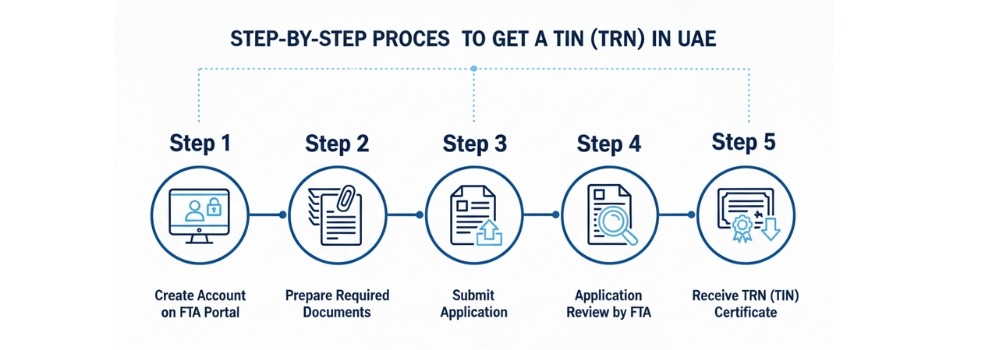
How to Apply for VAT Registration in the UAE (Step-by-Step)
VAT registration in the UAE is completed online through the Federal Tax Authority (FTA) portal. Businesses must create an account, submit financial details, and upload supporting documents to receive a Tax Registration Number (TRN). At this stage, many businesses prefer to consult a VAT registration consultantto ensure all financial details and documents are correctly prepared before submission.
Step 1: Create an Account on the FTA Portal
Visit the official FTA e-Services portal and register your business account.
Provide your email address and create login credentials
Verify your email to activate the account
Log in to access VAT services
👉 This account will be used for VAT registration, return filing, and compliance management.
Financial records (turnover proof, invoices, or contracts)
👉 Missing or incorrect documents are one of the most common reasons for delays.
Step 3: Complete the VAT Registration Form
Inside the FTA portal, select “Register for VAT” and complete the application form.
You will need to provide:
Business activity details
Annual turnover and expected revenue
Import/export information (if applicable)
Details of owners and shareholders
Contact and address information
👉 Ensure all financial figures match your supporting documents to avoid rejection.
Step 4: Upload Supporting Documents
Upload all required documents in the specified format.
Make sure files are clear and readable
Use correct formats (PDF, JPG, etc.)
Double-check document validity before submission
👉 Incomplete uploads can result in application rejection or delays.
Step 5: Review and Submit the Application
Before submitting:
Carefully review all entered details
Ensure accuracy in turnover and business activity
Confirm all documents are attached
Once submitted, you will receive a reference number to track your application. It’s important to note that while the FTA doesn’t charge for registration itself, businesses often opt for expert consultation. To get a full understanding of vat registration UAE fees, explore the service charges that may apply.
VAT Registration Deadlines in the UAE
Businesses in the UAE must register for VAT within a specific timeframe once they meet the registration threshold.
If your taxable supplies exceed AED 375,000, you must apply for VAT registration within 30 days of crossing the threshold
If you expect your revenue to cross the threshold soon, it is recommended to prepare for registration in advance
Missing the deadline can result in penalties from the Federal Tax Authority (FTA)
👉 Important: Late registration can result in penalties, and missing the deadline might also increase the vat registration UAE cost due to potential fines or expedited processing fees.
VAT Compliance in the UAE
Registration is only effective when paired with proper compliance. Understanding the process of filing VAT returns in the UAE helps businesses meet deadlines, avoid penalties, and maintain long-term credibility.
Filing returns: Depending on size and FTA rules, returns are submitted quarterly or monthly. Timely filing ensures transparency and avoids penalties.
Maintaining records: Proper invoices and financial documents must be kept to prove adherence and simplify audits. Organized records also help businesses track performance and plan strategically.
Avoiding penalties: Late registration, missed returns, or poor record‑keeping can lead to fines and reputational damage. Staying compliant protects reputation and ensures smooth operations.
Consistent compliance ensures smooth operations and strengthens business credibility.
Free Zone and Foreign Companies
VAT rules also apply to Free Zone entities and foreign businesses operating in the UAE.
Free Zone companies: Designated zones may have special rules, but crossing the AED 375,000 threshold requires registration. Voluntary registration is also available for supplies above AED 187,500.
Foreign businesses: Companies outside the UAE but conducting business within the country must register, submit documents, and obtain a TRN to remain compliant.
Understanding these rules ensures that both Free Zone entities and foreign companies operate smoothly in the UAE market.
Benefits of VAT Registration
Completing VAT registration in the UAE offers businesses far more than just meeting a legal requirement. It creates a framework for financial stability and credibility.
Legal compliance and protection: Registering ensures your company is recognized by the Federal Tax Authority, helping you avoid fines and penalties. This legal safeguard allows businesses to operate confidently without fear of sudden disruptions.
Ability to claim input VAT refunds: Businesses investing in offices or commercial spaces should also understand VAT on commercial property in the UAE, as it directly impacts input VAT recovery and cash-flow planning.
Enhanced business credibility: Customers, suppliers, and partners are more likely to trust companies that follow proper tax procedures. Registration signals professionalism and reliability, which can strengthen long‑term relationships.
Preparedness for expansion: Voluntary registration allows smaller businesses to align with tax systems early. This readiness makes scaling smoother, as compliance is already in place when revenues grow.
Improved financial management: VAT registration encourages businesses to maintain accurate records, which not only supports audits but also helps in better forecasting, budgeting, and strategic planning.
Alongside VAT compliance, businesses must also assess their direct tax obligations. Completing corporate tax registration in the UAE ensures full regulatory alignment as companies grow.
Whom Should You Approach for VAT Registration?
Navigating VAT registration in the UAE can feel overwhelming, especially with rules around thresholds, required documents, and compliance obligations. The safest way to avoid mistakes is to consult with experts who understand the system thoroughly.
HFA Consulting specializes in guiding businesses through the registration process. From preparing trade licenses and financial records to applying online via the Federal Tax Authority portal, their team ensures every step is handled correctly. They also advise whether your company falls under mandatory registration at the AED 375,000 threshold or qualifies for voluntary registration at AED 187,500.
With HFA Consulting, you don’t just get assistance with paperwork; you gain a partner who helps you stay compliant, avoid penalties, and strengthen your business credibility.
Conclusion
Timely VAT registration in the UAE is more than a box to tick; it is a safeguard for sustainable business growth. By registering on time, companies avoid penalties, maintain proper records, and build credibility with customers and partners.
Whether your business qualifies for mandatory registration at the AED 375,000 threshold or opts for voluntary registration at AED 187,500, completing the process through the Federal Tax Authority ensures smooth compliance.
Beyond compliance, VAT registration strengthens financial discipline, supports transparency, and positions businesses to compete confidently in the market. Filing returns regularly, keeping accurate invoices, and staying aligned with tax rules all contribute to long‑term stability. In short, VAT registration is not just about obligations it is about building a strong foundation for future success.
When combined with VAT compliance, understanding corporation tax advantages for businesses allows companies to structure finances without any hustle while staying aligned with UAE tax regulations.
Completing VAT registration on time is vital, but businesses should also plan for the vat registration UAE cost, which may include fees for consultants and ongoing VAT filing services.
FAQs
Who is eligible for VAT registration in UAE?
Any business whose annual taxable supplies exceed AED 375,000 must complete VAT registration. This is known as mandatory VAT registration UAE. The rule applies to companies across all sectors, including mainland and Free Zone entities, ensuring they meet the VAT registration requirements set by the Federal Tax Authority.
What is the TRN?
The Tax Registration Number (TRN) UAE is a unique identifier issued once a business completes the VAT registration process UAE. It is required for issuing VAT invoices, filing returns, and proving compliance during audits. Without a TRN, businesses cannot legally charge VAT or claim refunds.
What are the penalties for late registration?
Failing to register on time can result in fines from the Federal Tax Authority VAT registration system. Penalties may include financial charges, restrictions on claiming input VAT, and reputational damage. Timely registration ensures compliance and protects businesses from unnecessary costs.
How much does it cost to register for VAT in the UAE?
VAT registration in the UAE is free of charge when applying through the Federal Tax Authority (FTA) portal. The government does not charge any official fee for submitting a VAT registration application or obtaining a Tax Registration Number (TRN).
How to check vat registration number in UAE?
You can verify a VAT registration number (TRN) in the UAE through the official Federal Tax Authority (FTA) portal using its online verification tool. 👉 Follow these steps: 1. Go to the FTA website: https://tax.gov.ae 2. Navigate to “TRN Verification” under e-Services 3. Enter the Tax Registration Number (TRN) you want to check 4. Complete the captcha verification 5. Click Search. Once registered, you may still need professional help for compliance. Understanding the vat registration UAE fees for ongoing consultancy or filing services is crucial to avoid unexpected costs.
The UAE has long been celebrated as one of the world’s most business-friendly environments. But on 1 June 2023, the country entered a new era of fiscal policy when the federal corporate tax officially came into force. For tens of thousands of businesses operating across the Emirates, understanding and managing corporate tax compliance is no longer optional; it is a legal obligation.
The introduction of corporate tax in the UAE was driven by the country’s commitment to aligning with global tax transparency standards set by the OECD, including the Base Erosion and Profit Shifting (BEPS) framework. It also reflects the UAE’s ambition to diversify government revenue and maintain its competitive edge as a global business hub, while meeting international expectations around fair taxation.
Whether you run a mainland LLC, a free zone entity, or a multinational branch office, your obligations under Federal Decree-Law No. 47 of 2022 are real and enforceable. This guide breaks down everything you need to know, from who pays to how much to what happens if you don’t comply.
Key Takeaways
UAE corporate tax applies to most businesses and individuals earning above a set threshold from business activity.
A zero per cent rate applies to income below the lower threshold; only profits above it attract the standard rate.
Free zone businesses can still benefit from preferential tax treatment, but only if they meet strict Qualifying Free Zone Person conditions.
Registration with the FTA is mandatory, and missing your deadline triggers immediate financial penalties.
Tax returns and payments are due within nine months of your financial year-end.
Small businesses below the revenue threshold may qualify for full relief through the Small Business Relief provision.
Transfer pricing rules apply to all related party transactions and must be documented properly.
Records must be kept for a minimum number of years and must be available for FTA audit at any time.
Who Is Subject to UAE Corporate Tax?
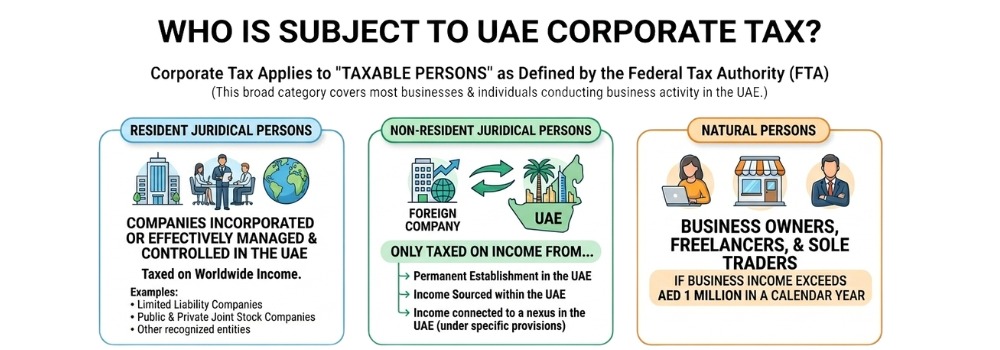
Corporate tax applies to what the Federal Tax Authority (FTA) defines as “taxable persons.” This broad category covers most businesses and individuals conducting business activity in the UAE.
Resident juridical persons
Meaning companies incorporated or effectively managed and controlled in the UAE are subject to corporate tax on their worldwide income. This includes limited liability companies, public and private joint stock companies, and other entities recognised under UAE law.
Non-resident juridical persons
Are taxed only on income attributable to a permanent establishment in the UAE, income sourced within the UAE, or income connected to a nexus in the UAE under the law’s specific provisions.
Natural persons
Individual business owners, freelancers, and sole traders are subject to corporate tax if their business income exceeds AED 1 million in a calendar year. This is a notable threshold that brings many self-employed professionals into the tax net for the first time.
Certain categories are explicitly excluded. These include income earned by individuals from employment (salaries, wages, and end-of-service benefits), dividends and capital gains received from qualifying shareholdings, and income from personal investment activity that is not conducted through a licensed business.
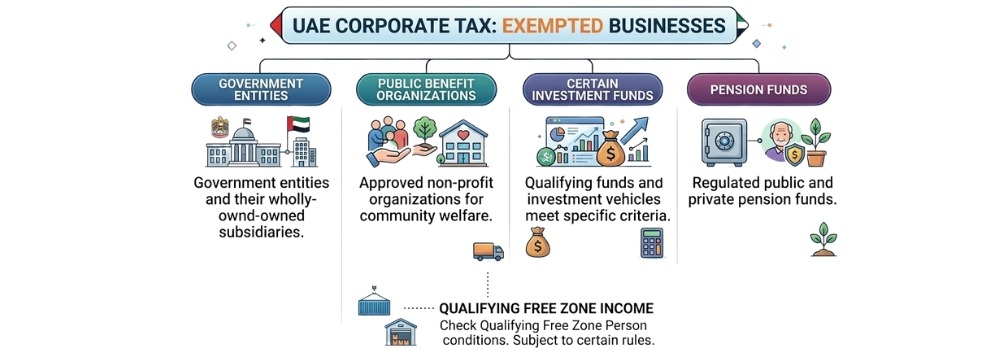
Government entities, government-controlled entities meeting specific criteria, extractive businesses subject to Emirate-level taxation, and qualifying public benefit organisations are also generally exempt.
How UAE Corporate Tax Rates and Thresholds Work
The UAE corporate tax rate structure is designed to be straightforward and internationally competitive.
The standard rate is 9% on taxable income exceeding AED 375,000. Taxable income up to that threshold is taxed at 0%, effectively protecting small and micro businesses from any tax burden.
For multinationals that fall within the scope of the OECD’s Pillar Two rules, specifically, multinational enterprise groups with consolidated global revenues of at least EUR 750 million, a different rate of 15% applies under the Qualifying Domestic Minimum Top-up Tax (QDMTT). This ensures that large multinationals pay a minimum effective tax rate even where UAE rates would otherwise fall below that threshold.
These rates place the UAE among the lowest corporate tax jurisdictions globally, preserving its appeal to foreign investors while meeting international commitments.
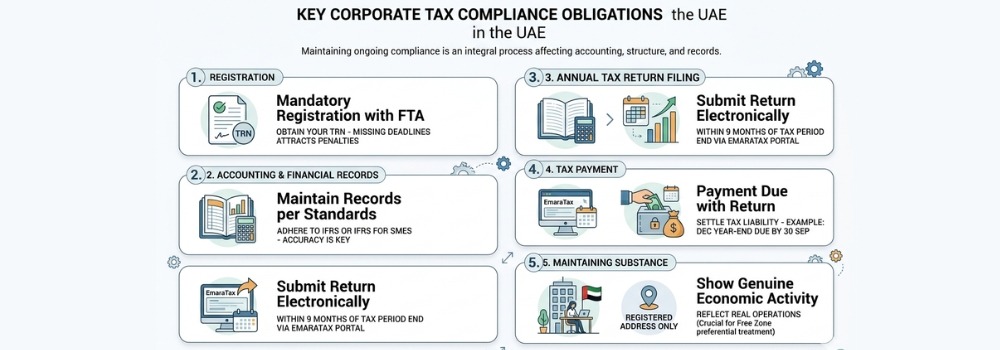
Key Compliance Obligations
Staying compliant with UAE corporate tax law involves more than simply paying a bill once a year. It is an ongoing process that touches your accounting practices, legal structure, and record-keeping systems.
Registration
The first and most time-sensitive obligation. All taxable persons must register with the FTA and obtain a Tax Registration Number (TRN) for corporate tax purposes. Registration deadlines are staggered based on your trade licence issuance date, so missing yours can attract immediate penalties.
Accounting and financial records
Must be maintained in accordance with International Financial Reporting Standards (IFRS) or, for smaller businesses, IFRS for SMEs. Your financial statements form the foundation of your tax return, so accuracy is non-negotiable.
Annual corporate tax return filing
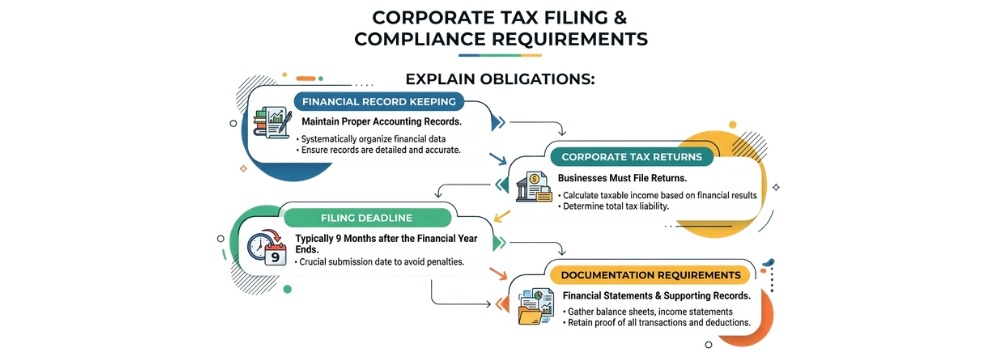
Required for each tax period, which generally corresponds to your financial year. The return must be submitted electronically through the EmaraTax portal within nine months of the end of the relevant tax period.
Tax payment
Due at the same time as the return, nine months after the end of the tax period. This means that if your financial year ends on 31 December, your return and payment are due by 30 September of the following year.
Maintaining adequate substance
Also, a compliance consideration, particularly for free zone businesses claiming preferential treatment. Your UAE operations need to reflect genuine economic activity, not merely a registered address.
How Is Taxable Income Calculated in the UAE?
Taxable income under UAE corporate tax starts with your accounting net profit or loss as reported in your audited financial statements. From there, specific adjustments are made.
Exempt income is excluded. This includes qualifying dividends received from UAE-resident companies and foreign subsidiaries (subject to conditions), qualifying capital gains from the disposal of shares in subsidiaries, and income from international shipping or qualifying aircraft operations under certain criteria.
Non-deductible expenses are added back. These include entertainment expenses (only 50% are deductible), fines and penalties, bribes, and any expenditure not incurred wholly and exclusively for business purposes. Interest deductions are also subject to limitations. The general interest limitation rule caps net interest deductions at 30% of adjusted EBITDA, though businesses with net interest expenditure below AED 12 million are exempt from this cap.
Tax losses from previous periods can be carried forward and offset against a significant portion of taxable income in future tax periods. This provides meaningful relief for businesses that experienced losses in the early years of operation or during difficult trading periods.
Businesses within the same qualifying group can also elect to form a Tax Group, filing a single consolidated return and offsetting profits and losses across group members, which can substantially reduce the overall tax burden.
How UAE Corporate Tax Applies to Free Zone Businesses (QFZP Rules)
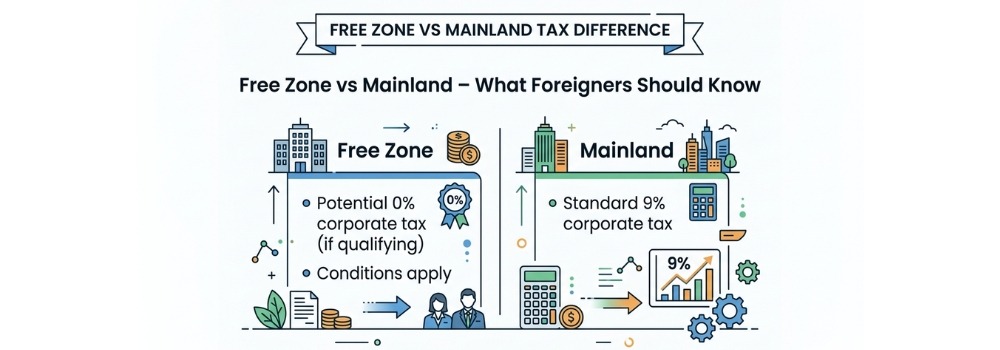
One of the most discussed aspects of UAE corporate tax compliance is how it applies to free zone entities. Free zones such as DIFC, ADGM, JAFZA, and over forty others have traditionally offered tax-free environments, and many businesses relocated or established there specifically for that reason.
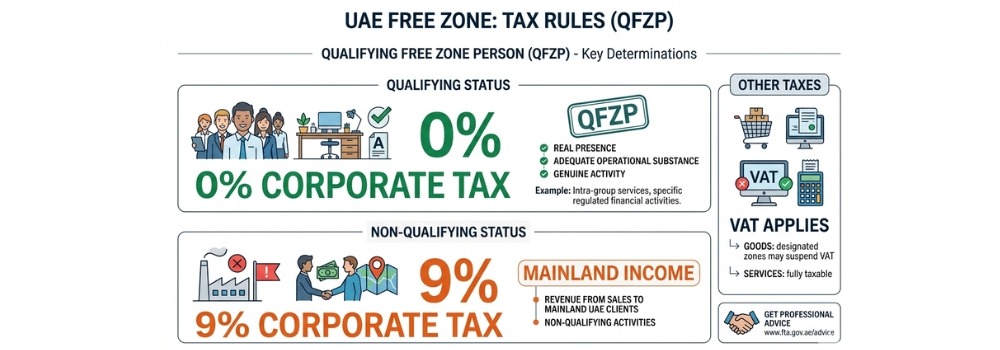
Under the new law, free zone businesses can still benefit from a 0% corporate tax rate, but only if they qualify as Qualifying Free Zone Persons (QFZPs). The conditions are strict.
To qualify, a free zone entity must maintain adequate substance in the UAE, derive only “qualifying income” (as defined under Ministerial Decision No. 139 of 2023), not elect to be subject to the standard corporate tax regime, comply with transfer pricing rules, and prepare audited financial statements.
Qualifying income broadly covers income from transactions with other free zone persons, income from certain specified activities (such as fund management, reinsurance, logistics, and aircraft engine services), and income from international transactions involving goods that do not enter the UAE mainland market.
If a free zone entity earns income from mainland UAE customers or engages in non-qualifying activities, that portion of income is taxed at the standard 9% rate. This dual treatment requires careful tracking and allocation of income streams.
Failing to meet any one of the QFZP conditions for a tax period can result in the entity losing its qualifying status for that period and the following four tax periods, a significant consequence that underscores the importance of proactive free zone compliance management.
Transfer Pricing and Related Party Transactions
For businesses with related party transactions, whether with parent companies, subsidiaries, affiliated entities, or connected individuals, transfer pricing compliance is a critical component of corporate tax obligations.
The UAE has adopted the OECD Transfer Pricing Guidelines in full. This means that all transactions between related parties must be conducted at arm’s length, that is, on terms that independent parties would agree to under comparable circumstances.
Businesses must maintain a Master File and Local File if their revenue or assets cross certain thresholds, and must be prepared to produce this documentation upon FTA request. Country-by-Country Reporting (CbCR) obligations also apply to qualifying multinational groups.
The FTA has the authority to adjust taxable income where it determines that related party transactions were not priced at arm’s length. This can result in significant upward adjustments to taxable income and corresponding tax liabilities, making proactive transfer pricing documentation not just a compliance formality but a financial risk management measure.
Common related party transactions that attract scrutiny include management fees, intercompany loans, royalties and licensing fees, and the sale or purchase of goods between group entities.
What Are the Penalties for Non-Compliance with UAE Corporate Tax?
The FTA has established a strong penalty framework to enforce corporate tax compliance. These penalties are not symbolic; they are meaningful financial consequences designed to incentivise timely and accurate compliance.
Late registration
carries a fixed administrative penalty per violation. If a business continues to operate without registering, further violations can accumulate quickly, making early registration far cheaper than delay.
Late filing of the tax return
Results in escalating monthly penalties starting at a lower rate in the first year and doubling thereafter. The longer the return remains unfiled, the more costly the position becomes.
Late payment of tax
Triggers percentage-based monthly penalties that begin accruing from the day after the due date. The FTA compounds these charges over time, meaning that an initially manageable liability can grow substantially if left unresolved.
Failure to maintain adequate records
Treated seriously by the FTA, with penalties that double for repeat offences within a two-year window. Businesses that cannot produce records during an audit face both the financial penalty and the risk of estimated assessments on their taxable income.
Voluntary disclosure
The most important tool available to a business that identifies an error or omission after filing. Proactively correcting a mistake with the FTA attracts significantly reduced penalties compared to those imposed when the FTA discovers the same error during an audit. Early self-correction is not just responsible; it is financially strategic.
Tax evasion
sits in an entirely different category. Deliberately concealing income, falsifying records, or providing misleading information to the FTA exposes a business and its directors to the most severe penalties in the framework, potentially including criminal prosecution. No compliance saving is worth that exposure.
Practical Corporate Tax Compliance Checklist
Managing compliance is far easier when broken into concrete, actionable steps. Here is a practical checklist for businesses operating in the UAE:
Before your first tax period
Register with the FTA via EmaraTax before your applicable deadline. Confirm your financial year-end and identify your first tax period. Engage a qualified UAE tax advisor if you do not have in-house expertise.
Assess whether your business qualifies for Small Business Relief or QFZP status. Implement accounting systems capable of producing IFRS-compliant financial statements.
During the tax period
Track all income and expenditure in line with UAE corporate tax rules. Identify and document all related party transactions with proper transfer pricing analysis. Maintain records of any exempt income separately. Monitor interest expenses relative to your EBITDA if you have significant debt financing.
At year-end
Prepare or commission audited financial statements. Prepare your corporate tax return and calculate taxable income. Apply any available tax loss carry-forwards. Submit the return and make payment by the nine-month deadline. Retain all supporting records for a minimum of seven years.
Who Should You Consult for Corporate Tax Compliance in the UAE?
For businesses dealing with UAE corporate tax requirements, HFA Consulting provides structured support to ensure full compliance with local regulations, filing obligations, and reporting standards.
As experienced tax consultants in Dubai, the firm manages corporate tax registration, accurate return filing, transfer pricing documentation, and ongoing compliance requirements in line with Federal Tax Authority guidelines, helping businesses avoid penalties and maintain consistent regulatory compliance.
Conclusion
UAE corporate tax compliance marks a fundamental shift in how businesses in the Emirates must operate. The rates remain internationally competitive, the framework offers meaningful reliefs for small businesses and qualifying free zone entities, and the FTA has provided substantial guidance to help taxpayers navigate the new rules.
But compliance is not passive. It demands proactive registration, robust accounting, careful structuring of related party transactions, and timely filing and payment. Businesses that treat corporate tax as an afterthought rather than an integrated part of financial management face real and escalating financial penalties.
The good news is that for well-organised businesses, UAE corporate tax compliance is entirely manageable. The earlier you build the right systems and seek the right advice, the less disruptive the process will be.
FAQS
When did the UAE corporate tax come into effect?
UAE corporate tax officially came into effect for financial years beginning on or after 1 June 2023. For most businesses with a calendar financial year (1 January to 31 December), the first tax period subject to corporate tax was the year ending 31 December 2024, with returns and payments due by 30 September 2025.
Do freelancers and sole traders have to pay corporate tax?
Yes, in some cases. Natural persons, including freelancers, sole traders, and individual business owners, are subject to corporate tax if their annual business turnover exceeds AED 1 million. Personal income from employment, investment dividends, and real estate held personally (not through a business) is generally excluded.
Are free zone companies exempt from corporate tax?
Not automatically. Free zone companies can access a 0% corporate tax rate, but only if they qualify as Qualifying Free Zone Persons (QFZPs) under the FTA’s conditions. These include maintaining adequate substance, earning only qualifying income, and complying with transfer pricing rules. Income from mainland UAE activities or non-qualifying activities is taxed at 9%.
What is Small Business Relief, and who qualifies?
Small Business Relief allows eligible businesses to be treated as having zero taxable income, effectively paying no corporate tax for a tax period. To qualify, your revenue must not exceed AED 3 million in the relevant tax period and in all prior tax periods from 1 June 2023. This relief is available for tax periods ending on or before 31 December 2026. Businesses that are members of a multinational group with consolidated revenues exceeding EUR 750 million do not qualify.
When do I need to file my corporate tax return?
Your corporate tax return must be filed within nine months of the end of your tax period. For example, if your financial year ends on 31 December, your return is due by 30 September of the following year. Payment is due at the same time as the return.
Is VAT the same as corporate tax in the UAE?
No. VAT (Value Added Tax) and corporate tax are entirely separate taxes administered by the FTA. VAT at 5% applies to the supply of most goods and services and is collected from customers. Corporate tax applies to business profits. A business may be registered for VAT, corporate tax, or both, depending on its activities and revenue.
Can I deduct salaries and rent from taxable income?
Yes. Salaries, wages, rent, utilities, professional fees, and other ordinary business expenses are generally deductible in calculating taxable income, provided they are incurred wholly and exclusively for business purposes and are not specifically disallowed under the corporate tax law. Entertainment expenses are only 50% deductible. Payments to related parties must meet the arm’s length standard to be fully deductible.
What records do I need to keep and for how long?
Businesses are required to retain all records and documents relevant to their corporate tax return for a minimum of seven years from the end of the relevant tax period. This includes financial statements, invoices, contracts, bank statements, payroll records, and transfer pricing documentation. The FTA can request these records during an audit, and failure to produce them attracts penalties.
What happens if I miss the FTA registration deadline?
Missing your corporate tax registration deadline results in an immediate penalty of AED 10,000. If you continue to operate without registering, further violations and penalties can accumulate. It is advisable to register as soon as possible, even if your deadline has passed. Voluntary registration and disclosure generally result in lower penalties than those imposed following an FTA audit or investigation.
Do holding companies or investment vehicles pay corporate tax?
It depends on their structure and activities. Holding companies that receive qualifying dividends and qualifying capital gains from subsidiaries may be able to exempt that income from corporate tax under the participation exemption rules. However, they must still register with the FTA, file returns, and meet the conditions for each exemption claimed. Pure investment holding structures with no employees and no genuine UAE substance should seek specific legal and tax advice to ensure their arrangements remain compliant.
The UAE has built its reputation as a global business hub on the promise of a tax-friendly environment, and for the most part, that reputation still holds. But “tax-friendly” no longer means “tax-free.” VAT was introduced in 2018, and Corporate Tax became effective in June 2023.
If you own a business, freelance independently, or operate from a free zone, you almost certainly have active tax obligations you need to understand and meet.
The good news is that the UAE’s tax system is relatively straightforward compared to most countries. There is no personal income tax, no capital gains tax, and no inheritance tax. What does exist is VAT at five per cent and Corporate Tax at nine per cent above a threshold, which is managed entirely through one digital platform called EmaraTax. Once you understand how the system works, compliance is manageable.
This guide covers exactly how to pay tax in the UAE in 2026, from understanding which taxes apply to you, to registering on EmaraTax, filing your return, making the payment, and staying compliant year after year. Whether you are a freelancer, SME owner, mainland business, free zone company, or an expat trying to understand your position, this guide has you covered.
Key Takeaways
Before you read the full guide, here is what you need to know at a glance:
What
Detail
UAE Personal Income Tax
Zero per cent, your salary is never taxed
VAT Rate
Five per cent mandatory registration above AED 375,000 in taxable supplies
Corporate Tax Rate
Nine per cent on net profits above AED 375,000
Official Tax Portal
EmaraTax (emaratax.gov.ae). All registration, filing, and payment happen here
Your Payment Identifier
A unique IBAN assigned to your tax file, GIBAN, is required for every bank transfer
VAT Return Deadline
28 days after the end of each tax period
Corporate Tax Deadline
Nine months after your financial year-end
Free Zone Rule
Zero per cent CT available for Qualifying Free Zone Persons on qualifying income only
Record Keeping
Five years for VAT, seven years for Corporate Tax
Expats
UAE salary is tax-free, but home-country obligations may still apply
Types of Tax in the UAE (2026)
The first step in figuring out how to pay tax in the UAE is understanding which taxes actually apply to your situation. Not every tax type will be relevant to every reader, so here is a clear breakdown of what exists, what the rates are, and who it affects.
Personal Income Tax
Personal income tax in the UAE remains at zero per cent. This means your salary, wages, dividends, and rental income as an individual are not subject to any tax at the federal level.
The UAE Ministry of Finance has consistently reaffirmed this position, and there are no current proposals to change it. This is one of the primary reasons the UAE continues to attract high-earning professionals and entrepreneurs from around the world.
Corporate Tax (CT)
Corporate Tax was introduced with effect from June 2023 and applies to the net profits of businesses operating in the UAE. The rate is nine per cent on profits above AED 375,000. Below that threshold, the rate is zero, which effectively protects small businesses and startups from the burden of corporate taxation in their early years.
Free zone businesses operate under a separate set of rules and may be eligible for a zero per cent rate on qualifying income. This is covered in detail in its own section later in this guide. Corporate Tax applies to businesses registered in the mainland UAE, and in certain circumstances to free zone businesses earning non-qualifying income.
VAT (Value Added Tax)
VAT, introduced in January 2018, applies to most goods and services supplied within the UAE. Businesses must register for VAT if their taxable supplies exceed AED 375,000. For those looking to get help navigating the registration process, understanding the VAT registration UAE fees that come with hiring professionals can be beneficial.
Voluntary registration is available from AED 187,500 useful if you want to reclaim input VAT on your business purchases before hitting the mandatory threshold.
Once registered, businesses collect VAT from their customers, offset it against the VAT they have paid on their own purchases, and remit the difference to the FTA through a regular VAT return.
Excise Tax
Excise Tax applies to a specific category of goods considered harmful to health or the environment, such as tobacco products, energy drinks, carbonated drinks, and similar items. The rates range from fifty per cent to one hundred percent depending on the product category.
If your business imports, manufactures, or stockpiles these goods, you will need to register for Excise Tax separately. For most businesses, this will not apply, but it is worth being aware of. Visit the Federal Tax Authority website for the full product list and rates.
Customs Duty
Customs duty applies to goods imported into the UAE and is governed by the GCC Common Tariff, which sets a general rate of five per cent on the customs value of most imported goods.
Certain categories are exempt or subject to different rates. If your business relies on importing goods from outside the GCC, this is a cost you will factor into your pricing and supply chain planning.
Tax Type
Rate
Who It Applies To
Personal Income Tax
0%
All individuals’ salaries, dividends, and rental income
Corporate Tax
0% / 9%
Businesses with net profits above AED 375,000
VAT
5%
VAT-registered businesses on goods and services
Excise Tax
50%–100%
Importers/manufacturers of specific goods
Customs Duty
5% (general)
Businesses importing goods from outside the GCC
How to Pay Tax in the UAE Step-by-Step (EmaraTax Portal)
Everything related to UAE tax registration, filing, payment, and correspondence is handled through the EmaraTax portal at emaratax.gov.ae. This is the official platform operated by the Federal Tax Authority, and it replaced the older e-Services portal. Here is a complete walkthrough of the process, step by step.
Step 1: Create Your EmaraTax Account
Navigate to emaratax.gov.ae and click Sign Up. You will be asked to provide your email address, mobile number, and either your Emirates ID (for UAE residents) or your passport number (for non-residents).
After entering your details, you will receive a one-time password (OTP) on your registered mobile number to verify your identity. Once verified, your EmaraTax account is active and ready to use.
If you already had an account on the old FTA e-Services portal, your data should have been migrated, but it is worth logging in and confirming your details are accurate before proceeding with any filings.
Step 2: Register for Tax and Obtain Your TRN
Log in and go to Register for Tax. Select your tax type: VAT, Corporate Tax, or Excise Tax and complete the application. You will need to upload your trade license, Emirates ID or passport copy, and bank account details.
Once approved, the Federal Tax Authority issues your TRN (Tax Registration Number), your unique identifier for all filings, invoices, and FTA correspondence.
For Corporate Tax, registration deadlines are tied to your trade license issue month; miss it, and penalties apply. Check the FTA’s published timeline and register before your window closes.
Step 3: Log In and Explore Your Dashboard
Your EmaraTax dashboard is the central hub for everything. After logging in, you will see a clear overview of your tax status, including any pending returns, recent payment history, upcoming deadlines, and official FTA correspondence.
Spend a few minutes getting familiar with the layout before your first filing. The portal is designed to be self-explanatory, but knowing where things are saves time when deadlines are approaching.
Step 4: Open Your Tax Return
Navigate to the Returns section of the EmaraTax portal. Select the relevant tax type, VAT or Corporate Tax, and the portal will display all available periods for which a return can be filed. Choose the correct period and click to open the return.
Step 5: Select the Correct Tax Period
This step sounds simple, but selecting the wrong period is one of the most common errors businesses make, and it cannot be corrected after submission. VAT returns are filed quarterly by default, covering three-month periods.
Monthly filing is available for businesses approved by the FTA for this frequency. Corporate Tax returns follow your business’s financial year, which may or may not align with the calendar year. Always double-check you have the correct period before entering any figures.
Step 6: Enter Your Tax Details
For a VAT return, enter your total sales (output tax) and business purchases (input tax) across each category: standard-rated, zero-rated, exempt, and imports. For Corporate Tax, enter your net profit, deduct allowable expenses, and arrive at your taxable income. EmaraTax calculates the amount due automatically once your figures are in.
Step 7: Review and Submit the Return
Before you click Submit, review every line of your return carefully. Check that the period is correct, that your output and input tax figures are accurate, and that you have not missed any deductions you are entitled to claim.
The most common errors at this stage are missed input tax credits on VAT returns and incorrect period selection. Once you click Submit, the return is finalised and cannot be amended, so take your time here.
Step 8: Generate Your Payment Reference and GIBAN
After submission, EmaraTax generates two things: your Payment Reference Number and your GIBAN (General IBAN), a unique bank account number the Federal Tax Authority assigns to your tax file. Every payment must go to this GIBAN, or it will not be matched to your account, leaving you with an outstanding balance on record.
Step 9: Pay Your Tax
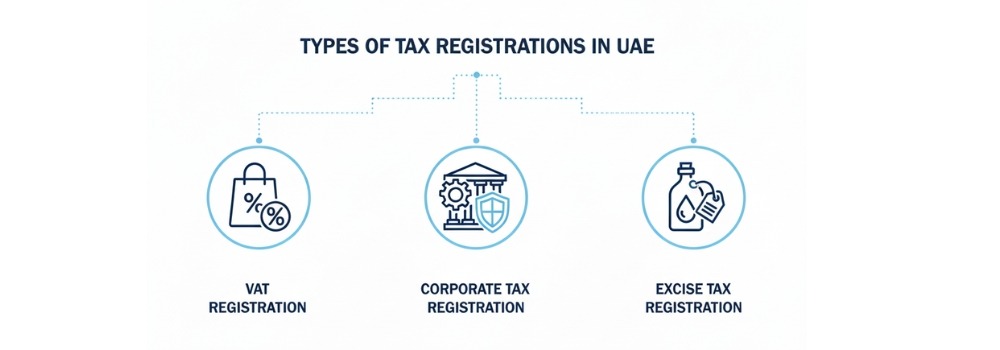
The EmaraTax portal offers several payment methods to suit different preferences and processing timelines:
Bank transfer to your GIBAN: Transfer the exact tax amount from your business bank account to your GIBAN. Include your payment reference number in the transfer description field. Bank transfers typically take one to two business days to reflect in the portal.
e-Dirham card: The e-Dirham is a government-backed prepaid card system. Payments via e-Dirham are processed on the same day, making this a good option when you are close to a deadline.
Credit or debit card: You can pay directly through the EmaraTax portal using a standard Visa or Mastercard. This is the most convenient method for smaller tax amounts and processes quickly.
Whichever method you choose, always retain proof of payment before closing your browser session.
Step 10: Confirm Payment and Download Your Receipt
Once payment has been processed, log back into EmaraTax and navigate to My Payments to confirm the status has updated to paid. Download your official payment receipt and save it securely both digitally and, if your business generates significant tax liabilities, in physical form as well.
The Federal Tax Authority has the right to audit your records, and payment receipts are a core part of your compliance documentation. Receipts must be retained for a minimum of five years.
Step 11: Know Your Deadlines and Avoid Penalties
Understanding your filing and payment deadlines is not optional it is one of the most important parts of UAE tax compliance. The FTA does not offer grace periods, and penalties start accumulating from the first day after a missed deadline.
Free Zone Businesses Special Tax Rules
If you operate from a UAE free zone, your situation is more nuanced than most guides suggest.
A Qualifying Free Zone Person (QFZP) is eligible for a zero per cent Corporate Tax rate on qualifying income. To qualify, your business must have a real presence in the free zone, actual employees, adequate operational substance, and genuine activity. This is not automatic just because you hold a free zone license.
Income that does not qualify, for example, revenue from sales to mainland UAE clients, is taxed at the standard nine per cent rate. This is one of the most common and costly misclassifications free zone businesses make.
VAT still applies in free zones. There is no blanket VAT exemption. However, Designated Zones operate under modified VAT rules: the transfer of goods within a Designated Zone may have VAT suspended, but services remain fully taxable.
If you’re in a free zone and regularly invoice mainland UAE clients, get advice from a registered tax agent before assuming your income is qualifying. The FTA takes this classification seriously.
Tax for Expats and Salaried Employees
The short answer: your UAE salary is not taxed. Personal income tax is zero, and that includes salaries, wages, capital gains, and inheritance. The UAE remains one of the most attractive locations in the world for this reason.
However, there are situations where tax does apply:
Freelancers and self-employed individuals who operate through a UAE entity and earn above AED 375,000 may be subject to Corporate Tax at nine per cent. This catches many people off guard.
Expats from the UK, US, Australia, and several other countries may still owe tax to their home country on UAE-sourced income. UAE’s zero-tax environment does not automatically exempt you from your home jurisdiction’s rules.
The UAE has signed over 140 Double Taxation Agreements (DTAs) with countries around the world. If you need to prove UAE tax residency to your home country’s tax authority, you can apply for a Tax Residency Certificate directly through the EmaraTax portal.
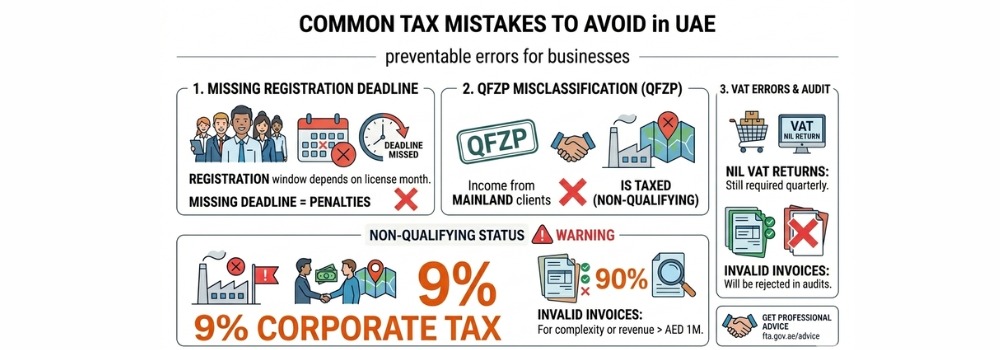
Common Mistakes to Avoid
Getting these wrong is expensive and preventable.
Missing your CT registration deadline is the most common first mistake. The deadline depends on the month your license is issued, and many business owners don’t find out until after the window has passed.
Filing a nil VAT return is still required even if you had zero sales in a quarter. Many businesses skip this and receive an automatic penalty.
Using the wrong bank account for tax transfers is surprisingly common. Always use your GIBAN, the unique account number the Federal Tax Authority generates for your file, not any general FTA banking detail you may find elsewhere.
Misclassifying free zone income as qualifying income is a frequent and costly error for QFZP businesses selling to mainland clients.
Claiming input VAT without valid tax invoices will be rejected during an audit. Every credit needs a proper invoice showing the supplier’s TRN.
If your annual revenue exceeds AED 1 million, seriously consider hiring a registered UAE tax agent. The compliance complexity at that level makes professional support a worthwhile investment.
Who Provides Tax Advisory Services in the UAE?
For businesses managing UAE tax requirements, HFA Consulting provides comprehensive tax advisory services designed to ensure full compliance with local regulations and Federal Tax Authority guidelines.
As experienced tax consultants in Dubai, we support corporate tax registration, return filing, transfer pricing documentation, and ongoing advisory, helping businesses maintain accurate reporting, minimise risks, and stay aligned with evolving tax laws across the UAE.
Conclusion
The UAE is low-tax, not zero-tax. VAT and Corporate Tax are real obligations with real penalties for getting them wrong. The great thing is that the EmaraTax portal handles registration, filing, and payment in one place, and the process is straightforward once you know the steps.
The biggest risks are missing deadlines, misclassifying free zone income, and assuming expat status means no obligations anywhere.
For complex situations, free zone structures, multiple income sources, or expat home-country obligations, consult a registered UAE tax agent or visit the Federal Tax Authority’s official website at tax.gov.ae for authoritative guidance.
The UAE offers a low-tax environment, but businesses must be diligent about VAT and Corporate Tax obligations. Whether you’re filing returns or registering for VAT, it’s important to factor in VAT registration UAE fees if you plan to seek professional assistance to ensure compliance
FAQS
How Do I Pay Tax in the UAE Online?
Register on the EmaraTax portal at emaratax.gov.ae, complete your VAT or Corporate Tax return for the relevant period, generate your GIBAN and payment reference, then pay via bank transfer, e-Dirham, or credit card through the portal.
What Is a GIBAN Number in UAE Tax?
GIBAN stands for General IBAN. It is a unique bank account number that the Federal Tax Authority assigns to your tax file on EmaraTax. When making a bank transfer to pay your tax, the GIBAN ensures the payment is automatically matched to your account. Never make a transfer without it.
Can I Pay UAE Tax Through a Bank Transfer?
Yes. After filing your return on EmaraTax, use the GIBAN generated by the portal as the beneficiary IBAN and include your payment reference number in the transfer description. Bank transfers typically process within two business days.
What Happens If I Miss the UAE Tax Payment Deadline?
The FTA applies a late payment penalty of AED 500 per month minimum, plus two per cent of the unpaid tax amount. Non-registration penalties range from AED 10,000 to AED 50,000. Always file on time, even if you cannot pay in full immediately.
Do Expats Pay Income Tax in the UAE?
No. The UAE does not levy personal income tax on salaries or most investment income. However, if you operate a business earning above AED 375,000, Corporate Tax at nine per cent applies. UK, US, and Australian expats should also review their home-country tax obligations separately.
How Much Corporate Tax Do I Pay in the UAE?
Corporate Tax is zero on net profits up to AED 375,000, and nine per cent on profits above that threshold. Qualifying Free Zone Persons may be eligible for zero per cent on qualifying income if they meet the Federal Tax Authority’s substance requirements.
The UAE’s real estate market is one of the most dynamic in the world, but for investors, developers, and tenants, a single three-letter acronym can be the difference between profit and penalty: VAT.
Navigating the landscape of UAE VAT on real estate can feel like deciphering a complex plan. While whispers of “tax-free” zones persist, the reality is that the sale and lease of non-residential properties are subject to clear, non-negotiable tax rules.
Get it wrong, and you face fines. Get it right, and you optimize your cash flow, ensure compliance, and secure your investment.
This guide cuts through the complexity. We will give you the definitive, step-by-step breakdown of how VAT affects your holdings. Starting with the most critical principle: the standard rate that governs VAT on commercial property in the UAE.
Quick Summary of VAT on Commercial Property in UAE
Particulars
Summary
VAT Rate
5% standard rate
Applies To
Sale and rent of commercial property
Who Pays
Tenant pays, landlord collects
VAT Registration
Mandatory above AED 375,000
Input VAT Recovery
Allowed for VAT-registered businesses
What is VAT on Commercial Property in the UAE?
VAT on commercial property in the UAE is a 5% tax applied to business-use real estate, including rent and sales. It applies when the property is used for commercial or income-generating activities.
While the FTA does not charge a fee for VAT registration, businesses may incur vat registration UAE cost if they choose to hire professionals for assistance. Understanding these costs beforehand will help you budget accordingly.
The UAE VAT Standard Rate (5%)
The core principle is that the supply of commercial real estate is considered a taxable supply at the standard rate of 5%. This rate applies to the transaction’s value and is mandatory for any business that is registered for VAT or is required to be registered.
This 5% standard rate applies to two main scenarios:
Sale: The transfer of ownership of the property.
Lease/Rent: The periodic payment for the right to occupy the property.
Example of VAT on commercial rent
If annual rent = AED 100,000 VAT (5%) = AED 5,000 Total = AED 105,000
VAT on Commercial Property at a Glance
Item
Details
VAT Rate
5%
Applies To
Sale and lease
Authority
Federal Tax Authority
Registration Threshold
AED 375,000
Input VAT Recovery
Allowed
What is considered commercial property in UAE for VAT?
The UAE VAT legislation defines commercial property by what it is not. Generally, a commercial property is any land or building that does not qualify as residential property, bare land, or a property used by a charity for a specific charitable activity.
Examples of properties subject to VAT on commercial property in the UAE include:
Offices and Business Centers: Any dedicated workspace used for administrative or commercial purposes.
Retail Shops, Malls, and Showrooms: All spaces dedicated to selling goods or services to consumers.
Warehouses and Industrial Facilities: Storage units, factories, and logistics hubs.
Hotels and Serviced Apartments: These are treated as commercial operations due to the services provided.
Bare Land: Crucially, even the sale of bare land is considered commercial and is subject to the standard 5% VAT.
In short, if the property is used to generate taxable business revenue, it is classified as a taxable supply, and the 5% rate applies. This is the foundation upon which all other VAT rules in VAT real estate are built.
Selecting the right location is the first step in commercial success. Whether you choose the bustling trade hubs or industrial zones, understanding the local nuances of how to open a business in Dubai provides the structural foundation for your property needs.
Location choice dictates more than just footfall; it defines your entire tax boundary. The difference between Freezone and Mainland setups can significantly influence your eligibility for certain VAT exemptions or Corporate Tax reliefs on the commercial holdings.
Securing the right space is only part of the process. Your tax obligations change based on whether your company is registered in a Freezone or on the Mainland. To ensure your company structure is tax-optimized from day one, you can explore professional business setup services that align your trade license with your real estate goals.
Is VAT Applicable to Commercial Rent in the UAE?
The rental or lease of any property defined as commercial (offices, retail, warehouses, etc.) is considered a taxable supply under the UAE Federal Tax Authority (FTA) laws. This means that a standard rate of 5% VAT applies to the transaction value.
This rule holds for virtually all agreements designed to grant the right of occupation for a commercial purpose:
Commercial Lease: Standard long-term contracts for office space or retail units.
Sublease: When a tenant leases the property to a third party, the original tenant (now the new landlord) must charge 5% VAT.
Short-Term Rental: Even short-term licensing or rental agreements for commercial use (like temporary pop-up shops or serviced offices) are subject to the 5% VAT rate.
Who pays VAT landlord or tenant in UAE?
To understand compliance for VAT on rent in the UAE, you must be clear on the roles of the two main parties:
Role
Responsibility
VAT Status
Landlord (The Supplier)
Collects and Remits
Managing these thresholds requires a proactive approach to your tax status. Before reaching this limit, ensure you fully understand the specific VAT registration requirements inthe UAE to avoid the heavy fines associated with late notification
Tenant (The Customer)
Pays
The tenant pays the 5% VAT on top of the base rent to the landlord.
The VAT amount is not a cost borne by the landlord; it is a tax collected on behalf of the government. The ultimate economic burden of the VAT on the rent falls on the tenant.
Pro-Tip for Tenants: If you are a VAT-registered business and the rented commercial property is used for your taxable business activities, you are typically eligible to recover this 5% VAT (input tax) in your next VAT return, effectively making the tax cost-neutral to your registered business.
Effective tax planning does more than ensure compliance; it boosts your bottom line. Understanding the corporation tax advantages available to UAE businesses can help you structure your commercial leases more efficiently for long-term growth.
For new market entrants, these thresholds can be approached more quickly than expected. Establishing a clear process for VAT returns for startups in the UAE early on prevents the administrative bottleneck that often hampers growth during the first year of operations.
What details must a VAT invoice include in UAE?
Compliance starts with documentation. Since the rent is a taxable supply, the landlord (as the supplier) is legally obligated to issue a proper Tax Invoice to the tenant. This is critical for both parties: the landlord for accurate reporting, and the tenant for potential VAT recovery.
A compliant VAT invoice for UAE VAT rent must clearly detail the following:
The words “Tax Invoice” are clearly displayed.
The Landlord’s name, address, and Tax Registration Number (TRN).
The Tenant’s name, address, and TRN (if applicable).
The date of issue.
A description of the supply (e.g., “Quarterly rent for Office Unit 101, Business Tower”).
The Total Amount Payable (rent exclusive of VAT).
The VAT Rate applied (5%).
The VAT Amount charged (clearly separated from the rent).
Failing to issue a proper Tax Invoice can lead to penalties for the landlord and prevent the tenant from recovering the input tax.
VAT on Residential Property in UAE vs Commercial: The Crucial Distinction
The biggest mistake an investor can make in the UAE real estate sector is assuming that the VAT rules for commercial and residential properties are the same. They are fundamentally different, and this difference dictates everything from pricing and tenant contracts to tax registration obligations.
While VAT on commercial property is designed to be fully taxable (5%), the rules governing residential property are designed to avoid taxing the end-consumer (the resident), ensuring that the cost of housing remains accessible.
Here is a clear comparison of how UAE VAT on real estate is applied across the different property categories:
Commercial vs. Residential VAT Treatment
Property Type
VAT Rate
Notes
Input VAT Recovery for Supplier?
Commercial
5% (Standard-Rated)
Applies to rent, sale, and related services (e.g., brokerage, property management).
Yes, generally
Residential (First Supply)
0% (Zero-Rated)
Applies to the first sale or lease of a new building, provided it is supplied within 3 years of completion.
Yes (The supplier can recover VAT paid on construction costs).
Residential (Subsequent Supply)
Exempt
Applies to all sales or leases after the first supply (e.g., resale of an old home, regular apartment rental).
No (The supplier cannot recover input VAT related to this exempt income).
Understanding this clear split is fundamental to accurate VAT compliance for all real estate players in the UAE. Professional help with VAT registration and compliance will ensure that you avoid costly errors. Be sure to ask about vat registration UAE cost if you need advice on complex cases involving mixed-use properties or exemptions.
UAE VAT on Real Estate: Rules for Sales & Leasing
The rules for the sale and leasing of property form the bedrock of VAT real estate UAE compliance. They are not complex, but they are absolutely non-negotiable. Whether you are transferring ownership or simply renting out space, the VAT status of the property dictates the tax rate.
1. VAT on the Sale of Commercial Property (5%)
The sale of any commercial property, whether it is an office tower, a retail shop, or a warehouse, is a taxable supply subject to the standard 5% VAT rate.
Seller’s Role: The seller (if VAT-registered) must charge the buyer 5% VAT on the total agreed-upon selling price.
Buyer’s Obligation (Special Payment Mechanism): In a secondary market sale (when the property is sold by a non-developer), the buyer may be required to pay the 5% VAT directly to the Federal Tax Authority (FTA) using the EmaraTax e-services portal before the title transfer can be completed at the Land Department. This mechanism is crucial for ensuring the government receives the tax promptly.
Input Tax Recovery: A VAT-registered buyer who intends to use the commercial property for their own taxable business (e.g., leasing it out, using it as an office) can generally recover the 5% VAT paid on the purchase price.
Who Handles the VAT Payment? The responsibility for paying the VAT depends on who you are buying the property from:
Transaction Type
Who Collects the VAT?
How is it Paid?
Buying from a Developer
The Developer
You pay the 5% VAT to the developer; they remit it to the FTA.
Secondary Market (Individual/Reseller)
The Buyer (Directly)
The buyer pays 5% VAT directly to the FTA via the EmaraTax portal before the Title Deed is issued.
Transfer of Going Concern (TOGC)
No VAT Applied
If a tenanted commercial building is sold to a taxable buyer as a “business,” it may be outside the scope of VAT.
2. VAT on the Sale of Residential Property (0% or Exempt)
The VAT treatment for residential sales is designed to protect end-users and differs based on the property’s age and history:
First Supply (0% Zero-Rated): The very first sale or lease of a new residential building, provided it occurs within three years of its completion, is Zero-Rated (0%). This allows the developer to recover the VAT they paid on construction costs, but the buyer pays no tax.
Subsequent Supply (Exempt): Any sale or lease of the residential property that occurs after the first supply (or if the first supply occurs more than three years after completion) is exempt from VAT. This means the seller/landlord does not charge VAT, but they cannot recover any input VAT on related costs.
3. Navigating Mixed-Use Property Rules: Allocation is Key
Mixed-use properties like a tower with commercial retail units on the ground floor and residential apartments above present the most complex scenario for VAT, as two different tax treatments apply to a single building.
When a mixed-use property is sold or leased, the consideration must be accurately apportioned:
Commercial Portion: The portion of the sale price or rental income attributable to the commercial space (offices, retail, common areas serving commercial tenants) must be charged at 5% VAT.
Residential Portion: The portion attributable to the residential units is treated as either Zero-Rated (0%) or Exempt, following the rules outlined above.
The Capital Asset Scheme
When a commercial property purchase or exceeds AED 5,000,000 (excluding VAT), it is classified as a “Capital Asset.” This triggers specific long-term compliance requirements:
10-Year Monitoring Period: The FTA requires owners to monitor the use of the building for Upcomming 10 years.
Adjustments for Change of Use: If you initially recovered 100% of the VAT but later convert part of the building for exempt use (e.g., residential units), you may be required to repay a portion of that recovered VAT to the FTA.
Annual Tracking: You must perform an annual adjustment if the proportion of use between taxable and exempt supplies changes over the decade.
Managing a ten-year monitoring period requires precise annual tracking to avoid massive repayment risks to the FTA. Many investors choose to partner with tax consultants in Dubai to handle these complex adjustments. Having an expert manage your capital asset records protects your ROI and keeps your portfolio fully compliant over the long term.
Input VAT Allocation
For the developer or owner of a mixed-use building, this split is critical for input VAT recovery:
Input VAT (VAT paid on construction, maintenance, etc.) that directly relates to the commercial portion can be recovered in full.
Input VAT that directly relates to the exempt residential portion cannot be recovered.
Input VAT on common expenses (like a shared lobby or central cooling system) must be apportioned between the taxable (commercial) and exempt (residential) supplies using a fair and consistent methodology, a process that often requires specialist tax advice.
How does VAT apply to commercial rent in UAE?
While the 5% rule for VAT on commercial property is straightforward, real-world lease agreements involve more than just rent. Landlords and tenants must understand the VAT treatment of all fees, deposits, and service charges to prevent compliance issues.
When VAT Applies to Rental Payments
The 5% VAT must be applied to the rent and collected by the landlord on the earliest of the following dates:
The date the payment is due (as per the lease agreement).
The date the rent payment is actually made.
The date a tax invoice is issued.
This means VAT is generally due when the rent cheque is issued or banked, not necessarily when the entire lease term concludes.
The Tax Status of Deposits and Termination Fees
The tax implications of ancillary payments hinge on whether the payment is considered “consideration” (a payment for a supply) or a penalty/security:
Payment Type
VAT Treatment
Landlord/Tenant Action
Security Deposits (Refundable)
Outside the Scope of VAT
Not subject to VAT when collected. It is a security, not a payment for a supply.
Security Deposits (Retained)
Subject to 5% VAT
If the landlord later retains the deposit (e.g., to cover unpaid rent or damages the tenant was responsible for), the retained amount becomes a payment for a supply, and 5% VAT is due.
Early Termination Fees
Subject to 5% VAT
This fee is typically considered payment for the landlord’s agreement to release the tenant from their contractual obligation. If the tenant is VAT-registered, the termination fee attracts 5% VAT.
Dilapidation Payments
Varies
If the payment is compensation for damage (a penalty), it’s generally outside VAT scope. If it is compensation for the landlord to carry out repairs the tenant was obligated to perform, it is subject to 5% VAT.
Service Charges and Utilities: Often Taxable
A common area of confusion is the array of supplementary costs associated with the commercial property. In almost all cases related to commercial leasing, these charges are treated the same as rent; they are standard-rated:
Charge Type
VAT Treatment
Rationale
Service Charges
Subject to 5% VAT
These fees (for common area maintenance, security, and landscaping) are considered part of the overall payment for the right to occupy the premises and are therefore taxable supplies.
Utility Charges (Recharged)
Subject to 5% VAT
If the landlord pays for utilities (like electricity, water, and cooling) and charges them to the tenant, the charge is generally treated as an ancillary component of the taxable commercial lease and is subject to 5% VAT.
Agency/Broker Fees
Subject to 5% VAT
Real estate agency and brokerage services are professional services and are always subject to the standard 5% VAT rate.
For commercial property, assume that any payment made to the landlord or related service provider for the use or upkeep of the premises is subject to VAT on rent in the UAE at the standard 5% rate, unless specifically classified otherwise by the FTA.
How to Pay VAT in the UAE (Step-by-Step)
Compliance with the UAE VAT on real estate framework relies heavily on correct procedures managed through the Federal Tax Authority’s (FTA) digital portal. This step-by-step guide walks you through the core requirements for registering, filing, and remitting your tax due.
The FTA requires you to keep these records for at least five years, and any error in your invoices can lead to immediate fines. To simplify this process and ensure your quarterly filings are 100% accurate, working with VAT consultants in Dubai provides the technical oversight needed. Professional help turns a stressful tax season into a routine, handling error-free administrative tasks smoothly.
Step 1: Register for VAT (Mandatory for Most)
If your business is involved in commercial property (which is standard-rated) or other taxable supplies, you must determine your registration status.
Mandatory Registration: A business must register for VAT if the total value of its taxable supplies (including the VAT on commercial property sales and rent) and imports exceeds the mandatory threshold of AED 375,000 over the previous 12 months, or is expected to exceed it in the next 30 days.
Voluntary Registration: A business may voluntarily register if its supplies/imports or taxable expenses exceed AED 187,500. This is often advisable as it allows you to recover Input VAT paid on costs.
Action: Complete the application on the FTA’s online platform (EmaraTax) and obtain your Tax Registration Number (TRN).
Before applying for a TRN, businesses must evaluate if they meet the mandatory or voluntary financial limits. You can find a detailed breakdown of the specific VAT registration requirements in the UAE to ensure your application is submitted correctly.
Step 2: File Your VAT Return on the FTA Portal
Once registered, you are required to submit a VAT return, typically every quarter, although the FTA may specify monthly filing for certain businesses.
Deadline: Returns must be filed and payment remitted by the 28th day following the end of the tax period.
Process: Log in to the EmaraTax portal. You will input your Output Tax (VAT collected on sales and rent) and your Input Tax (VAT paid on purchases and expenses).
Net VAT Due: The system calculates the difference. If your Output Tax is higher than your Input Tax, the difference is the amount you must pay to FTA. If the Input Tax is higher, you may be due a refund.
Step 3: Pay VAT Through the FTA
Payment is made electronically through the EmaraTax platform. The FTA no longer accepts physical cash payments, ensuring efficiency and transparency.
You can pay VAT in the UAE using one of the following integrated methods:
GIBAN Transfer: The most common method. You obtain a unique Government IBAN (GIBAN) for your specific VAT liability from the EmaraTax dashboard and transfer the funds using your bank’s online platform.
FAB Magnati Gateway: This allows for instant payment using a credit card or debit card (Visa or MasterCard) via the FTA’s integrated payment gateway (Note: this may incur a small transaction charge).
Step 4: Keep Tax Invoices and Records
The foundation of compliance is robust record-keeping. The FTA requires that all VAT-registered businesses maintain complete and accurate records for a minimum of five years.
Tax Invoices: You must issue valid Tax Invoices for all your taxable supplies (including VAT on commercial property rent).
Input Tax Documentation: Keep all invoices for expenses where you paid Input VAT (e.g., utility bills, service charges) to justify your claim for recovery.
Warning on Penalties: The FTA enforces strict deadlines. Penalties for late payment are severe, starting with an immediate 2% penalty on the unpaid tax amount, which can escalate rapidly. Filing your return and making payment must be done on time to ensure your business remains fully compliant.
VAT Compliance Checklist for Businesses
VAT registration completed
Tax invoices issued correctly
VAT returns filed on time
Input VAT properly recorded
Commercial vs residential classification verified
Common Mistakes to Avoid in VAT Real Estate UAE
Even with a clear understanding of the tax rules, minor procedural errors can lead to significant penalties from the FTA. For those dealing with VAT on commercial property in the UAE, vigilance is key. Here are the most frequent and most costly mistakes made by owners and businesses:
Avoiding penalties is only half the battle; the other half is being prepared for FTA scrutiny. Conducting a small business audit in the UAE helps identify leakages in your tax reporting before they become liabilities, allowing you to accurately calculate corporate tax in the UAE based on verified net profits.
Mistake
Impact
Not charging VAT
Penalties
Wrong invoice
No VAT recovery
Missing deadlines
Fines
Misclassification
Tax liability
1. Misclassifying Property as Residential (The Costly Assumption)
The Mistake: Treating a commercial property (like a retail store or a serviced apartment) as VAT-Exempt or Zero-Rated simply because a human resides or works there. This often happens with mixed-use buildings where the owner applies the residential exemption to the entire floor plan.
The Fix: Always verify the official use of the unit. If the unit is leased out to a business or is used for any taxable non-residential purpose (e.g., hotel use), it is standard-rated (5%). Relying on the rules for VAT on residential property in the UAE for a commercial unit will result in under-charging VAT, making the owner liable for the shortfall plus penalties.
2. Not Charging VAT on Commercial Rent
The Mistake: Many small landlords, even if registered for VAT, mistakenly assume that rent is automatically exempt, especially if they are new to the UAE VAT rent framework.
The Fix: If your total taxable supplies (including commercial rent) exceed AED 375,000, you are legally required to be VAT-registered and must charge 5% VAT on commercial rent. Failure to do so means the FTA will later hold the landlord responsible for the uncollected tax amount, calculated from the gross rental income, plus fines. Ensure your lease agreements clearly state the rent exclusive of VAT and the VAT amount separately.
3. Issuing Incorrect or Incomplete VAT Invoices
The Mistake: Providing a simple receipt or a pro-forma invoice instead of a full Tax Invoice that meets all FTA requirements. Common omissions include failing to clearly state the seller’s or buyer’s TRN, or merging the VAT amount with the rent (e.g., stating “Total Rent: AED 105,000 including VAT”).
The Fix: The invoice is the official proof of the transaction. For the tenant to successfully recover their input tax, they need a compliant invoice. For the landlord, it is proof of their Output Tax liability. Use the checklist provided earlier (TRNs, separate VAT amount, the phrase “Tax Invoice”) every single time to ensure full compliance.
4. Missing VAT Deadlines
The Mistake: Filing VAT returns or making payments late. This is a purely administrative error, but one that the FTA penalizes severely.
The Fix: VAT filing and payment must be completed by the 28th day following the end of the tax period. Set robust reminders, utilize the EmaraTax portal’s built-in alerts, and treat the filing deadline as a fixed, non-negotiable date to avoid accruing late payment penalties.
Is It Better to Consult a VAT Specialist?
Given the complex distinctions between the standard-rated VAT on commercial property in the UAE and the zero-rated or exempt treatment of VAT on residential property in the UAE, relying on general information is an expensive gamble. While commercial rent attracts the standard 5% VAT on commercial property, proper accounting for mixed-use allocations, input tax recovery, and specific payments (like early termination fees) requires specialized knowledge.
For investors and businesses navigating these rules, consulting an FTA-registered tax agent is an essential investment to ensure timely filing, accurate tax invoicing, and the avoidance of severe penalties. For expert, localized guidance on your commercial real estate portfolio, consider consulting with a reputable UAE-based firm like HFA Consulting, who specialize in VAT compliance and strategic financial structuring in the Emirates.
Managing a commercial portfolio often requires a dedicated team, and scaling your operations by ensuring your back-office is as compliant as your tax filings. ensures your management team is supported while you focus on high-level property acquisitions.
Closing the Loop: When and How to Deregister. If you sell your commercial portfolio or your taxable income falls below the voluntary threshold, you must consider VAT Deregistration.
Eligibility: You can deregister if your taxable supplies/expenses fall below AED 187,500 in 12 months or if you cease making taxable supplies entirely.
The 20-Day Rule: You must apply for deregistration within 20 business days of becoming eligible.
The Penalty Trap: Failure to apply for deregistration within this strict window results in a late fee of AED 10,000.
Settlement: All outstanding liabilities and final tax returns must be filed and paid before the FTA approves the deregistration.
Conclusion
Grasping the rules surrounding VAT on commercial property in the UAE is non-negotiable for success in the Emirates’ real estate sector. The key distinction remains clear: commercial properties (sales and leases) are standard-rated at 5% VAT, while the VAT on residential property in the UAE is either zero-rated or exempt.
Full compliance hinges on correctly calculating the UAE VAT rent, understanding the difference between deposits and taxable fees, accurately handling mixed-use properties, and ensuring every payment is backed by a compliant tax invoice. Missing VAT deadlines or misclassifying supplies can lead to immediate financial penalties.
For complex scenarios, such as the Special Payment Mechanism (SPM) during sales or the accurate apportionment of Input VAT in mixed-use developments, seeking expert advice is the smartest investment. For professional, localized guidance on your commercial real estate portfolio, consider consulting with a reputable UAE-based firm like HFA Consulting, who specialize in VAT compliance and strategic financial structuring in the Emirates. Protect your investment by ensuring your tax affairs are accurate and fully compliant from the start.
Frequently Asked Questions
How is VAT calculated on commercial rent in UAE with example?
VAT on commercial rent is calculated at 5% of the rental value. For example: If annual rent is AED 120,000: VAT = AED 6,000 Total payable = AED 126,000 The landlord collects AED 6,000 and reports it in their VAT return.
What happens if a landlord does not charge VAT on commercial rent?
If VAT is not charged but the landlord is required to be registered, the FTA can still demand the VAT amount from the landlord, calculated from the gross rent. For example: If rent was AED 100,000 (VAT not charged), the FTA may treat it as VAT-inclusive and recover approx. AED 4,761 as VAT, plus penalties.
Can a business fully recover VAT paid on office rent?
A VAT-registered business can recover 100% of VAT on office rent only if: i: The property is used for taxable business activities ii: A valid tax invoice is available If used partially for non-taxable activities, only a proportionate recovery is allowed.
How does VAT apply when a tenant subleases a commercial property?
When a tenant subleases a commercial property, they become the supplier and must charge 5% VAT on the sublease rent, provided they are VAT registered. They must also issue a tax invoice and report it in their VAT return.
When exactly does VAT become due on commercial rent?
VAT becomes due at the earliest of: i: When rent is paid ii: When the invoice is issued iii: When payment is due as per contract This means VAT is typically triggered per payment cycle (monthly/quarterly), not annually.
How is VAT paid to the FTA in UAE?
VAT is paid through the EmaraTax portal by: i: Filing VAT return (monthly or quarterly) ii: Calculating output VAT minus input VAT iii: Paying the net amount via GIBAN transfer or card payment The deadline is typically the 28th day after the tax period ends.
The UAE is known for having no personal income tax on salaries, which is why many professionals choose to live and work in cities like Dubai and Abu Dhabi.
However, the tax system is changing for businesses and higher earners. A 9% corporate tax applies to profits above AED 375,000, and a 5% VAT is charged on most goods and services.
Freelancers also need to keep track of their income to stay compliant with local regulations. In addition, foreigners may still have tax obligations in their home country depending on their residency status and tax agreements.
To better understand UAE income tax for foreigners, let’s explore the guide below.
Overview
Foreigners in the UAE generally pay 0% personal income tax on salaries, investments, or rental income, making it a tax-free environment for individuals. There is no personal tax registration required. However, a 5% VAT applies to goods/services, and a 9% corporate tax applies to large business incomes.
What Types of Income Are Tax-Free in the UAE?
The UAE remains a highly attractive location for professionals and investors. While new rules exist for businesses, most individual earnings remain free from direct taxation. You can manage your finances with more certainty when you know which categories of income stay in your pocket.
Income Type
Tax Status
Notes
Salary
0%
No personal income tax
Freelance Income
Depends
Corporate tax may apply
Business Profits
9%
Above AED 375,000
Dividends
0%
Generally tax-free
Capital Gains
0%
In most cases
Rental Income
0%
For individuals
For freelancers, the UAE tax law treats your work as a business activity. If your annual revenue stays below AED 1 million, you do not need to register for corporate tax. However, if your profit exceeds AED 375,000, the 9% rate applies.
Most personal investments, such as dividends and capital gains, are not subject to income tax in Dubai. This allows you to grow your wealth without the burden of complex tax filings on your personal savings.
Why the UAE Has No Personal Income Tax
The UAE maintains a zero-percent personal income tax rate as a core part of its economic strategy. By allowing you to keep 100% of your earnings, the government encourages high-level talent and global investors to move to the country.
This model creates a vibrant domestic economy where residents spend their disposable income on local businesses, real estate, and services.
Instead of taxing your paycheck, the government generates revenue through a diversified business-friendly model. This approach focuses on attracting foreign investment by offering 100% company ownership and world-class infrastructure.
The UAE uses its natural resource wealth and sovereign investments to fund public services like safety and transport without needing to tax its individual salaries.
What Taxes Exist in the UAE Instead
While your personal income remains tax-free, the UAE uses a modern tax system to maintain its high-quality infrastructure. You will encounter these primary costs as a resident or business owner:
VAT (5%)
A Value Added Tax applies to most everyday purchases. This consumption tax is standard across the country for goods and services.
Corporate Tax (9%)
If your business or freelance activity earns a net profit above AED 375,000, you must pay this flat rate. It ensures that large companies contribute to the national economy.
Licensing and Government Fees
To operate a business or live in the UAE, you pay for specific permits. These include trade license renewals, visa processing fees, and municipal housing fees attached to your utility bills.
Does Corporate Tax Apply to Foreigners?
Yes, corporate tax applies to you if you operate a commercial business or work as a licensed freelancer in the UAE. While your personal salary remains tax-free, the government treats your business earnings as a separate category. You must monitor your annual profits to determine if you owe the 9% rate under UAE tax law.
Many foreigners living in Dubai or Abu Dhabi mistake the lack of personal income tax for a total absence of tax. If you hold a trade license, you are part of the corporate tax system. This ensures that all commercial entities contribute to the infrastructure you use to run your business.
Who Needs to Pay Corporate Tax?
Specific groups must register and potentially pay tax based on their earnings. You fall into this category if you manage mainland businesses registered outside of a free zone. These entities must comply with the 9% tax on profits above AED 375,000.
Freelancers with licenses also face these rules because the government considers their income as business income. You must register once your annual revenue exceeds AED 1 million. Any company earning above the AED 375,000 threshold only pays the tax on the portion of net profit that exceeds that specific amount.
Who Is Not Affected?
Most individuals residing in the UAE will not be impacted by these changes. You are not affected by corporate income tax in the UAE if you are a salaried employee. Your monthly paycheck, bonuses, and housing allowances stay 100% tax-free. Individuals with no business activity also have no corporate tax obligations.
This means if you do not own a company or sell professional services, you do not need to worry about filings. Passive investors remain exempt as well. Your earnings from personal bank interest, stock dividends, or owning a home for personal use do not attract any tax.
Free Zone vs Mainland – What Foreigners Should Know
Choosing between a Free Zone and a Mainland setup is a major decision for any expat. This choice now dictates your tax obligations and how you can trade within the country. While both options offer benefits, they operate under different sets of rules regarding corporate income tax in the UAE.
Free Zone Tax Treatment
Free Zones are popular because they offer the potential for a 0% corporate tax rate. However, this is no longer automatic. To qualify for the zero rate, your business must maintain “adequate substance” in the UAE.
This means you must have a physical office, enough qualified employees, and incur enough operating expenses within the zone.
You only benefit from the 0% rate on “qualifying income.” This typically includes earnings from trading with other Free Zone entities or international clients outside the UAE.
If your Free Zone company earns money from the UAE mainland, that specific portion of income is usually taxed at the standard 9% rate. You must keep very clear financial records to separate these two types of income.
Mainland Tax Treatment
A Mainland license allows you to trade freely with any customer inside or outside the UAE. This flexibility is the main reason businesses choose this structure. From a tax perspective, Mainland companies follow the standard rule: you pay 0% tax on profits up to AED 375,000 and 9% on any profit above that amount.
While the tax rate is higher once you cross the threshold, the compliance can be simpler. You do not have to worry about the complex “qualifying income” rules that Free Zone entities face.
You simply track your total net profit and pay the tax if you exceed the limit. This makes it a great choice for local shops, cafes, and service providers who deal mostly with customers inside the country.
How Foreigners Become Tax Residents in the UAE
Tax residency is different from having a residency visa. While your visa allows you to live and work in the country, you only become a tax resident if you meet specific legal criteria.
Under UAE tax law, you are considered a tax resident if you are physically present in the UAE for at least 183 days during a consecutive 12-month period.
There is also a shorter path for those with a valid residency permit. If you have a permanent home in the UAE or carry on a job or business here, you can qualify as a tax resident after only 90 days of physical presence.
The government also looks at your “centre of financial and personal interests.” This includes where your family lives, where you hold your bank accounts, and where your primary business activities take place.
Why Tax Residency Is Important
Proving your tax residency is vital for your global financial planning. When you obtain a Tax Residency Certificate (TRC) from the Federal Tax Authority, you gain a powerful tool to manage your international tax obligations.
Avoid Double Taxation
The UAE has signed double taxation agreements with over 100 countries. These treaties ensure you do not pay tax on the same income in two different jurisdictions. If your home country tries to tax your global income, your UAE tax residency status can protect your earnings.
Access Tax Treaties
Holding a TRC allows you to benefit from reduced tax rates on dividends, interest, and royalties earned outside the UAE. It acts as official proof to foreign tax authorities that you are a legitimate resident of the UAE tax system.
Legal Tax Planning
Establishing residency helps you structure your business and personal investments clearly. It provides a transparent framework for your finances, making it easier to open international bank accounts and comply with global reporting standards.
Global Income and Double Taxation Explained
While the UAE does not tax your personal income, your home country might still have a claim on your earnings. This depends entirely on your citizenship and the specific residency rules of your origin nation. You must understand how your home government views your “global income” to avoid unexpected tax bills.
Double taxation occurs when two different countries both try to tax the same income. To prevent this, the UAE has signed over 100 Double Taxation Agreements (DTAs).
These treaties decide which country has the primary right to tax you. If you are a UAE tax resident, these agreements often protect your UAE-sourced salary from being taxed again by your home government.
Real Examples
The rules vary significantly depending on which passport you hold and where you were previously a resident.
US Citizens Taxed Globally
If you are a US citizen or a green card holder, the IRS taxes your worldwide income regardless of where you live. You must file a US tax return every year.
However, you can use the Foreign Earned Income Exclusion (FEIE) to exclude up to $132,900 of your UAE earnings from US tax in 2026. You may also need to file an FBAR if your UAE bank balances exceed $10,000 at any point.
UK Tax Depends on Residency
For British expats, tax liability depends on the Statutory Residence Test. You are generally safe from UK tax on your UAE salary if you spend fewer than 16 days in the UK during a tax year.
However, if you keep a home in the UK or visit for more than 90 days, you might trigger “automatic residency.” In that case, the UK could tax your global income.
EU Rules Vary by Country
Most European countries, like France or Germany, use a residency-based system. If you move your “center of life” to the UAE and stay for more than 183 days, you usually stop paying tax in your home country.
Be careful with specific exceptions; for example, Germany recently ended its tax treaty with the UAE. This means German expats must now follow strict domestic rules to prove they are no longer tax residents at home.
How the UAE Helps Foreigners Avoid Double Tax
The UAE has built a massive network of tax treaties to protect residents from being taxed twice on the same income. Currently, the country has signed agreements with over 100 nations.
These treaties are essential because they clarify which country has the legal right to tax specific types of income, such as salaries, dividends, or business profits.
When you become a tax resident in the UAE, you can apply for a Tax Residency Certificate. This document acts as official proof for foreign tax authorities. It shows that you are subject to the UAE tax system, which allows you to trigger the protections found in these international agreements.
Without these treaties, many foreigners would face the risk of paying tax in the UAE on business profits and then paying again in their home country.
Key Benefits of DTAs
These agreements provide more than just a general shield. They offer specific financial and legal advantages for expats and international business owners.
Reduced Foreign Tax Burden
One of the most immediate benefits is the reduction of withholding taxes on income earned outside the UAE.
If you own shares in a company in your home country or earn interest from a foreign bank account, the tax treaty often lowers the rate that the foreign government can take. This ensures more of your global investment income stays with you.
Legal Protection Against Double Taxation
DTAs provide a clear legal framework that prevents tax disputes between countries. If two nations both claim you as a tax resident, the treaty includes “tie-breaker” rules to settle the issue.
These rules look at where you have a permanent home or where your personal and economic ties are strongest. This protection gives you peace of mind that your financial planning follows recognized global standards.
Do Freelancers Pay Tax in the UAE?
Working as a freelancer in the UAE offers a flexible way to earn, but it does come with specific tax responsibilities.
Whether or not you pay tax depends on how much you earn and the type of permit you hold. Under UAE tax law, the government views a freelancer as a natural person conducting a business activity. This means your professional earnings are not treated as a personal salary, but as business revenue.
If your total revenue stays below AED 1 million in a calendar year, you are generally not required to register for corporate tax. However, once your gross income crosses this AED 1 million mark, you must register with the Federal Tax Authority.
Even after registering, you only start paying the 9% corporate income tax UAE rate if your net profit exceeds AED 375,000. This structure ensures that small-scale freelancers and those just starting do not face a heavy tax burden.
Key Considerations
Navigating the tax system as an independent worker requires staying organized with your documents and income tracking.
Freelance License Requirement
To work legally as a freelancer in Dubai or Abu Dhabi, you must hold a valid freelance permit or trade license. This license is the foundation of your tax status. Without it, you cannot legally invoice clients within the UAE.
Your license also determines whether you fall under a Free Zone or Mainland jurisdiction, which affects your qualifying income status for tax exemptions. Since free zone license cost in Dubai varies by authority and business activity, your choice of jurisdiction can directly impact how much you spend to stay compliant.
Corporate Tax Threshold
You must remember the difference between revenue and profit. Revenue is the total money you collect, while profit is what remains after you subtract your business expenses.
You only pay the 9% tax on the portion of your profit that is above AED 375,000. If your expenses are high and your net profit stays below this number, your actual tax bill will be zero, though you may still need to file a tax return.
Remote Work vs UAE-Based Income
If you live in the UAE but work remotely for a company located entirely outside the country, your tax situation may differ.
Individuals on a Remote Work Visa who are employees of a foreign company generally do not pay income tax in Dubai for foreigners because they are considered salaried employees of an overseas entity.
However, if you are a remote contractor running your own setup, the AED 1 million revenue rule still applies to you if you are a resident.
Do You Need to Register for Tax in the UAE?
Registration is a mandatory step for almost everyone conducting business in the Emirates, regardless of whether they actually end up paying the 9% tax. The Federal Tax Authority (FTA) uses the registration process to bring all commercial activity into the system, ensuring every entity is accounted for.
Corporate Tax Registration for Businesses
Every incorporated legal entity in the UAE, including Mainland companies, Free Zone establishments, and branches of foreign corporations, must register for Corporate Tax. This requirement applies even if the business is currently dormant or not yet generating a profit.
For businesses incorporated or recognized on or after March 1, 2024, the registration must typically be completed within three months from the date of incorporation or establishment.
If you are a foreign company with a Permanent Establishment (PE) in the UAE, you generally have nine months from the date the PE was established to finalize your registration. Missing these windows can trigger a flat administrative penalty of AED 10,000.
Federal Tax Authority (FTA) Compliance
All tax-related activities are managed through the EmaraTax portal. This digital platform is where you apply for your Tax Registration Number (TRN), file your annual returns, and make payments.
To stay compliant in 2026, you must ensure your registration details are accurate and reflect your current trade license. The FTA now uses automated systems to cross-reference your bank activity and license renewals.
If you operate multiple branches of the same legal entity, you only need one single registration under the head office. However, you must keep all your financial records and supporting documents for at least seven years to satisfy potential audit requirements.
Registration May Be Required Even Below Threshold
A common misconception is that you only need to register if your profits exceed AED 375,000. In reality, the threshold for registration is different from the threshold for payment.
Juridical Persons (Companies)
You must register regardless of your income level. Even if you earn zero profit, you are a “Taxable Person” under the law and must obtain a TRN.
Natural Persons (Freelancers/Sole Proprietors)
You only have a mandatory requirement to register if your total business turnover (gross revenue) exceeds AED 1 million within a calendar year. If you crossed this million-dirham mark in 2025, your hard deadline to register is March 31, 2026.
Small Business Relief (SBR)
If your revenue is below AED 3 million, you can elect for Small Business Relief to be treated as having no taxable income. However, this relief is not automatic; you must still register for tax and then “elect” for the relief when you file your annual return.
What Happens If You Ignore UAE Tax Rules?
Ignoring the UAE’s tax regulations in 2026 is no longer a simple procedural delay; the Federal Tax Authority (FTA) has moved into a mature enforcement phase.
Automated systems now cross-reference trade licenses and bank activities, meaning non-compliance is quickly detected. Failing to adhere to the rules can lead to immediate financial loss and long-term regulatory friction.
Fines for Non-Registration
If you fail to submit your Corporate Tax registration application within the timelines specified by the FTA, an administrative penalty of AED 10,000 is automatically imposed. This is a fixed, one-time fine per entity.
However, there is a strategic relief mechanism available in 2026. Under the current Penalty Waiver Initiative, the FTA will waive (remit) this AED 10,000 fine if you meet one specific condition: you must file your first Corporate Tax return or annual declaration within seven months of the end of your first tax period.
For example, if your financial year ends on December 31, 2025, you must file by July 31, 2026, to have the registration penalty reversed. If you miss this secondary filing window, the penalty becomes permanently payable.
Late Filing and Payment Penalties
Starting April 14, 2026, a new harmonized penalty framework (Cabinet Decision No. 129 of 2025) takes effect, changing how late actions are billed.
Late Filing
If you miss your tax return deadline, you face a penalty of AED 500 per month for the first 12 months. After one year of delay, the fine increases to AED 1,000 per month. This applies even if you owe zero tax.
Late Payment
The previous system of compounding percentage-based fines has been replaced by a flat annualized rate of 14%. This interest is calculated monthly on any outstanding tax balance from the day following the due date.
Inaccurate Returns
Submitting an incorrect tax return now carries a AED 500 penalty for the first violation. This can be waived if you voluntarily disclose the error before the FTA discovers it, corrected doesn’t change the tax due.
Legal and Financial Risks
Beyond the immediate fines, continued non-compliance creates broader risks for your business operations:
Audit Scrutiny
Frequent penalties or late registrations act as “risk signals” that may trigger a full FTA audit. During an audit, failure to keep records for the required seven years can result in an additional AED 10,000 fine for the first offense.
License Restrictions
In severe cases of tax evasion or repeated failure to settle dues, the FTA has the authority to coordinate with licensing bodies to suspend trade licenses or restrict visa renewals for company directors.
Reputational Impact
As the UAE aligns with global tax standards, a clean tax record is increasingly required for opening corporate bank accounts, securing government contracts, or engaging in high-level business partnerships.
Tax Situations for Different Types of Foreigners
How the tax system affects you depends entirely on your residency status and how you earn your money.
The UAE government distinguishes between individual employment income and business revenue to ensure that professionals remain attracted to the region while commercial entities contribute to the economy.
Professional Category
Personal Income Tax
Corporate Tax Status
Key Condition for 2026
Salaried Employee
0%
Not Applicable
No tax on salary, bonuses, or housing allowances.
Freelancer
0%
9% (on profits)
Only register if gross revenue exceeds AED 1 million.
Business Owner
0%
9% (on profits)
Mandatory registration regardless of profit level.
Remote Worker
0%
Exempt
Must prove a monthly income of USD 3,500 from abroad.
Understanding Your Specific Category
If you are a Salaried Employee, your financial life remains simple and tax-free. You do not need to register with the Federal Tax Authority or file any returns. Your take-home pay is exactly what is stated in your contract, minus any voluntary pension or insurance contributions.
For a Freelancer, the government treats you as a “Natural Person” in business. You only enter the tax system if your annual gross turnover crosses the AED 1 million mark. Even then, you only pay the 9% rate on the portion of your net profit that exceeds AED 375,000.
If you are a Business Owner with a registered company like an LLC, you must register for a Tax Registration Number immediately, even if your company is not yet making a profit.
Remote Workers on a Virtual Work Visa enjoy a unique position. Since your income comes from an employer located outside the UAE, you generally face no tax within the country.
However, you must maintain your residency by spending enough time in the UAE to meet the 183-day rule if you want to claim UAE tax residency and protect your income from your home country’s tax authorities.
How the UAE Compares Globally
The primary reason professionals and investors flock to the United Arab Emirates is the highly competitive tax structure. While many developed nations rely heavily on personal income tax to fund public services, the UAE uses a business-friendly model that allows you to retain more of your hard-earned money.
In 2026, the gap between the UAE and other major economies remains significant. Many Western countries have seen tax brackets shift upward to manage national debts, making the 0% personal income tax in cities like Dubai and Abu Dhabi even more attractive for high-earning expats.
Country
Personal Income Tax Rate
Corporate Tax Rate
Primary Benefit
UAE
0%
0% to 9%
Keep 100% of your salary
UK
Up to 45%
25%
High personal tax brackets
USA
Up to 37%
21%
Global taxation for citizens
EU (Avg)
20% to 50%
15% to 31%
Progressive tax systems
Understanding the Competitive Edge
When you compare the income tax in Dubai for foreigners to the rates in the UK or the EU, the difference in take-home pay is substantial. For a professional earning the equivalent of $150,000, living in London or Paris could mean losing nearly half of that amount to income tax and social security. In the UAE, that same professional keeps the entire $150,000.
The introduction of the 9% corporate income tax UAE rate still keeps the country at the lower end of the global spectrum. For example, the US corporate rate is more than double the UAE rate, and most EU nations have implemented a 15% global minimum tax.
By keeping the threshold for tax at AED 375,000, the UAE ensures that startups and small businesses can grow without the immediate burden of high taxation.
A Strategic Choice for Expats
Choosing to live and work in the UAE is often a long-term financial strategy. While you will encounter a 5% VAT and certain municipal fees, these consumption-based taxes are far lower than the combined income and property taxes found in other parts of the world.
This allows for faster wealth accumulation and more freedom in how you choose to spend or invest your capital.
Pros and Cons of the UAE Tax System
The UAE remains one of the most tax-efficient environments globally in 2026. However, the introduction of corporate tax and stricter VAT enforcement means that “tax-free” no longer means “compliance-free.” Understanding both the benefits and the obligations is key to a successful financial strategy.
Advantages
Limitations
0% Personal Income Tax: No tax on your salary, bonuses, or personal investment dividends.
5% VAT on Consumption: Most goods and services carry a Value Added Tax, increasing daily living costs.
High Take-Home Pay: Compared to the UK or US, your net income is significantly higher for the same gross salary.
Corporate Tax Compliance: Businesses and high-earning freelancers (over AED 1m revenue) must now register and file returns.
Double Taxation Relief: A network of 100+ treaties protects your UAE earnings from being taxed by your home country.
Five-Year Limit on Refunds: As of 2026, you must claim VAT refunds within five years or lose the credit permanently.
Startup Friendly: Profits below AED 375,000 are taxed at 0%, supporting small business growth.
Strict Penalties: Fines for late registration (AED 10,000) and late filing (AED 500/month) are strictly enforced in 2026.
Advantages
The biggest draw for expats is the absence of personal income tax. Whether you are a high-level executive or a remote worker, you keep 100% of your earnings. This allows for faster savings, easier debt repayment, and higher disposable income for investments.
Furthermore, the UAE does not tax capital gains, inheritance, or wealth for individuals, making it an ideal hub for wealth preservation.
The business environment is also designed for growth. With Small Business Relief (SBR) available until the end of 2026, companies with revenue under AED 3 million can effectively pay 0% tax, provided they elect for this relief in their tax returns.
Limitations
The primary “con” for many is the VAT system. While 5% is low by global standards, it applies to everything from utility bills to dining out. In 2026, the Federal Tax Authority (FTA) also introduced tougher rules to combat tax evasion, meaning businesses must be much more diligent with their documentation to avoid losing their “input tax” credits.
Another shift is the compliance burden. Even if you qualify for 0% tax (like a Free Zone company with qualifying income), you are still legally required to register with the FTA and file annual returns. Failing to do so can result in heavy administrative fines that wipe out your tax savings.
Foreign Tax Obligations
It is a common mistake to think that UAE tax residency settles all global obligations. If you are from a country that taxes based on citizenship (like the USA) or has complex residency tests (like the UK or Germany), you may still owe tax back home.
In 2026, several countries have tightened their “habitual abode” rules, meaning you must prove you have truly moved your life to the UAE to stop being taxed in your home jurisdiction.
Recent Changes Foreigners Should Know (2023–2026)
The transition from a “tax-free” to a “tax-compliant” environment is now complete. As of early 2026, the UAE has moved from the implementation phase into a strict enforcement era. While the 0% personal income tax remains the gold standard, the administrative rules surrounding business and residency have become significantly more detailed.
Key Update
Status for 2026
Impact on Foreigners
Corporate Tax
Fully Active
9% tax on profits over AED 375,000 for businesses and high-earning freelancers.
Penalty Reset
April 14, 2026
New 14% annual interest model for late payments; fixed fines for registration delays.
Tax Residency
Enhanced Checks
183-day rule strictly monitored; 90-day rule available for those with “primary residence.”
Audit Power
Expanded
The FTA now uses AI to cross-reference bank data with trade licenses and VAT filings.
Steps for Foreigners to Stay Tax Compliant in 2026
Maintaining tax compliance in the UAE requires active management of your residency status and business records. As the Federal Tax Authority (FTA) has moved into a mature enforcement phase, automated penalties are now common for those who miss registration or filing windows.
Compliance Action
Requirement for 2026
Deadline / Frequency
Maintain Residency
Spend at least 183 days in the UAE for full tax residency.
Annual tracking
Track Income
Separate personal and business accounts for accurate reporting.
Continuous
Tax Registration
Obtain a TRN via EmaraTax if you meet the criteria.
One-time (unless details change)
Annual Filing
Submit a Corporate Tax return even if your tax is 0%.
Within 9 months of the year-end
Maintain Valid Residency and Documentation
To benefit from the UAE’s 0% personal income tax and protect your global earnings from your home country, you must satisfy the physical presence requirements.
Most international tax treaties require you to spend at least 183 days in the UAE to be considered a tax resident. You should keep a log of your travel dates and maintain a valid Emirates ID. If you need to prove your status to a foreign government, you can apply for a Tax Residency Certificate through the FTA portal.
Track All Income Sources Separately
If you are a freelancer or a business owner, you must strictly separate your personal funds from your professional revenue. The FTA monitors total gross turnover to determine your tax obligations.
For “Natural Persons” (freelancers), you are only brought into the corporate tax framework if your total business revenue exceeds AED 1 million in a calendar year.
Income such as your personal salary from a UAE employer, dividends from personal stock investments, and income from personal real estate rentals are generally excluded from this “Business Revenue” calculation.
However, all fees, commissions, and service payments earned through your professional activities must be included and tracked for your annual declaration.
Register on the EmaraTax Portal
Registration for Corporate Tax is mandatory for all legal entities and high-earning individuals. You must use the EmaraTax digital platform to apply for your Tax Registration Number (TRN). Even if you expect your taxable profit to stay below the AED 375,000 threshold, you are still required to register if you meet the turnover criteria.
For freelancers whose business turnover crossed AED 1 million during the 2025 calendar year, the mandatory deadline to register is March 31, 2026. Missing this deadline results in an automatic administrative penalty of AED 10,000.
Once registered, you must file your return and settle any tax due within nine months of the end of your financial year. For most people using the standard calendar year, this deadline is September 30, 2026.
Understand Home Country Tax Rules
Living in the UAE does not automatically cancel your tax obligations in your country of origin. Some nations, like the United States, tax their citizens on worldwide income regardless of where they live.
US citizens must file an annual return and should explore the Foreign Earned Income Exclusion (FEIE) to minimize their US tax bill.
For citizens of the UK, Canada, or EU nations, you must ensure you have formally “severed ties” according to your home country’s specific residency tests.
The UAE’s network of Double Taxation Agreements (DTA) provides a legal shield, but these protections often only apply once you have registered as a tax resident in the UAE and can provide the necessary documentation to your home tax authority.
Who Should Pay Attention to UAE Tax Rules
As of March 2026, the UAE’s tax environment has transitioned from an introductory phase into a strict enforcement era. While personal salary remains untaxed, the “Natural Person” rule for business activities means that many individuals now fall under the corporate tax umbrella.
These four groups face the highest risk of penalties if they do not manage their compliance actively.
High-Income Expats
If you are a high-earning professional, your biggest tax challenge in 2026 is not the UAE government, but your home country. Most developed nations use a residency-based tax system.
To protect your UAE salary from being taxed by your origin country, you must satisfy the “183-day rule” to prove you are a UAE tax resident. Without a valid Tax Residency Certificate (TRC) from the Federal Tax Authority (FTA), your home country may still view you as a taxpayer and demand a share of your earnings.
Entrepreneurs and Business Owners
If you have incorporated a company in the UAE, you are now a “Taxable Person” in the eyes of the law. Under the 2026 regulations, even dormant companies or those making zero profit must register for Corporate Tax.
The FTA has introduced automated checks that cross-reference trade licenses with tax records. If your company was incorporated after March 2024, you have exactly three months from your incorporation date to register. Missing this window results in a non-negotiable AED 10,000 administrative fine.
Freelancers (Natural Persons)
Freelancers must monitor their “Gross Turnover” (total money received before expenses) with extreme care. You are only subject to UAE corporate tax if your business revenue exceeds AED 1 million in a calendar year.
However, once you cross this million-dirham mark, the administrative burden increases. If your revenue in 2025 exceeded this threshold, your legal deadline to register for a Tax Registration Number (TRN) is March 31, 2026.
Failing to register by this date triggers the AED 10,000 fine, even if you owe no actual tax on your profits.
Remote Workers and Digital Nomads
Remote workers on a Virtual Work Visa generally enjoy a tax-free stay in the UAE as long as their income comes from a foreign employer. However, you must be careful not to create a “Permanent Establishment” (PE) within the UAE. In 2026, the FTA is more vigilant about remote workers who unintentionally cross the line into “conducting business.”
If you begin hiring local UAE-based contractors or lease a dedicated physical office space, the government may classify your remote setup as a local business, making your global income subject to the 9% UAE Corporate Tax.
Who to Consult for Income Tax in the UAE as a Foreigner
With practical experience in UAE tax compliance, HFA Consulting is among the trusted tax consultants in Dubai, helping businesses manage corporate tax requirements in 2026 with clear and structured support. It handles Federal Tax Authority compliance, ensures accurate corporate tax registration, and completes required filings on time, while structuring tax positions properly so businesses stay compliant and avoid penalties.
Conclusion
The 2026 tax environment in the UAE marks a definitive shift from a period of transition to one of active enforcement. While the country continues to offer a highly competitive 0% personal income tax structure, the introduction of more detailed corporate tax rules and a unified penalty framework means that compliance is now a critical business function.
For foreigners, freelancers, and entrepreneurs, success in this market requires moving away from reactive accounting toward real-time financial management, ensuring that all revenue thresholds and registration windows are monitored with precision.
Ultimately, the goal of these updates is to foster a transparent and world-class economic hub that rewards organized and compliant entities. By staying informed of the latest Federal Tax
By following authority directives and maintaining diligent records, you can continue to leverage the UAE’s unique financial advantages while avoiding the risk of automated administrative fines. For those with complex cross-border interests or high-volume business activities, engaging with expert tax consultants in Dubai like HFA Consulting ensures that every filing is technically sound and aligned with current legislation.
FAQS
Do foreigners pay income tax in the UAE?
No. There is 0% personal income tax on employment income for foreigners in the UAE. Your monthly salary, bonuses, and allowances are not taxed by the government, and there is no requirement for individuals to file personal tax returns on their wages.
Is the UAE completely tax-free for expats?
Not entirely. While there is no personal income tax, you will encounter a 5% Value Added Tax (VAT) on most goods and services. Additionally, there are indirect taxes like excise tax on specific products (sugary drinks, tobacco) and municipal fees on restaurant bills or house rentals.
What is the tax rate in the UAE?
For individuals, the rate is 0%. For businesses and certain freelance activities, a 9% corporate tax applies to net profits exceeding AED 375,000. If a business or freelancer earns less than this profit threshold, the rate remains 0%.
Do freelancers pay tax in the UAE?
It depends on your revenue. In 2026, freelancers are only subject to corporate tax if their annual gross turnover exceeds AED 1 million. If you cross this revenue mark, you must register with the Federal Tax Authority, but you still only pay the 9% tax on the portion of your profit above AED 375,000.
Do I pay tax in my home country if I live in the UAE?
This depends on your home country’s laws. Some nations, like the US, tax citizens on worldwide income regardless of where they live. Most other countries tax based on residency; you may still owe tax if you haven’t formally “severed ties” or if you spend too much time back home. The UAE’s network of Double Taxation Agreements helps prevent you from being taxed twice on the same income.
Keeping up with the UAE’s shifting business landscape can feel like a full-time job. Not long ago, the Emirates was known as a purely tax-free haven, but things are changing fast. If you’re a business owner, a freelancer, or an investor, you’ve likely heard whispers about the UAE’s new tax rules.
These updates aren’t just about collecting revenue; they are a strategic move to align the country with global transparency standards and diversify the economy. But what do these rules and regulations of the new tax in uae actually mean for your bank account and your operations?
The shift can be confusing. Are you wondering if your current setup still complies with UAE tax rules? Whether it’s navigating the UAE tax residency rules to determine where you owe money or understanding the specific UAE federal tax authority rules that govern your filing, the “wait and see” approach is no longer an option.
From small startups to massive corporations, everyone is now asking: “How do I adapt to the new tax rule in the UAE without getting hit by penalties?” The solution lies in staying ahead of the curve and mastering the tax rules in the UAE before they catch you.
Overview
A 9% federal corporate tax now applies to business profits over AED 375,000, starting from financial years on or after June 1, 2023. To meet global standards, a 15% minimum top-up tax for large multinationals begins in 2025.
Additionally, 2026 updates bring a five-year statute of limitations on tax claims, revised penalties, and updated VAT compliance rules.
Key UAE Tax Rule Changes in 2026
Staying compliant is the only way to avoid heavy fines under the UAE Federal Tax Authority rules. Here is a breakdown of the specific shifts you need to know:
New VAT Law Amendments
Under Federal Decree-Law No. 16 of 2025, the focus has shifted heavily toward transparency. These tax rules in the UAE now prioritize strict anti-evasion measures. If your business isn’t keeping crystal-clear records, you could be flagged during a routine check.
Five-Year Deadline for VAT Refunds
Timing is everything when it comes to your bottom line. One of the most critical UAE tax rules is the new five-year “use it or lose it” policy. This means you must claim your VAT refunds within a strict five-year window.
If you miss this deadline, the risk is absolute: those expired credits are gone forever and can no longer be used to offset your future payments.
Changes to the Reverse Charge Mechanism
To make life easier for certain sectors, the government has simplified invoicing requirements for specific transactions. This new tax rule in the UAE reduces the paperwork burden on businesses, provided they follow the updated electronic filing standards.
Stronger Audit and Compliance Powers
The authorities now have expanded rights to look into your books. There is a much sharper focus on fraud prevention, meaning your documentation must be ready for an audit at any time. Think of it as a move from “self-reporting” to “active verification.”
Input Tax Recovery Restrictions
Are you clear on the UAE VAT input tax credit rules? There is now a zero-tolerance policy for evasion. If a business is found to be involved in tax evasion, it completely loses the right to recover any input VAT. In short, if you don’t play by the rules, you pay the full price without any deductions.
UAE Corporate Tax Rules (Current Structure)
The introduction of federal corporate tax marks a significant shift in how companies operate within the Emirates. This framework is designed to ensure the UAE remains a leading global hub for business while meeting international tax transparency standards.
Instead of a blanket tax on all income, the system uses a tiered approach to support smaller businesses and startups while ensuring larger entities contribute their fair share.
Tax Rates
Understanding your tax liability depends entirely on your annual net profit. Currently, the rates are split into two main brackets:
0% on profits up to AED 375,000:
This threshold is specifically designed to reduce the burden on small businesses and entrepreneurs, allowing them to reinvest more of their earnings into growth.
9% on profits above AED 375,000
Any profit exceeding this amount is subject to the standard statutory rate. It is a competitive rate globally, aimed at maintaining the UAE’s attractiveness to foreign investors.
Compliance and Reporting Requirements
Under the UAE federal tax authority rules, compliance is no longer optional. Every taxable person, including those in Free Zones, must register for Corporate Tax and obtain a Tax Registration Number.
You are required to file a tax return for each financial period, usually within nine months of the end of that period. Keeping accurate financial records is essential, as these documents form the basis of your filings and are necessary if you are ever selected for a small business audit.
Upcoming E-Invoicing System in the UAE
The way you handle paper and PDF invoices is about to change forever. The UAE is launching a nationwide digital invoicing initiative to modernize how financial data is shared between businesses and the government.
This isn’t just a minor update; it’s a move toward a “paperless” tax environment where every transaction is recorded in real-time.
Digital Invoicing Initiative
This system moves beyond simple digital files. Under the new UAE federal tax authority rules, an e-invoice is a structured data file (like XML) that is instantly validated and exchanged between the supplier, the buyer, and the FTA.
This “5-corner model” ensures that every transaction is recorded accurately and securely, leaving no room for manual errors or hidden records.
Implementation Timeline Starting 2026
Preparation is key, as the rollout happens in specific stages. A pilot program for selected businesses and voluntary adopters begins on July 1, 2026, giving early movers a chance to test their systems in a live environment before the mandates kick in.
Mandatory Phase January 2027
The first mandatory wave begins on January 1, 2027, for large businesses with an annual revenue of AED 50 million or more. These companies must have an Accredited Service Provider (ASP) appointed by July 31, 2026, to ensure they are ready for the switch.
Full Rollout July 2027
By July 1, 2027, the rules will extend to all other taxpayers with revenue below the AED 50 million threshold. Government entities will follow shortly after in October 2027. If you fall into this group, you must appoint your ASP by March 31, 2027, to avoid significant monthly penalties for non-compliance.
Benefits for Transparency and Reporting
The move to e-invoicing is designed to slash manual errors and make tax reporting almost instantaneous. For your business, this means faster payment cycles and a massive reduction in processing costs, with some estimates suggesting up to 66% in savings.
For the authorities, it provides a clear, tamper-proof audit trail, making it much harder for fraud or tax evasion to slip through the cracks. It essentially creates a fairer, more efficient market where compliance is built directly into your daily workflow.
Excise Tax Updates
The UAE has officially shifted its strategy for taxing sweetened beverages. Moving away from a flat-rate model, the government has introduced a tiered volumetric tax system effective from January 1, 2026.
This change is specifically designed to target the sugar content in drinks, rewarding manufacturers who offer healthier options while increasing the cost for high-sugar products.
New Tiered Tax System for Sugary Drinks
Instead of a simple percentage-based tax, beverages are now categorized into tiers based on the amount of sugar they contain per 100ml. This system applies to all ready-to-drink beverages, as well as powders, gels, and concentrates.
High Sugar Category
Drinks containing 8g or more of sugar per 100ml fall into this tier. These products face the highest excise rate of AED 1.09 per liter. This category typically includes regular sodas and high-sugar energy drinks.
Moderate Sugar Category
Beverages with a sugar content between 5g and less than 8g per 100ml are taxed at a reduced rate of AED 0.79 per liter. This tier is intended to nudge manufacturers toward modest reformulations that reduce sugar levels without changing the product’s core identity.
Low and Zero Sugar Category
If a drink contains less than 5g of sugar per 100ml, it qualifies for the 0% excise rate. Similarly, beverages that use only artificial sweeteners (with no added sugar) are also exempt from this tax. This makes low-calorie and diet options much more price-competitive on the shelf.
Impact on Beverage Manufacturers and Retailers
For manufacturers, this change is a major incentive for product reformulation. Reducing sugar by just a few grams per serving can move a product into a lower tax bracket, significantly lowering the “landed cost” and allowing for better retail pricing.
Retailers and importers face a new administrative hurdle: the mandatory Emirates Conformity Certificate. Every beverage must now have a lab report from an accredited facility verifying its sugar content.
Without this certificate, the Federal Tax Authority (FTA) will automatically classify the drink as “High Sugar” and apply the maximum tax rate of AED 1.09 per liter by default. This makes accurate documentation and inventory management more critical than ever to protect profit margins.
How UAE Tax Rule Changes Affect Businesses
Adapting to the UAE’s new tax rules is no longer just a task for your accounting department; it’s a core business strategy.
Every decision you make, from pricing to contract terms, is now filtered through the lens of these updated rules and regulations of the new tax in uae. Here is how these shifts practically change your daily operations.
Compliance Requirements
The burden of proof has shifted. Under the UAE federal tax authority rules, businesses are expected to maintain digital-ready records that can be audited at a moment’s notice.
This means moving away from manual spreadsheets and adopting FTA-compliant accounting software. You must ensure your registration for both VAT and Corporate Tax is current and that your UAE tax residency rules status is clearly defined to avoid double taxation or residency disputes.
Financial Planning and Accounting Updates
Your profit margins may look different under the tax rules in uae. With the 9% corporate tax on profits over AED 375,000, businesses must now factor in tax liabilities during their annual budgeting.
Furthermore, understanding the UAE VAT input tax credit rules is vital for cash flow management. If you don’t correctly account for the VAT you pay on business expenses, you are essentially leaving money on the table or worse, creating a deficit in your filings.
Risk of Penalties for Non-Compliance
The cost of a mistake has never been higher. The new tax rule in the UAE includes a revised administrative penalty framework designed to discourage late filings and incorrect data submission. Understanding the UAE Corporate Tax penalty provisions is essential for businesses to avoid unnecessary fines. Beyond just penalties, there is also a reputational risk; the FTA has increased its audit powers to identify fraud and evasion.
If a business is caught intentionally breaking the UAE tax rules, the penalties can include massive surcharges and the permanent loss of the right to recover input tax. Staying compliant isn’t just about following the law; it’s about protecting your business’s future.
Steps Businesses Should Take to Stay Compliant
Staying ahead of the UAE’s new tax rules requires a proactive approach rather than a reactive one. To protect your business from penalties and ensure smooth operations, you should focus on these four critical areas immediately.
Review VAT Credit Balances
Under the updated UAE VAT input tax credit rules, you have a strict five-year window to claim your refunds. It is essential to conduct a thorough review of your historical VAT records to identify any unclaimed input tax.
If you have credits approaching that five-year limit, you must act now; otherwise, those funds will be permanently forfeited and cannot be used to offset future tax liabilities.
Update Accounting Systems
Your old spreadsheets may no longer cut it. To comply with UAE Federal Tax Authority rules, your accounting software must be capable of generating the structured data required for modern reporting and aligned with accounting standards in UAE.
This includes the ability to track profit thresholds for corporate tax and handle the complexities of the new tax rule in uae. Updating your systems now ensures that your financial reporting is accurate, automated, and ready for the next filing season.
Prepare for E-Invoicing
With the digital invoicing initiative rolling out in stages starting in 2026, the time to prepare is today. You should begin evaluating Accredited Service Providers (ASPs) who can integrate with your current systems.
Transitioning early allows your team to get comfortable with the “5-corner model” of real-time validation before it becomes a legal requirement. Being an early adopter can also improve your relationship with vendors who prefer faster, digital payment cycles.
Conduct Internal Tax Audits
Don’t wait for the authorities to knock on your door. Conducting a regular internal audit is the best way to identify gaps in your compliance before they become costly problems.
Review your UAE tax residency rules status, verify your import tax rules UAE documentation, and ensure every transaction has the correct supporting evidence. An internal check-up helps you catch manual errors, prevent fraud, and ensure your business is “audit-ready” at all times.
Common Mistakes Businesses Should Avoid
Even well-intentioned businesses can fall into traps that lead to unnecessary costs. Avoiding these common pitfalls is the easiest way to stay on the right side of the UAE Federal Tax Authority rules.
Missing Refund Deadlines
One of the most expensive errors a company can make is failing to track the calendar. As per the UAE tax rules, you have exactly five years to claim your VAT refunds.
Many businesses treat these credits as a permanent asset on their balance sheet, but the new “use it or lose it” policy means they can vanish. If your internal tracking isn’t flagging old credits, you are effectively giving away your hard-earned cash back to the state.
Incorrect VAT Filings
Errors in reporting are a major red flag for authorities. This often happens when businesses don’t fully understand the UAE VAT input tax credit rules or miscalculate the tax on imported goods, especially when they file VAT in UAE without proper reconciliation.
Filing an incorrect return, even by mistake, can trigger audits and lead to administrative penalties. It’s not just about the numbers; it’s about applying the right tax rules in the UAE to the right transaction.
Poor Documentation
If it isn’t documented, as far as the tax man is concerned, it didn’t happen. Many businesses struggle during audits because they lack valid tax invoices, proof of payment, or proper contracts.
With the UAE’s new tax rules moving toward digital transparency, keeping “shoebox” receipts or unorganized folders is a recipe for disaster. Proper documentation is your only defense if the authorities question your UAE tax residency rules or your business expenses.
Who to Consult for Tax Consultancy in the UAE
Staying on top of the UAE new tax rules doesn’t have to be a solo struggle. Many businesses work with professional tax consultants in dubai to ensure every filing is accurate and timely.
Expert firms like HFA Consulting provide the technical support needed to manage the rule of tax agent in UAE , helping you handle everything from corporate tax registration to complex VAT audits.
By partnering with a specialized consultancy, you bridge the gap between reading the law and applying it correctly, ensuring you remain fully compliant with the uae federal tax authority rules while you focus on your business goals.
Conclusion
The UAE new tax rules represent a major leap toward a more transparent and globally aligned economy. From the 9% corporate tax threshold to the strict five-year window for VAT refunds and the upcoming e-invoicing mandate, the requirements for doing business in the Emirates have changed.
Staying compliant with these new tax rule in uae updates is no longer just about avoiding penalties; it is about ensuring your business remains credible and operationally sound in a digital-first regulatory environment.
By acting now auditing your records, updating your systems, and understanding the UAE federal tax authority rules you can turn these regulatory changes into a foundation for long-term stability and growth.
FAQs
What are the new tax rules in the UAE for 2026?
The 2026 updates introduce a strict five-year deadline for VAT refunds, a new tiered excise tax on sugary drinks, and expanded audit powers for the authorities. They also focus on a digital-first approach to reporting and stricter anti-evasion measures.
Has the UAE increased VAT?
No, the standard VAT rate remains at 5%. However, the uae tax rules have been updated to change how certain credits are claimed and how specific industries, like the beverage sector, are taxed through excise duties.
Who must pay corporate tax in the UAE?
Most businesses and individuals with a commercial license must pay. Currently, a 0% rate applies to profits up to AED 375,000, while a 9% rate applies to any profits exceeding that amount. Free Zone entities may also be subject to these rules depending on their “Qualifying Income.”
When will e-invoicing become mandatory?
It begins with a pilot phase in July 2026. Mandatory implementation for large businesses (revenue over AED 50 million) starts in January 2027, with all other taxpayers expected to comply by July 2027.
For a long time, doing business in the Emirates was mostly tax-free, which was a huge draw for entrepreneurs worldwide. However, things changed recently with the introduction of corporate tax in the UAE.
This move was made to bring the country in line with global financial standards and to help the economy grow beyond just oil revenues. It is a big step that shows the UAE is serious about being a transparent and modern place to do business.
This new regime is officially governed by Federal Decree-Law No. 47 of 2022. The law kicked off for financial years starting on or after 1 June 2023, and it is administered by the Federal Tax Authority (FTA).
Generally, if you run a business or perform commercial activities here, whether on the mainland or in a free zone, this likely affects you. With a competitive UAE corporate tax rate of 9% on profits over AED 375,000, the costs are still very low, but you must take corporate tax registration uae seriously.
Ignoring these rules can lead to a heavy UAE corporate tax penalty, so understanding how to stay compliant is the best way to keep your business running smoothly.
Corporate tax in UAE is a direct tax applied to the net profits of businesses operating in the country. Introduced under Federal Decree-Law No. 47 of 2022, it applies to financial years starting on or after 1 June 2023. The standard UAE corporate tax rate is 9% on profits above AED 375,000.
Overview
Under the UAE corporate tax law, businesses are taxed at a 9% federal rate on any profits that go over AED 375,000. This rule started applying to financial years beginning on or after 1 June 2023. If your business makes less than this amount, a 0% rate applies, meaning you won’t pay tax on those initial earnings. Some qualifying free zone companies might also be eligible for this 0% rate, depending on their specific activities.
To figure out what you owe, the tax is calculated based on your net profit after making certain legal adjustments. Even if you fall under the 0% threshold, corporate tax registration UAE is still a mandatory step for most. The entire system is managed by the Federal Tax Authority (FTA), so keeping your records clear and registering on time is the best way to avoid a UAE corporate tax penalty and keep your business in good standing
What Is Corporate Tax in the UAE and How Does It Work?
Simply put, corporate tax is a direct tax on the money a business makes. When a company earns a profit, the government takes a small percentage of that “net income” to help fund public services like roads, schools, and hospitals. It’s the business world’s way of contributing to the country’s growth.
A common question is: “Is this the same as the tax on my salary?” The answer is no. In the UAE, there is no personal income tax. This means your monthly salary, your personal bank interest, and even your personal real estate investments are not taxed. Corporate tax in the UAE is strictly for business activities and is calculated on net profits, which are what is left after you subtract your business expenses from your total sales. Understanding corporation tax advantages every business should know can help companies manage their finances better and stay compliant with UAE regulations.
Examples of what counts as taxable earnings:
Company Profits: The money your LLC or corporation clears at the end of the year.
Business Income: Earnings from a commercial activity you run, even as a freelancer (if you pass certain revenue limits).
Taxable Earnings: Your total revenue minus “allowable deductions” like rent for your office, staff salaries, and marketing costs.
Overview of the UAE Corporate Tax Law
The corporate tax law in the UAE serves as the backbone of the country’s modern fiscal policy. It provides the structured rules and framework that businesses must follow to ensure they are contributing fairly to the national economy.
Federal Decree-Law No. 47 of 2022
This is the primary piece of legislation governing the system. Its purpose is to establish a transparent, competitive, and world-class tax environment. Formalising how business profits are taxed, it helps the UAE align with international standards, boost economic transparency, and diversify government revenue sources beyond traditional sectors.
Role of the Ministry of Finance (MoF)
The Ministry of Finance acts as the “competent authority.” It is responsible for setting the overall tax policy, drafting the necessary legislation, and representing the UAE in international tax treaties. They ensure that the tax regime remains strategic, balanced, and attractive for global investment.
Role of the Federal Tax Authority (FTA)
The Federal Tax Authority (FTA) is the operational arm of the tax system. Think of them as the enforcer and administrator. Their primary duties include:
Overseeing the filing and processing of tax returns.
Enforcing compliance through audits and ensuring that penalties for non-compliance are applied correctly.
Providing public guidance to help businesses understand their obligations.
When the Law Came Into Effect
The law was enacted to apply to all businesses for their first financial year starting on or after 1 June 2023.
31 January 2022: Official announcement of the upcoming Federal Corporate Tax.
9 December 2022: Official issuance of Federal Decree-Law No. 47 of 2022.
1 June 2023: The law officially becomes effective for the first applicable financial periods.
UAE Corporate Tax Rate Explained
The UAE corporate tax system is designed to be straightforward and competitive, ensuring that businesses can continue to grow while contributing to the nation’s economy. The structure is tiered to protect smaller entities while maintaining a fair tax baseline for larger organisations.
Taxable Income
Corporate Tax in UAE Rate
Up to AED 375,000
0%
Above AED 375,000
9%
Why This Threshold Exists
The AED 375,000 threshold acts as a buffer for the business community. By applying a 0% tax rate to this initial amount, the government ensures that the vast majority of small businesses and startups are not burdened by immediate tax payments during their critical early growth stages.
This “tax-free” portion essentially covers basic operational costs and profit margins for smaller ventures, allowing them to reinvest their earnings back into the business.
Support for Startups and SMEs
Beyond the standard threshold, the UAE has introduced specific programs like the Small Business Relief, which is available to qualifying entities with annual revenues below AED 3 million until the end of 2026.
These measures highlight the government’s commitment to maintaining a business-friendly environment where innovation and entrepreneurship are encouraged rather than penalised.
The OECD Global Minimum Tax
While the UAE’s standard rate is 9%, it is important to note the global context. Under the OECD’s Pillar Two framework, very large multinational enterprise (MNE) groups those with consolidated global revenues exceeding EUR 750 million may be subject to a 15% global minimum tax.
To ensure that this tax revenue stays within the UAE rather than being collected by foreign tax authorities, the UAE has implemented a Domestic Minimum Top-up Tax (DMTT) for these large groups. For the vast majority of local businesses and SMEs, however, the standard 0% and 9% rules remain the primary focus.
Who Needs to Pay Corporate Tax in the UAE?
In the UAE, corporate tax applies broadly to almost all businesses and commercial activities. Whether you operate as a large corporation, a small family business, or an individual freelancer, it is important to determine your status under the law.
Mainland Companies
If your business is registered with an economic department in any of the seven emirates, it is considered a mainland company. All such businesses are subject to the UAE corporate tax regime. This means you must register for a Tax Registration Number (TRN), keep accurate financial records, and file an annual tax return with the Federal Tax Authority (FTA).
Free Zone Companies
Free Zone Companies registered in the UAE are also within the scope of the corporate tax law. However, they may benefit from a 0% tax rate if they qualify as a Qualifying Free Zone Person (QFZP). To maintain this 0% status, you must maintain adequate substance in the free zone, such as proper office space and qualified staff.
You must also generate Qualifying Income, which is mainly from activities outside the UAE or with other free zone entities. Additionally, you must adhere to strict transfer pricing rules and maintain audited financial statements. If these conditions are not met, the free zone company will be subject to the standard 9% corporate tax rate. These rules are part of the UAE free zone tax regulations that businesses must follow to continue benefiting from the available tax incentives.
Foreign Companies Operating in the UAE
A foreign company that does not have a physical headquarters in the UAE may still be liable for corporate tax if it has a Permanent Establishment (PE) in the country.
This generally occurs if the foreign entity has a fixed place of business in the UAE, such as an office, branch, or workshop. It also applies if the company operates through a dependent agent in the UAE who has the authority to habitually conclude contracts on behalf of the company. If a PE exists, the income attributed to that UAE-based activity is subject to corporate tax.
Freelancers and Sole Establishments
Many individuals are surprised to learn that they can be subject to corporate tax in the UAE. If you operate as a “natural person” conducting a business activity, such as a freelancer, consultant, or sole proprietor, you are within the scope of the law.
You are generally required to register for corporate tax if your total annual revenue from business activities exceeds AED 1 million. Once you are registered, the standard rules apply to your taxable income.
The first AED 375,000 of your net profit is taxed at 0%, and any net profit above that is taxed at 9%. If your total annual revenue is below AED 1 million, you currently do not need to register for corporate tax, even if you are operating a business activity.
Businesses Exempt from Corporate Tax
While the corporate tax law in the UAE is comprehensive, it does not apply to everyone. Certain entities are classified as “Exempt Persons” because they serve specific public, social, or governmental interests.
These entities are not subject to the standard corporate tax requirements, though some may still need to fulfill specific registration or notification obligations depending on their status.
Government Entities
Federal and local government entities, as well as government-controlled entities, are generally exempt from corporate tax. This is because these organizations exist to serve the public interest and carry out sovereign or government-mandated activities.
If these entities perform certain commercial activities, however, those specific activities might be treated as an independent business and could potentially be subject to tax.
Public Benefit Organizations
Organizations that are established exclusively for public welfare, such as registered charities and non-profit organizations, can qualify for an exemption.
To benefit from this, they must be listed in a formal Cabinet Decision and prove that their income is used strictly for their charitable or social goals. They cannot distribute profits to any private members, shareholders, or founders.
Certain Investment Funds
Qualifying Investment Funds can apply for an exemption from corporate tax. To qualify, these funds typically need to be regulated by a competent authority in the UAE or a recognized foreign regulatory body.
They must be set up to pool investor capital and should not be created for the primary purpose of tax avoidance.
Pension Funds
Public and private pension or social security funds are also exempt. This exemption recognizes the critical role these funds play in providing financial security for retirees and employees.
These funds must meet specific regulatory requirements to ensure they are genuinely serving their purpose of managing retirement savings or end-of-service gratuities.
Qualifying Free Zone Income
It is important to clarify that free zone companies are not automatically “exempt” in the same way as government bodies. However, a Qualifying Free Zone Person (QFZP) can benefit from a 0% tax rate on their qualifying income, which is considered one of the key benefits of free zone company in Dubai. This is a specific tax incentive rather than a blanket exemption.
To maintain this 0% status, these companies must meet strict conditions regarding their business presence, the nature of their income, and compliance with transfer pricing regulations. If these requirements are not met, their income becomes subject to the standard 9% corporate tax rate.
Corporate Tax Registration in the UAE
Staying compliant with tax laws is essential for any business operating in the Emirates. Proper registration is not just a legal requirement; it is your gateway to maintaining good standing with the authorities and avoiding unnecessary financial strain.
What Is Corporate Tax Registration
Corporate tax registration is the official process of registering your business with the Federal Tax Authority (FTA). Once you complete this process, you are issued a unique Corporate Tax Registration Number (TRN).
This number is vital, as you will need it for all your future tax filings, correspondence with the FTA, and any other regulatory obligations related to your business’s tax status. Even if your business qualifies for a 0% tax rate, you are generally still required to register.
Where to Register
All corporate tax registration in the UAE is handled online through the official FTA portal, known as EmaraTax. This user-friendly platform serves as the central hub for all your tax-related needs, from registration to filing returns. To get started, you can log in using your existing FTA account credentials or your UAE Pass for a faster, more secure experience.
Documents Required
To ensure your application is processed without delays, you should have your documentation ready before you begin. The FTA requires clear and valid copies of your official papers, which typically include:
Trade License: A current, valid copy of your commercial license.
Emirates ID: Copies for all business owners or shareholders who are UAE residents.
Passport Copy: Valid passport copies for all business owners or shareholders.
Financial Details: Documents such as your profit and loss statements or other financial records that verify your business income and structure.
Proof of Authorization: Documents like a Power of Attorney, board resolution, or the relevant sections of your Memorandum of Association (MOA) that show who is authorized to sign on behalf of the company.
If you need professional support with the registration process, working with an experienced tax consultant in Dubai can help ensure your corporate tax registration is completed correctly and on time.
Corporate Tax Registration Deadlines
The Federal Tax Authority has set specific timelines for registration, and meeting these is critical. If your business was established on or after March 1, 2024, you are generally required to register within three months of your incorporation or establishment date. For older entities, deadlines were staggered based on the month your commercial license was issued.
It is important to stay proactive because failing to register by the deadline can lead to an administrative penalty of AED 10,000. Because these deadlines can vary based on your specific legal structure and license date, it is a good practice to check your exact status on the EmaraTax portal or consult with a tax professional to ensure you remain fully compliant and penalty-free.
Businesses in the UAE must comply with specific deadlines under the corporate tax regime. The most important timelines include corporate tax registration deadlines set by the Federal Tax Authority and the annual filing deadline for corporate tax returns.
Corporate tax returns must generally be filed within nine months after the end of the financial year. Missing these deadlines can result in administrative penalties.
How to Calculate Corporate Tax in UAE
Calculating your corporate tax liability might seem complex at first, but it follows a structured, step-by-step approach.
Because your accounting profit is not always the same as your taxable income, the process involves a few specific adjustments to ensure you are reporting the correct figures to the Federal Tax Authority (FTA).
Determine Accounting Profit
The starting point for your calculation is your company’s net profit or loss as reported in your annual financial statements.
These statements must be prepared in accordance with internationally accepted accounting standards, such as the International Financial Reporting Standards (IFRS) or the IFRS for SMEs. This figure serves as the baseline for your tax assessment.
Adjust for Taxable Income
Since accounting profit includes everything from non-taxable income to non-deductible expenses, you must make “tax adjustments” to bridge the gap between your bookkeeping and the tax law.
Common adjustments include adding back expenses that the FTA does not allow, such as administrative fines, specific entertainment costs, or personal expenditures.
Conversely, you will subtract income that is legally exempt from corporate tax, such as qualifying dividends or certain foreign income. Once you apply these additions and subtractions, the resulting figure is your “Taxable Income.”
Apply Corporate Tax Rate
Once you have determined your final Taxable Income, you apply the tiered tax rates. The first AED 375,000 of your taxable income is taxed at 0%, meaning you pay no corporate tax on this portion. Any amount exceeding this threshold is then subject to the 9% corporate tax rate.
Net Profit
Taxable Portion
Corporate Tax
AED 300,000
0
0
AED 500,000
125,000
AED 11,250
In the example of an AED 500,000 profit, the first AED 375,000 is tax-free. The remaining AED 125,000 is then multiplied by 9%, resulting in a total tax liability of AED 11,250.
Corporate Tax Filing and Compliance Requirements
Staying compliant with the UAE’s corporate tax regime requires more than just paying your dues; it demands consistent financial discipline. The Federal Tax Authority (FTA) requires all taxable persons to maintain transparency, ensuring that every transaction is documented and that financial reports accurately reflect their business activities.
Financial Record Keeping
You must maintain proper accounting records that accurately represent your business’s financial position. These records serve as the foundation for your tax calculations.
It is a legal requirement to retain all financial statements, invoices, receipts, contracts, and other supporting documents for a minimum of seven years from the end of the relevant tax period.
This rigorous record-keeping is not just for the FTA; it acts as a safeguard, ensuring you are always prepared for an audit and can easily substantiate your reported income and deductions.
Corporate Tax Returns
Every business entity subject to corporate tax must file an annual Corporate Tax Return with the FTA. This return is the formal declaration of your business’s financial performance, taxable income, and the tax liability calculated for that period.
Even if your business is eligible for a 0% tax rate, you are still required to file this return to confirm your status and transparency.
Filing Deadline
The general rule is that your Corporate Tax Return must be filed and any tax due must be paid within nine months after the end of your financial year. For example, if your financial year aligns with the calendar year and ends on 31 December, your deadline for filing and payment is 30 September of the following year.
It is vital to track this deadline based on your specific financial year to avoid administrative penalties and late payment interest.
Documentation Requirements
When filing, you will need more than just a final profit figure. You should be ready to provide a comprehensive set of documents that justify your tax position. This includes audited or management-prepared financial statements, a breakdown of taxable vs. exempt income, and detailed schedules for any adjustments made to your accounting profit.
If you are part of a group or engaged in transactions with related parties, you may also need to provide Transfer Pricing documentation. Keeping these documents organized throughout the year will make the filing process significantly faster and less stressful when the deadline approaches.
Many businesses rely on expert tax consultancy services in Dubai to manage ongoing corporate tax compliance and avoid administrative penalties.
UAE Corporate Tax Penalties
Operating in the UAE requires a clear understanding of your fiscal responsibilities. The Federal Tax Authority (FTA) enforces strict compliance to ensure transparency and fairness across the business landscape.
If a business fails to adhere to the law, it faces a range of administrative fines, known as a UAE corporate tax penalty. Staying aware of these risks is the best way to safeguard your company’s financial health.
Late Registration Penalty
Registering your business is a fundamental step, and missing the corporate tax registration UAE deadline set by the FTA can come with a high cost. Failing to submit a corporate tax registration application on time generally results in an administrative penalty of AED 10,000.
While the government has introduced temporary waiver initiatives in specific circumstances for first-time filers, relying on these is risky. Proactive registration is the only reliable way to avoid this fine and ensure your business remains in good standing.
Late Tax Filing
Timely submission of your Corporate Tax Return is non-negotiable. If you fail to file your return by the designated deadline, the FTA imposes a penalty of AED 500 per month for the first 12 months of delay.
If the delay extends beyond one year, this fine increases to AED 1,000 per month. These penalties start the day after your filing deadline and accumulate monthly, quickly turning into a significant financial burden.
Incorrect Reporting
Accuracy is just as important as timeliness. If you submit a tax return that contains errors or misreported income, you may be subject to a fixed penalty of AED 500. While this may seem small, it serves as a warning.
If the incorrect filing leads to a significant discrepancy in tax liability and is discovered by the FTA after the submission deadline, you could face much steeper percentage-based penalties on the tax difference. It is always better to correct any identified errors through a voluntary disclosure before the FTA initiates an audit.
Failure to Maintain Records
The law requires every business to keep accurate, organized financial records for at least seven years. These records are the evidence that justifies your tax filings. If the FTA finds that your records are inadequate, incomplete, or missing, they may impose a penalty of AED 10,000 for the first violation.
If this happens again within 24 months, the fine doubles to AED 20,000. Keeping your bookkeeping clean is an essential operational habit that protects you from these avoidable costs.
UAE Corporate Tax Compliance Checklist
Staying compliant with the UAE’s corporate tax regime requires consistent financial discipline and a clear understanding of your obligations. Use this checklist to ensure your business remains in good standing with the Federal Tax Authority (FTA).
Compliance Area
Key Action Items
Registration
Register on the EmaraTax portal and obtain your Tax Registration Number (TRN).
Record Keeping
Maintain accurate financial records (invoices, ledgers, contracts) for at least 7 years.
Income Assessment
Calculate net profit per IFRS standards and adjust for non-deductible expenses.
Reporting
Prepare annual financial statements; ensure audits are done if revenue thresholds are met.
Filing
File your Corporate Tax Return electronically within 9 months of your financial year-end.
Payment
Settle any tax liabilities concurrently with your tax return submission.
Transfer Pricing
Document all related-party transactions to align with the “arm’s length” principle.
Exemption/Relief
Verify and document eligibility for Small Business Relief or Qualifying Free Zone status.
Corporate Tax Planning Strategies for UAE Businesses
Strategic tax planning allows businesses to manage their finances in a way that remains fully compliant with the UAE corporate tax law while legally minimizing the tax burden. Proactive management ensures your company retains more profit for reinvestment and growth.
Small Business Relief
The Small Business Relief (SBR) initiative is a key incentive for resident businesses and individuals with annual revenue not exceeding AED 3 million. By electing for this relief when filing your tax return, your business is treated as having no taxable income for that period.
This removes the need for complex tax calculations and reduces your administrative burden. This relief is available for tax periods ending on or before 31 December 2026, and you must proactively opt into it through the EmaraTax portal.
Allowable Expense Deductions
Lowering your tax bill often comes down to accurately identifying every legitimate business expense. An expense is generally “allowable” if it is incurred wholly and exclusively for your business operations.
Common deductible items include staff salaries and benefits, commercial rent, utilities, marketing costs, and depreciation on fixed assets. Keeping meticulous records of these expenditures ensures you can substantiate your deductions and reduce your overall taxable profit.
Loss Carry-Forward Rules
If your business experiences a tax loss, you are not simply stuck with that burden. The UAE regime allows you to carry forward these losses to offset taxable income in future profitable years.
You can utilize these losses to reduce your taxable income by up to 75% in any given subsequent tax period. The remaining unutilized losses can be carried forward indefinitely, provided you maintain accurate records and satisfy ownership continuity requirements.
Group Relief
For companies operating with multiple entities, forming a Tax Group is a powerful tool for optimization. A Tax Group allows the parent company and its subsidiaries to be treated as a single taxable person, simplifying your administrative filing. This structure enables the internal transfer of tax losses between members, which can effectively lower the total tax payable by the group.
To qualify, the parent company generally must own at least 95% of the subsidiary’s share capital, voting rights, and profits, and all members must follow the same financial year and accounting standards.
Common Corporate Tax Mistakes Businesses Make
Even the most organized businesses can stumble when navigating the complexities of the UAE’s corporate tax regime. Identifying these common pitfalls early can save you significant time, money, and stress.
Late Registration
Many businesses mistakenly believe that they can wait until they are ready to file their first tax return to register. However, registration is a distinct legal obligation. Failing to register for corporate tax within the timeframes specified by the Federal Tax Authority (FTA) can result in a fixed administrative penalty of AED 10,000.
It is essential to monitor your license issuance date and register well before your deadlines to avoid this immediate financial blow.
Poor Bookkeeping
Corporate tax calculations rely entirely on the quality of your financial data. Businesses often fail because they rely on outdated spreadsheets, mix personal and business expenses, or lack the supporting documentation (such as contracts and receipts) required to substantiate their figures.
Under the law, you must maintain your financial records for at least seven years. Without organized, audit-ready books, you risk incorrect filings, which can invite deeper scrutiny from the FTA during an audit.
Misunderstanding Free Zone Rules
A prevalent misconception is that operating within a Free Zone automatically grants a total tax exemption. In reality, while Qualifying Free Zone Persons may benefit from a 0% tax rate, this status is conditional.
Failing to meet the “adequate substance” requirements, misclassifying non-qualifying income, or failing to file an annual tax return can retroactively disqualify you from this benefit. Once disqualified, you could be subject to the full 9% tax rate on all your income, which creates a substantial and unexpected tax liability.
Incorrect Profit Calculation
Many business owners incorrectly assume that the profit shown on their internal management reports is their taxable income. Accounting profit often includes items that are non-deductible or exempt, requiring specific adjustments to arrive at the correct taxable income.
For instance, claiming non-deductible expenses like traffic fines or personal expenditures as business costs is a frequent error. When the FTA identifies these discrepancies, it leads to reassessments, interest charges, and potential penalties for underpayment.
Consequences of Non-Compliance
The consequences of these mistakes extend beyond simple fines. Persistent errors can strain your cash flow due to cumulative interest (calculated at 14% per annum on unpaid tax), damage your reputation with investors and banks, and significantly increase your risk of being selected for a comprehensive tax audit.
In severe cases, repeated non-compliance can even lead to the suspension of your trade license. Proactive tax management and regular consultations with a tax professional are the best ways to mitigate these risks and ensure your business stays focused on growth rather than remediation.
How a Tax Consultant Helps Businesses Stay Compliant
The UAE corporate tax regime can be challenging, especially as regulations evolve to meet international standards. Many companies work with a professional tax consultant in Dubai to ensure compliance with UAE corporate tax regulations and avoid costly penalties.
By partnering with experts, business owners can shift their focus back to core operations while maintaining full confidence in their financial standing.
Corporate Tax Advisory
Tax consultants provide deep technical insight into the nuances of the law. They help you interpret how specific regulations apply to your unique business model, whether you are a small startup or a large enterprise.
This advisory covers everything from understanding your tax base to clarifying complex provisions regarding related-party transactions and international tax treaties.
Compliance Support
Staying compliant is more than just filing a return; it requires meticulous, ongoing management. A consultant ensures that your company adheres to all legal requirements, including maintaining adequate “economic substance” and following strict record-keeping protocols.
They act as your representative, ensuring that all submissions to the Federal Tax Authority (FTA) are prepared accurately and filed well before any deadlines.
Tax Planning
Beyond ensuring you follow the rules, tax planning is about long-term financial health. Consultants analyze your financial structure to identify legitimate tax-saving opportunities.
This includes advising on the best use of Small Business Relief, loss carry-forward strategies, or the benefits of forming a Tax Group. Their goal is to help you optimize your cash flow while ensuring all tax-efficiency strategies remain fully aligned with legal standards.
FTA Registration Assistance
The registration process on the EmaraTax portal can be confusing, particularly when determining the exact classification of your business or verifying your eligibility for specific reliefs.
A consultant handles the entire registration workflow, ensuring that the information provided is consistent with your trade license and business structure. This eliminates the risk of errors and minimizes the potential for delays in obtaining your Tax Registration Number (TRN).
Who Should Businesses Consult for Corporate Tax Matters?
Businesses in the UAE should engage experienced professionals to ensure accurate financial reporting and full regulatory adherence in a tax landscape that demands precision.
Partnering with qualified corporate tax consultants in Dubai, such as HFA Consulting, provides essential expertise in identifying taxable income, navigating complex exemption rules, and implementing effective tax planning strategies.
By benefiting from the specialized knowledge of FTA-registered agents, companies can streamline their registration and filing processes, mitigate the risk of costly penalties, and optimize their tax positions to support sustainable, long-term growth.
Conclusion
Successfully managing corporate tax in the UAE is essential for maintaining your business’s credibility, avoiding severe administrative penalties, and ensuring long-term financial health.
As the tax landscape continues to mature, compliance requirements ranging from accurate bookkeeping and timely registration to precise profit reporting have become critical pillars of operational integrity.
Given the complexities involved in navigating exemptions, reliefs, and evolving regulatory standards, seeking professional guidance from established experts like HFA Consulting is a strategic move that helps you mitigate risks and optimize your tax position.
We encourage all business owners to stay proactively informed about legislative updates and prioritize robust financial practices to ensure your enterprise remains compliant, efficient, and well-positioned for sustainable growth in the UAE.
FAQS
When did corporate tax start in the UAE?
The UAE’s federal corporate tax regime was formally introduced under Federal Decree-Law No. 47 of 2022 and became effective for financial years starting on or after June 1, 2023, with the specific implementation date for each entity depending on its established financial accounting period.
What is corporate tax in the UAE?
Corporate tax is a direct tax levied on the net income or profits of businesses and other entities, designed to align the UAE with international best practices and diversify government revenue.
What is the corporate tax rate in the UAE?
The standard corporate tax rate is 9% on taxable income exceeding AED 375,000, while a 0% rate applies to taxable income up to that threshold.
Do free zone companies pay corporate tax?
Yes, they are subject to corporate tax, though “Qualifying Free Zone Persons” may benefit from a 0% preferential tax rate on their “Qualifying Income” if they meet specific substance and activity requirements.
What is the corporate tax threshold in the UAE?
The 0% tax rate applies to the first AED 375,000 of taxable income, and the 9% rate applies to any taxable income above that amount.
Is corporate tax mandatory for all businesses?
Registration is mandatory for almost all businesses and commercial activities, including mainland companies, free zone entities, and certain individuals engaged in business, regardless of their revenue or tax liability status.
What happens if a company fails to register for corporate tax?
Failure to register on time results in a fixed administrative penalty of AED 10,000, and further non-compliance can lead to additional fines, interest on unpaid taxes, and potential operational restrictions.
Can businesses reduce corporate tax legally?
Yes, businesses can legally manage their tax liability by ensuring all eligible business expenses are deducted, utilizing Small Business Relief if eligible, carrying forward tax losses to future years, or forming a Tax Group for consolidated reporting.
How to register for corporate tax in UAE?
Businesses must register electronically through the official FTA EmaraTax portal using their FTA credentials or UAE Pass, where they will submit required business and identification documents to obtain a Tax Registration Number (TRN).
Do private banks have to pay corporate taxes in the UAE?
Yes, commercial banks and financial institutions, whether operating in the mainland or free zones, are generally considered taxable persons and must comply with standard corporate tax registration and filing requirements.
Shopping in the UAE just got better! Did you know that as a visitor, you can easily reclaim the 5% VAT paid on your purchases? The UAE government offers a Tourist VAT refund scheme designed to make your shopping experience more rewarding.
This system allows you to get money back on eligible goods before you leave the country, ensuring you maximize your budget on luxury items, electronics, and souvenirs.
Managing this process is the Federal Tax Authority (FTA) in partnership with Planet, the authorized operator responsible for handling refunds at all exit points.
To successfully guide the tourist VAT refund procedure in the UAE, you must shop at registered stores, meet minimum spend requirements, and validate your purchases at dedicated kiosks located at the airport, seaport, or land border.
Eligibility Criteria
Not every purchase or visitor qualifies for this scheme, so it is important to understand the rules before you shop.
To claim your VAT refund in the UAE for tourists, you must be a non-UAE resident visiting the country for leisure or business, and you must be at least 18 years old.
Furthermore, you must make your purchases from a retailer registered in the Tourist VAT Refund Scheme and obtain a digital “tax-free” tag at the time of purchase. This tag records the VAT paid on your purchases, which helps authorities calculate VAT on total amount spent when processing your refund.
Conversely, UAE residents are not eligible for this scheme. As of the current VAT refund rules for visitors in the UAE, GCC nationals may qualify if they are not residents of the UAE, while airline crew members departing on duty are specifically excluded.
Finally, to meet the tourist tax refund requirements in the UAE, each tax invoice must have a minimum purchase amount of AED 250.
Where You Can Shop
To start your journey toward a VAT refund in the UAE for tourists, you need to shop at the right places. Look for retail stores displaying the official “Tax Free” logo at their entrance or checkout counter.
While thousands of shops across the UAE participate, not every retailer is registered with the system, so always ask the cashier before you buy if they offer tax-free shopping.
At the time of purchase, it is crucial to ask for a tax-free invoice and have your passport ready. The cashier will use this to scan your details and create a digital record linked directly to your travel document.
This digital system is managed by Planet Payment, the authorized operator responsible for handling all tourist tax refund requirements in the UAE, ensuring your purchases are validated seamlessly at the airport, seaport, or land border when you depart.
Required Documents for VAT Refund
To ensure your tourist VAT refund procedure in the UAE goes smoothly, preparation is key before arriving at the airport. You must present your original passport to the validation kiosk or staff; copies or digital images will not be accepted.
Additionally, have your original tax invoices featuring the QR code readily available, as these are mandatory to verify your digital tax-free tags created at the store. While this process is different from business compliance procedures, companies should also be aware of the documents required for VAT registration in UAE when applying for VAT with the Federal Tax Authority.
Required Documents Checklist
Document
Purpose
Original Passport
Scanned at the kiosk to verify your identity and tourist status.
Tax Invoices (with QR)
Scanned to link specific purchases to your refund request.
Purchased Goods
Must be physically present for inspection if requested.
Boarding Pass
Required to confirm your departure from the UAE.
Credit/Debit Card
Used only if you choose to receive your refund via card.
Step-by-Step Process to Claim VAT Refund
Following the correct procedure is vital to successfully getting a tax refund at the UAE airport. Here is the step-by-step process to follow from the moment you shop until you depart.
Stage
Action Required
1. At the Store
Inform the cashier you want a VAT refund, present your passport, and ensure the tax invoice is correctly issued and linked to your passport.
2. Before Leaving
Visit a VAT refund validation point (self-service kiosks or assisted counters) at major airports, seaports, or land borders to scan your passport and tax invoices.
3. Goods Validation
Customs may inspect your items, so ensure they are unused and available for inspection; goods must be exported within 90 days of purchase.
4. Receiving Refund
Choose your refund method: credit/debit card (recommended for large amounts) or cash (subject to a maximum limit per day).
Important Rules & Conditions
To ensure you successfully receive your money back, you must follow specific regulations set by the Federal Tax Authority. Understanding these VAT refund rules for visitors in the UAE is essential to avoid rejected claims.
Key Regulations Checklist
Rule
Description
Time Limit
Purchases must be validated and exported within 90 days from the date of purchase.
Goods Condition
Items must be unused and in their original packaging when presented for inspection.
Cash Limit
The maximum amount you can receive in cash is AED 35,000 per day.
Service Fee
A processing fee is deducted by the operator (Planet) from the total refund amount.
Excluded Items
Services (hotel stays, food), motor vehicles, and consumed goods are not eligible.
Refund Locations in UAE
To get a tax refund at the UAE airport, you must complete the validation process before checking in your luggage and passing through immigration. Planet Payment, the authorized operator, has kiosks and staffed desks at all major exit points.
List of Validation Locations
Exit Type
Specific Locations
Airports
Dubai International Airport (Terminals 1, 2, & 3), Abu Dhabi International Airport (Terminal A), Sharjah International Airport, Al Maktoum International Airport (DWC), Ras Al Khaimah International Airport.
Seaports
Port Rashid (Dubai), Port Zayed (Abu Dhabi), Port Khalid (Sharjah).
Land Borders
Hatta Border (Oman), Al Ghuwaifat Border (Saudi Arabia), Khatmat Malaha (Oman).
Tips for a Smooth VAT Refund
To make sure your tourist VAT refund procedure in the UAE is as seamless as possible, a little extra preparation goes a long way. Following these simple tips can save you time and stress at the airport.
Pro-Tips Checklist
Tip
Why it Matters
Arrive Early
Allow an extra 30–45 minutes at the airport for validation before checking in luggage.
Pack Wisely
Keep all purchased goods in your hand luggage for easy inspection by customs officials.
Verify Documents
Double-check invoice details and ensure the Tax-Free tag is attached to the invoice.
Choose Payment Method
Verify refund method (cash vs. card) at the kiosk before confirming the transaction.
Who to Consult for VAT in Dubai
Handling the complexities of Value Added Tax regulations in the UAE requires expert guidance to ensure full compliance and maximize financial efficiency. Whether you are a business owner trying to understand your tax liabilities or a visitor needing assistance with the tourist VAT refund procedure in the UAE, partnering with a specialized firm like HFA Consulting is essential.
By taking advantage of professional VAT consultancy services in Dubai, you can streamline your documentation processes, receive accurate advice tailored to your specific situation, and avoid costly penalties from the Federal Tax Authority, ensuring a smooth experience from start to finish.
Conclusion
Maximizing your shopping experience in the UAE is simple when you follow the straightforward tourist VAT refund procedure in the UAE. Remember to only shop at participating retail stores displaying the “Tax Free” logo and ask for your tax invoice to be linked to your passport at the time of purchase.
Ensure your goods are unused and available for inspection, and crucially, keep all your documents and tax invoices with QR codes safe to get a tax refund at the UAE airport without delays.
FAQS
Can I claim VAT after leaving the UAE?
No, it is not possible to claim a VAT refund after you have officially left the UAE. The entire validation process, managed by Planet Payment, must be completed before you pass through immigration and depart the country.
You must visit a designated validation point, either a self-service kiosk or an assisted counter at the airport, seaport, or land border exit point to scan your passport, tax invoices, and present the purchased goods for inspection if required. Failure to validate before departure means you forfeit the refund.
Can someone else claim on my behalf?
No, the tourist VAT refund system is strictly linked to the individual who made the purchase. The validation process requires scanning your original passport or the travel document used to enter the UAE to verify your identity and tourist status.
Therefore, the refund must be initiated and completed personally by the passport holder named on the tax invoice. The registered operator cannot process claims for transactions linked to another person’s travel documents.
What happens if I lose the invoice?
If you lose your original tax invoice, you will unfortunately be unable to claim a refund for that specific purchase. The tax invoice featuring the official QR code (Tax-Free tag) is mandatory for verification by the Planet Payment system and customs officials. Without this document, there is no digital record for the operator to validate that VAT was paid on a specific item, or to prove the item is being exported.
How long does refund processing take?
The time it takes to receive your money depends on the payment method you choose at the airport validation point. If you select a cash refund, you will receive the funds immediately, though cash refunds are subject to a maximum daily limit of AED 35,000. If you choose to have the refund credited to a credit or debit card, the funds are typically processed within 7 to 10 business days, depending on your bank’s processing times.
Getting your tax paperwork in order in the UAE is a key step for anyone living or working in the Emirates. Many people find the terms used by the government a bit confusing at first, but the process is designed to be user-friendly once you know which number you actually need.
If you are a resident or a business owner, you likely need a number for tax reporting or to open a bank account.
This guide explains exactly how to get a TIN and clears up the confusion between the different types of tax IDs used in the country.
What Is a TIN Number in the UAE?
To understand what a TIN is in the UAE, you first need to know that the Emirates uses a slightly different name for it. While many countries use the term Tax Identification Number, the UAE officially uses the Tax Registration Number (TRN).
Even though the names are different, they serve the same purpose. Whether you are looking for an individual taxpayer identification number or a company identification number, the TRN is the official ID you will use for all tax-related matters in the country.
Understanding the Tax Identification Number (TIN)
A tax identification number (TIN) is a unique set of digits given to residents and businesses. Its main job is to help the government identify taxpayers and track their tax filings. In the UAE, this number is essential for anyone who needs to pay VAT or Corporate Tax.
TIN in the UAE is equal to TRN (Tax Registration Number)
If a bank or a foreign government asks for your tax identification number for UAE residents, they are usually asking for your TRN. In the Emirates, these two terms are used for the same thing.
When you get a TIN online, the document you receive will show your TRN. This 15-digit number is what you will put on your invoices, tax returns, and official business documents. It is the primary UAE tax identification number for business and personal tax reporting.
Issued by the Federal Tax Authority
The only way to apply for a tax identification number is through the Federal Tax Authority (FTA). The FTA is the government body in charge of collecting taxes and managing tax laws across all the emirates.
When you use the official FTA portal to get a TIN number, they review your documents, such as your Emirates ID or trade license, before issuing the number. Because it comes directly from the FTA, your TRN number in Dubai or any other emirate is recognised globally for tax purposes.
Who Needs a TIN (TRN) in the UAE?
Not every person or business in the Emirates needs to get a TIN number immediately. The requirement depends mostly on how much money you are making and the type of work you do.
Here is a simple breakdown of who needs to apply for a tax identification number and when:
Businesses exceeding the VAT threshold
If your business has a turnover (sales) of more than AED 375,000 in a 12-month period, you must register for VAT. Once you do, the FTA will give you a TRN number in Dubai (or whichever emirate you are based in).
You can also choose to register voluntarily if your turnover is over AED 187,500. This is often a smart move if you want to claim back the tax you pay on business expenses like rent or supplies.
After registration, businesses are required to maintain proper financial records and regularly file VAT in UAE through the FTA portal to ensure compliance with tax regulations and avoid penalties.
Companies subject to UAE Corporate Tax
As of 2024, most companies in the UAE are required to register for Corporate Tax, regardless of their profit levels. This means almost every UAE tax identification number for business is now mandatory.
Even if your company is in a Free Zone and pays zero rate VAT in uae, you still need to register to stay on the right side of the law. While there are many benefits of free zone company in Dubai, such as potential tax incentives and simplified business setup, Free Zone businesses must still complete corporate tax registration and comply with reporting requirements set by the authorities.
Import and export businesses
If you are moving goods in or out of the country, having a tax identification number (TIN) is essential. Customs authorities often require a valid TRN to clear your shipments.
Without a company identification number, your goods could be delayed at the border, or you might face extra charges.
Freelancers and consultants
If you are a freelancer with a permit, you are treated like a small business. You only need to worry about an individual taxpayer identification number if your yearly income goes above the VAT threshold of AED 375,000.
However, if you work with international clients, they might ask for your tax identification number for UAE residents to satisfy their own country’s tax rules.
Types of Tax Registrations in the UAE
In the UAE, the tax system is designed to be integrated. Rather than having multiple different ID numbers for every small task, the government uses a few specific registrations that all fall under the umbrella of a tax identification number (TIN).
When you register for any of these, you are essentially getting your official tax identity.
VAT Registration
This is the most common type of tax registration. If your business sells goods or services and its turnover is high enough, you must register for Value Added Tax. This registration generates a TRN number in Dubai and the other emirates, which serves as your primary tax identification number (TIN) for everyday business.
To complete the process, businesses must prepare the documents required for VAT registration in UAE, which typically include a trade license, passport copies of owners or partners, Emirates ID (if applicable), bank account details, and financial records showing business turnover.
Corporate Tax Registration
Since 2023, almost all businesses in the UAE, including those in Free Zones,s must register for Corporate Tax.
Even if your company qualifies for a 0% tax rate, you still need to apply for a tax identification number specifically for corporate tax reporting. This ensures the government can track your profits and confirm you are following the rules.
Once registered, businesses are required to maintain proper financial records so they can accurately Calculate Corporate Tax in UAE and submit their annual tax returns in compliance with the regulations set by the authorities.
Excise Tax Registration
This registration is for businesses that deal with specific goods like tobacco, energy drinks, or sugary beverages. Because these items have a different tax rate, you need an excise tax registration.
Like the other types, this process will give you a unique company identification number to use on your customs and tax forms.
One Portal, Multiple Numbers
The important thing to remember is that each of these registrations is handled through the same Federal Tax Authority (FTA) portal. While each registration might generate a unique number for that specific tax, they all link back to your main taxpayer profile.
Step-by-Step Process to Get a TIN (TRN) in the UAE
The application process for a Tax Registration Number (TRN), the UAE’s version of a TIN, is entirely digital. By using the EmaraTax portal, you can complete your registration from your home or office.
Follow these steps to apply for a tax identification number correctly:
Step 1: Create an Account on the FTA Portal
The first move is to visit the official Federal Tax Authority (FTA) website. You will need to sign up for an EmaraTax account using a valid email address and mobile number. Once you verify your account via email, you can log in to your personal dashboard.
Step 2: Prepare Your Required Documents
To avoid delays, have digital copies of these documents ready before you start. The FTA is very strict about clear, valid paperwork:
Trade License: A valid copy of your business license.
Identity Documents: Passport copies and Emirates IDs for all owners and authorized signatories.
MOA (Memorandum of Association): Or any similar document that shows the company’s ownership structure.
Bank Account Details: You will need your IBAN and bank name (a bank validation letter is often helpful).
Financial Proof: A signed declaration of your turnover for the last 12 months, supported by sample invoices or audit reports.
Step 3: Submit Your Application
Once logged in, select the option to register for VAT or Corporate Tax. You will be guided through an online form where you must:
Enter your business activity details (what you actually sell or do).
Provide your physical office address in the UAE.
Upload the documents you prepared in Step 2.
Declare your expected revenue for the next 30 days.
Step 4: Application Review by the FTA
After you hit submit, the FTA will review your application. This usually takes between 5 to 20 business days. During this time, the authority might email you to ask for “additional information” or clarification on your financial figures. Keep an eye on your inbox so you can respond quickly.
Step 5: Receive Your TRN (TIN) Certificate
When your application is approved, your Tax Registration Number will appear on your dashboard. You can then download your official VAT Registration Certificate. This document is proof of your tax status, and you should keep it safe as you’ll need to show it to banks, suppliers, and customers.
How Long Does It Take to Get a TIN in the UAE?
The official timeline to receive your tax identification number (TIN) is generally between 5 and 20 working days. Because the UAE uses a digital-first system, the process is usually smooth and does not require physical visits to government offices.
Most people receive their TRN number in Dubai or other emirates within the first two weeks. However, this depends on how busy the Federal Tax Authority (FTA) is at the time of your application.
Average Processing Time
For a standard application with clear documents, you can often see an approval in about 10 working days. If you are a resident applying for an individual taxpayer identification number, the process might even be faster if your Emirates ID details are up to date.
Businesses applying for a UAE tax identification number for business should plan for the full 20-day window. This gives the FTA enough time to verify your trade license and financial turnover proof.
Factors Affecting Approval Time
The most common reason for a delay is document clarity. If your passport copy or trade license is blurry, the FTA will ask you to resubmit it. This back-and-forth can add several days to your wait time.
Another factor is the accuracy of your financial data. When you apply for a tax identification number, your reported turnover must match the invoices you provide. If the numbers are confusing, the authority will take extra time to review your file.
Peak Registration Periods
At the end of a financial quarter or right before a new tax deadline, many people get a TIN online at the same time. This high volume of applications can lead to minor delays in the system.
To get your tax identification number (TIN) as quickly as possible, it is best to submit your application well before your business hits the mandatory registration limit. This ensures you stay compliant without the stress of a last-minute rush.
Cost of Getting a TIN Number in the UAE
One of the best things about the UAE tax system is that it is very affordable to get started. The government has made the digital process accessible so that businesses can stay compliant without high upfront costs.
No Government Fee for VAT Registration
The Federal Tax Authority (FTA) does not charge any government fees to apply for a tax identification number through the EmaraTax portal. Whether you are performing a mandatory registration or choosing to do so voluntarily, the online application itself is free of charge.
This applies to both VAT and Corporate Tax registrations. As long as you handle the application yourself using the official portal, you will not have to pay the government a dirham to receive your TRN number in Dubai or any other emirate.
However, businesses must still understand the types of VAT in UAE and ensure they comply with all tax regulations set by the Federal Tax Authority to avoid potential penalties.
Optional Certificate Charges
While the registration is free, there is a small cost if you want an official, physical-style paper. Most businesses simply download the digital UAE tax identification number for a business certificate for free.
However, if you require a printed, attested VAT registration certificate for specific legal reasons or international banking, the FTA usually charges a small administrative fee, which is typically around AED 250.
Consultant Service Charges
Many business owners prefer to hire a professional to handle their tax identification number for UAE residents or company registration. This is where you might encounter a cost.
Tax consultants and accounting firms in the UAE usually charge a service fee to:
Review your financial documents for accuracy.
Ensure you meet the turnover thresholds correctly.
Manage the back-and-forth communication with the FTA.
These fees vary depending on the complexity of your business, but they are commercial charges paid to the consultant, not to the government.
Avoid Late Registration Penalties
While it is free to get a TIN number online, it can be very expensive if you wait too long. If your business crosses the mandatory turnover limit and you fail to apply within 30 days, the FTA can issue a late registration fine of AED 10,000.
Staying on top of your application is the best way to ensure that the cost of getting your company identification number stays at zero.
TIN for Individuals in the UAE
When it comes to personal taxes, the UAE remains one of the most attractive places to live. However, the introduction of Corporate Tax has changed the rules for some individuals. It is important to know if you are viewed as just a resident or as a “business person” in the eyes of the law.
Do Salaried Employees Need a TIN?
If you are a salaried employee working for a company in the UAE, the answer is generally no. You do not need to apply for a tax identification number for UAE residents because the country does not levy personal income tax on wages or salaries.
Your employer handles their own corporate tax, and your take-home pay is not taxed by the Federal Tax Authority (FTA).
For most people in this category, your Emirates ID serves as your primary identification for all government and banking services.
You only need to worry about a tax identification number (TIN) if you start a side business or earn significant income from activities outside of your job.
TIN for Freelancers and Sole Proprietors
Freelancers and people running sole establishments are in a different category. If you have a freelance permit or a professional license, you are considered a “Natural Person” carrying out a business activity. You will need to apply for a tax identification number if your business revenue is high enough.
For VAT, you must register and get a TRN number in Dubai or your emirate if your taxable sales exceed AED 375,000. For Corporate Tax, the rules are slightly different.
Even as an individual, you are required to register for a UAE tax identification number for business if your gross turnover from your business activities exceeds AED 1 million in a calendar year.
Corporate Tax for Natural Persons
The UAE Corporate Tax law applies to “Natural Persons” (individuals) only if they are conducting a business. It is important to know that not all money you receive counts toward the AED 1 million threshold. The government excludes certain types of personal income to keep things simple for residents.
Income that does not count toward your tax threshold includes your salary, personal investment income like dividends or capital gains, and income from personal real estate.
If your only income comes from these sources, you stay outside the scope of Corporate Tax and do not need a tax identification number (TIN).
Important Deadlines for Individuals
If you are an individual who crosses the AED 1 million business turnover limit, you must be careful about timing. For the 2026 tax year, natural persons who exceed the threshold are generally required to register for Corporate Tax by March 31 of the following year.
Failing to register on time can lead to a flat penalty of AED 10,000. If you are unsure if your side hustle or freelance work puts you over the limit, it is a good idea to keep clear records of your total sales from January to December. This simple habit will help you decide when it is time to get a TIN number online and stay compliant.
How to Verify a TIN Number in the UAE
The UAE’s Federal Tax Authority (FTA) provides a free tool that allows anyone to check the validity of a Tax Registration Number (TRN). You do not even need to be logged into an account to use it.
To verify a number, visit the TRN Verification tool on the official FTA website. Once there, you simply type in the 15-digit number provided by the supplier and complete a quick security check.
If the number is real, the system will immediately show you the legal name of the business in both English and Arabic.
Importance of Validating Supplier TRN
Checking a supplier’s tax number is more than just a formality; it is a vital step for your own tax compliance. If you pay VAT to a supplier who does not have a valid TRN, the government will not allow you to claim that tax back.
This means your business ends up losing 5% on every purchase from an unregistered vendor.
Furthermore, verifying these numbers helps you avoid fraud. Some companies might add a “tax fee” to their invoices without actually being registered with the government.
By using the verification tool, you can be sure that the tax you pay is actually going to the Federal Tax Authority and not into someone else’s pocket.
Penalties for Not Registering for VAT
While the UAE is a business-friendly environment, the government takes tax compliance seriously to ensure fairness across the market. If you are required to register for VAT and miss the deadline, you may face significant financial consequences.
As of 2026, the Federal Tax Authority (FTA) has refined the penalty framework to be more consistent. Here is what you need to know about the current penalties for not registering for VAT on time.
Late Registration Fines
The most immediate penalty for failing to register for VAT when required is a fixed late registration fine. In the UAE, if your business turnover crosses the mandatory threshold of AED 375,000, you have 30 days to submit your application to the FTA.
If you miss this 30-day window, a flat administrative penalty of AED 10,000 is typically applied. This fine is issued regardless of whether you owe a large amount of tax or just a small amount. The goal of this penalty is to encourage businesses to step forward and register as soon as they reach the legal limit.
Administrative Penalties for Non-Compliance
Beyond the initial late registration fine, there are other administrative penalties that can add up quickly. If a business continues to operate without a valid TRN number in Dubai or other emirates, they are technically unable to file tax returns.
From April 14, 2026, the UAE has moved toward a more harmonized penalty system. Under these new rules, late tax payments generally attract an annualized penalty of 14%, which is calculated and applied monthly on any outstanding tax amounts. Additionally, failing to submit a tax return on time can lead to a monthly fine of AED 500 for the first year of delay.
Compliance Requirements to Avoid Fines
The best way to stay safe is to maintain clear financial records. The FTA expects businesses to keep all their invoices, receipts, and accounting books for at least five years. If you are audited and cannot produce these records, you could face separate penalties starting at AED 10,000.
If you realize you have missed your registration deadline, it is better to act sooner rather than later. In some cases, the FTA offers voluntary disclosure options or one-time waivers for businesses that correct their status before an audit begins. Taking proactive steps can often lead to a reduction in the total amount of fines you have to pay.
Recovering from Penalties
If your business has already been issued a fine, you may be able to apply for a “reconsideration” or a waiver.
To do this, you must show a valid reason for the delay, such as a technical error on the portal or a significant medical emergency. You generally have 40 business days from the date the penalty was issued to file this request.
Who to consult for TIN in the UAE
To secure your tax identification number without the stress of navigating complex regulations alone, you should partner with an experienced firm like HFA Consulting. As expert VAT consultants in Dubai, they specialize in managing the entire registration process on the EmaraTax portal, ensuring that your documentation is perfect and your application meets all Federal Tax Authority (FTA) standards.
Their team of certified professionals can help you determine whether you meet mandatory or voluntary thresholds, manage your TRN acquisition, and provide ongoing support to keep your business compliant and free from costly late-registration penalties.
Conclusion
Securing your tax identification number (TIN) in the UAE is a straightforward digital process that begins by creating an account on the EmaraTax portal and submitting your trade license and financial documents to the Federal Tax Authority. While the system is designed to be simple, staying on top of your registration is a critical part of tax compliance in the UAE, as it allows your business to operate legally, reclaim VAT, and avoid the heavy fines associated with late registration.
If your business structure is complex or if you are unsure about reaching the mandatory thresholds for VAT and Corporate Tax, it is always a smart move to seek professional assistance to ensure your application is processed without any delays or errors.
FAQS
Is TRN the same as TIN in the UAE?
Yes, for all practical purposes, the TRN number in Dubai and the rest of the UAE is the same as a TIN. While international banks or foreign tax authorities may ask for a tax identification number (TIN), the Federal Tax Authority issues the Tax Registration Number (TRN) to serve this exact function for individuals and businesses.
Can I get a TIN without VAT registration?
Yes, you can obtain a tax ID without registering for VAT by registering for Corporate Tax instead. Since Corporate Tax is now mandatory for most businesses regardless of their turnover, you will receive a UAE tax identification number for business during the corporate tax registration process, even if you haven’t hit the VAT threshold yet.
Is TIN required for Free Zone companies?
Yes, is TIN mandatory in the UAE for Free Zone companies? Absolutely. Even if your company is located in a Free Zone and benefits from a 0% tax rate, you are still required to register with the FTA. This ensures you have a valid company identification number to file your tax returns and maintain your legal standing in the country.
Can I cancel my TRN?
You can cancel your TRN through a process called Tax Deregistration. This is usually done if your business stops operating, if you sell the company, or if your taxable turnover falls below the voluntary threshold for a specific period. You must apply for tax identification number cancellation within 20 business days of becoming eligible to avoid late deregistration fines.