Blog

  • Designated Free Zones in the UAE:  Complete Guide For Businesses

    Designated Free Zones in the UAE:  Complete Guide For Businesses

    The UAE is a top choice for businesses because of its strategic location and tax-friendly environment. It’s a hub that connects global trade, offering companies a stable place to grow. 

    But as the country’s tax system matures, staying compliant is about more than just having a license; it’s about knowing exactly where your business stands.

    Understanding designated free zones in the UAE can significantly impact your VAT treatment and tax planning strategy. Whether you are moving goods across borders or providing services, the “Designated Zone” status is a key factor in how much tax you pay and how you file your returns.

    What are Designated Free Zones in the UAE?

    A designated zone in the UAE is a specific area that the government treats as “outside the UAE” for VAT purposes. This doesn’t mean it’s not part of the country, but for tax on goods, these zones have their own rules.

    To keep this status, the zone must be fenced, have security, and follow strict customs controls. This setup helps traders move goods without paying the standard 5% VAT every time a shipment arrives.

    Key Differences: Free Zone vs. Designated Free Zone

    Here is a simple breakdown of the differences. While both offer great benefits for business owners, the way they handle taxes, specifically VAT on goods, is the main thing that sets them apart. Understanding these differences is important for businesses that want to comply with UAE Free zone tax regulations and manage their VAT obligations correctly.

    FeatureRegular Free ZoneDesignated Free Zone (DFZ)
    Location StatusPart of the UAE “Mainland” for VAT purposes.Treated as “Outside the UAE” for VAT on goods.
    VAT on Goods5% VAT usually applies to goods sold within the zone.0% VAT (Out of Scope) for most goods moved within or between DFZs.
    Physical SetupStandard office buildings or warehouses.Must be fenced, have security, and strict customs controls.
    VAT on Services5% VAT applies (standard rules).5% VAT applies (standard rules).
    Customs ControlStandard free zone rules.Under direct oversight of UAE Customs.
    Example ZonesDMCC, Dubai Media City, IFZA.JAFZA, DAFZA, Khalifa Port (KIZAD).

    UAE VAT Designated Zone List

    Not every free zone is a designated zone. If your zone isn’t on the official UAE VAT-designated zone list, it is treated just like the mainland. Here are some of the most popular zones that hold this status:

    EmirateExamples of Designated Zones
    DubaiJebel Ali Free Zone (JAFZA), Dubai Airport Free Zone (DAFZA), Dubai South
    Abu DhabiKhalifa Port Free Trade Zone, Abu Dhabi Airport Free Zone
    SharjahHamriyah Free Zone, Sharjah Airport International Free Zone (SAIF)
    Ras Al KhaimahRAK Maritime City, Al Hamra Industrial Zone

    VAT Treatment in Designated Free Zones

    The tax system treats goods and services differently depending on where they are traded. A designated zone in the UAE VAT acts like a special bubble. Inside this bubble, many transactions involving physical goods stay outside the 5% tax net, helping businesses move inventory without extra costs.

    When Is 0% VAT Applied?

    Moving goods between two different designated zones in the UAE usually keeps the transaction out of scope for VAT. This means if you ship products from Jebel Ali to Khalifa Port, you typically don’t have to worry about the 5% charge, as long as the goods stay within the fenced and secure designated zone areas.

    Selling products to customers outside the country also falls under the zero rate VAT in UAE. When goods are exported internationally, they are taxed at 0% VAT, meaning businesses can still reclaim input VAT while the sale itself remains tax-free. Because these items are leaving the UAE for global markets, the government applies the zero rate VAT in UAE to help local traders stay competitive internationally.

    When Does 5% VAT Apply?

    It is a common mistake to assume every business activity in a designated zone in the UAE is tax-free. If your company provides services like consulting, marketing, or legal advice, you usually must charge 5% VAT. 

    These rules apply even if your office is inside a famous free zone, as services are generally treated as being “used” within the country.

    The standard 5% rate also kicks in when goods leave the fenced area to enter the local market. If you sell products to a company on the UAE mainland, or if you buy office furniture for your own use inside the zone, those transactions are typically taxed just like any other mainland business.

    Key Conditions for Zero-Rating

    To keep your tax at 0%, the free zone law in the UAE requires that all goods stay strictly within the designated area. If items are moved out of the secure fence without the right customs paperwork, the Federal Tax Authority will view them as having entered the mainland, which triggers a tax bill.

    Documentation is the most important part of staying compliant as a qualifying free zone person in the UAE. You must keep clear records of your shipping bills, invoices, and customs entries to prove exactly where your goods are located. Without these papers, you risk facing heavy fines during an audit.

    Expert Tip: Incorrect VAT classification can lead to penalties. Taking the time to double-check your UAE free zone VAT rules today can save your business from unexpected costs later.

    Corporate Tax Implications for Designated Free Zones

    While designated zones offer major VAT advantages, they also play a central role in the UAE’s Corporate Tax system. Being in a designated zone in the UAE is often the first step toward qualifying for a 0% tax rate on your business profits. However, this benefit is not automatic and depends on following a specific set of rules.

    0% Corporate Tax Eligibility

    To enjoy the 0% rate, your business must be recognized as a qualifying free zone person in the UAE. This means you must earn “qualifying income” from activities the government has approved, such as manufacturing, shipping, or distributing goods from a designated zone. 

    If your income comes from “excluded” activities like banking or certain retail sales to individuals, you may have to pay the standard 9% tax on those profits, as outlined under FTA Corporate Tax regulations.

    Substance Requirements

    The government wants to ensure that businesses receiving tax benefits are actually operating within the zone. To meet these substance requirements, you must have a physical office, adequate assets, and a qualified team working within the designated free zones in the UAE.

    Running a “shell company” with no real local operations will likely disqualify you from the 0% tax rate and lead to the standard 9% charge.

    Compliance Obligations

    Even if your tax bill is zero, you still have work to do. Every company in a designated zone in the UAE VAT list must register for Corporate Tax and file an annual return. 

    You are also required to keep audited financial statements and follow “transfer pricing” rules, which ensure that any deals you make with sister companies or partners are done at fair market prices.

    Mainland Transactions Impact

    Doing business with companies on the UAE mainland can change your tax position. Generally, income earned from mainland customers is taxed at 9%. If this “non-qualifying” income stays very small (below 5% of your total revenue or AED 5 million), you can often keep your 0% status. 

    However, crossing this limit could result in your entire business being taxed at the mainland rate for several years.

    Expert Tip: Incorrect VAT or Corporate Tax classification can lead to penalties. It is always best to keep your mainland and free zone income streams clearly separated in your accounting books to avoid any surprises during an audit.

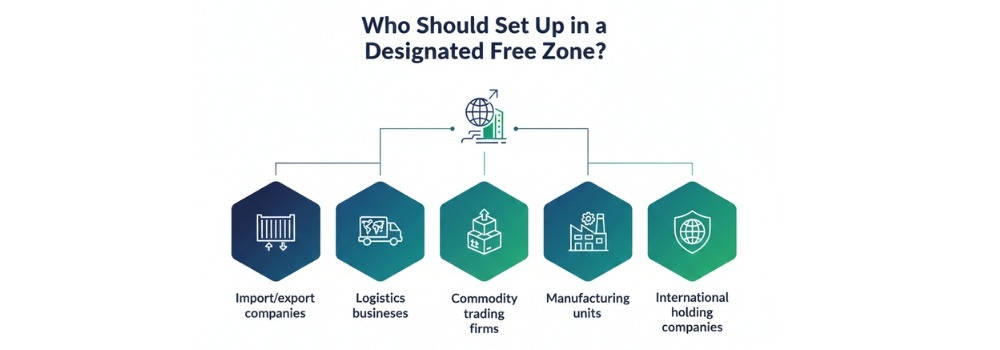
    Who Should Set Up in a Designated Free Zone?

    Choosing the right location for your business setup depends heavily on your industry and how you handle goods. While any free zone offers benefits like 100% ownership, designated free zones in the UAE are specifically designed for companies that need high-volume logistics and tax-efficient trading.

    Import and Export Companies

    If your business moves physical products across borders, a designated zone is almost essential. These zones allow you to bring goods into the country without paying customs duties or the 5% VAT upfront. 

    This setup is perfect for re-exporting, as you can store, repack, or even process goods within the zone and ship them to international markets without ever triggering a local tax bill.

    Logistics Businesses

    Companies that manage warehouses, shipping, and distribution thrive in designated zones in the UAE VAT because of their proximity to major ports and airports. 

    Being in a fenced area with direct customs oversight means you can offer faster turnaround times for your clients. It also simplifies your cash flow, as goods moving between other designated zones remain “out of scope” for VAT.

    Commodity Trading Firms

    Under the latest 2026 rules, commodity traders get significant relief in these zones. Whether you are trading metals, energy, or even environmental commodities like carbon credits, doing so through a designated zone in the UAE often qualifies you for the 0% Corporate Tax rate. 

    This makes the UAE one of the most competitive hubs in the world for large-scale commodity exchange.

    Manufacturing Units

    Manufacturers benefit from the “outside the UAE” status of these zones when importing raw materials. You can bring in the components you need, assemble your products, and then decide whether to sell them locally (paying VAT at the border) or export them globally (staying tax-free). 

    This flexibility is a major reason why industrial giants choose the list of designated free zones in the UAE for their regional bases.

    International Holding Companies

    Even if you don’t handle physical goods, a designated zone can be the right choice for an international holding structure. It provides a stable, highly regulated environment for managing global assets and subsidiaries. 

    As a qualifying free zone person UAE, a holding company can often enjoy 0% tax on dividends and capital gains, provided they meet the substance requirements by having a real presence in the zone.
    Benefits of Operating in a Designated Free Zone

    Setting up your business in a designated zone in the UAE offers more than just a prestigious address. These areas are engineered to support high-growth companies by removing the common financial and administrative hurdles found in many other global markets. From tax savings to complete control over your assets, the advantages are built directly into the free zone law of the UAE.

    VAT Advantages on Goods

    The biggest draw for traders is the unique VAT treatment. In a designated zone, goods are considered “outside the UAE” for tax purposes. This means you can import inventory, store it, or move it between other designated zones in the UAE VAT without paying the 5% tax upfront. 

    This “tax-free bubble” helps you keep your prices competitive and ensures your cash isn’t tied up in tax payments while products are sitting in a warehouse.

    Customs Duty Exemptions

    Operating within the list of designated free zones in the UAE also means you are exempt from customs duties on goods imported for re-export. 

    You can bring raw materials or finished products into the zone, process or store them, and ship them back out to international markets without paying any import duties. This makes the UAE an incredibly cost-effective hub for global supply chains and manufacturing units.

    100% Foreign Ownership

    Unlike some mainland setups that may require a local partner, companies in designated free zones in the UAE enjoy full ownership. You have total control over your business decisions, branding, and operations. 

    This 100% ownership, combined with independent regulations within each zone, gives international investors the confidence to build long-term headquarters in the region.

    Repatriation of Profits

    A major benefit for international firms is the freedom to move money. There are no currency restrictions or hidden taxes when you want to send your earnings back to your home country. 

    You can repatriate 100% of your capital and profits whenever you choose. This financial flexibility, paired with the status of a qualifying free zone person in the UAE, ensures that the wealth your business creates stays in your hands.

    Strategic Port & Airport Access

    Most designated zones in the UAE are physically connected to the country’s world-class infrastructure. For example, JAFZA is built around one of the world’s largest container ports, while DAFZA is located right next to a major international airport. 

    This “gate-to-gate” access means your goods move from the ship or plane directly into your warehouse with minimal transit time, cutting your logistics costs and speeding up your delivery schedules.

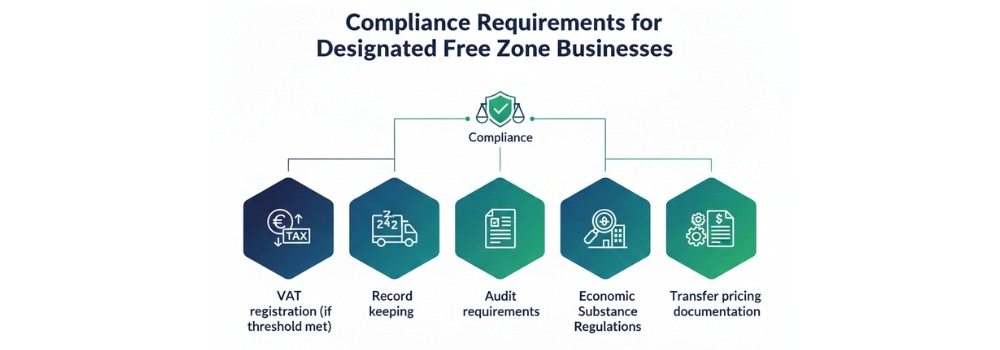
    Compliance Requirements for Designated Free Zone Businesses

    Running a business in a designated zone in the UAE comes with specific responsibilities. The government offers great tax benefits, but in exchange, they expect high levels of transparency and record-keeping. Staying on top of these rules ensures your business keeps its “Designated” status and avoids unnecessary fines.

    VAT Registration

    Even if you operate in a designated zone in the UAE VAT bubble, you must register for VAT if your taxable sales and imports exceed AED 375,000 over 12 months. 

    You can also choose to register voluntarily if your turnover is above AED 187,500. This is often a smart move for startups, as it allows you to reclaim VAT on your startup costs, like office fit-outs or equipment, while staying compliant with the vat registration requirement in UAE.

    Record Keeping

    The free zone law in the UAE is very strict about paperwork. You must keep all your financial records, including invoices, customs documents, and bank statements, for at least five years. These records must be clear enough for the Federal Tax Authority (FTA) to track every item that entered or left your facility. 

    If you move goods between designated zones in the UAE, having the correct “Bill of Entry” and shipping papers is the only way to prove the transaction was tax-free.

    Audit Requirements

    For 2026, most companies in these zones must undergo a yearly financial audit. This is especially true if you want to be a qualifying free zone person in the UAE and claim the 0% Corporate Tax rate

    An independent auditor must check your books to confirm that your income is “qualifying” and that you have followed all local regulations. These audited statements are usually required by the free zone authority to renew your trade license.

    Economic Substance Regulations (ESR)

    If your business performs certain “relevant activities” like shipping, distribution, or acting as a holding company, you must follow Economic Substance Regulations.

    This means you must prove that your business has a real “substance” in the UAE. You do this by showing you have a physical office, a local management team, and that your core activities happen within the designated free zones in the UAE.

    Transfer Pricing Documentation

    If your free zone company does business with sister companies or related partners (like a parent company in another country), you must follow transfer pricing rules. 

    You are required to prove that the prices you charge each other are the same as what you would charge a stranger. For larger firms, this involves keeping a “Master File” and a “Local File” that explain your pricing strategy, ensuring no profits are being unfairly shifted to avoid tax.
    Common Mistakes Businesses Make

    Even with the best intentions, many business owners run into trouble by oversimplifying the tax rules. The free zone law in the UAE is generous, but it is also very specific. 

    Small errors in how you label a transaction or where you store your goods can quickly lead to unexpected tax bills or penalties from the Federal Tax Authority.

    Assuming All Free Zones are Designated

    One of the most frequent errors is thinking that every free zone in the Emirates offers the same VAT benefits. In reality, there is a very specific UAE VAT-designated zone list. 

    If you set up in a popular zone that isn’t officially “designated,” you are treated just like a mainland company for VAT purposes. Always double-check the status of your specific zone before signing a lease or moving inventory.

    Misunderstanding VAT on Services

    Many entrepreneurs believe that being in a designated zone in the UAE makes their entire business “tax-free.” However, the “out of scope” rules almost exclusively apply to physical goods. 

    If you are providing services like consulting, design, or software development, you are usually required to charge the standard 5% VAT, even if your client is also based in a designated zone.

    Improper Invoicing

    Invoicing is where most compliance issues start. To benefit from the 0% rate, your invoices must clearly show the correct tax treatment and include the necessary customs references. 

    If you fail to mention that a transaction is between two designated zones in UAE VAT, or if you miss a mandatory tax ID number, the FTA may view the sale as a standard taxable transaction during an audit.

    Failing to Maintain Stock Records

    Because these zones are “outside the UAE” for tax, the government needs to know exactly what is inside the fence. If your physical stock doesn’t match your digital records, or if you can’t produce the “Bill of Entry” for a specific shipment, you may be accused of “smuggling” goods into the local market. 

    Maintaining a real-time, accurate inventory log is a non-negotiable part of operating in designated free zones in the UAE for VAT benefits.

    Ignoring Corporate Tax Qualification Tests

    With the introduction of new rules for 2026, simply having a license is no longer enough to avoid tax. Many businesses fail to monitor whether they actually meet the criteria to be a qualifying free zone person in the UAE. 

    If you don’t meet the “adequate substance” test or if you earn too much “non-qualifying” income from the mainland, you could lose your 0% tax status and be hit with the standard 9% Corporate Tax rate.

    How to Choose the Right Designated Free Zone in the UAE

    With over 40 options across the Emirates, picking the right location is about more than just finding the lowest price. 

    A designated zone in the UAE should act as a strategic partner for your business, offering the specific tools you need to scale. For 2026, here are the key factors you should weigh before making your decision.

    Type of Business Activity

    The first step is matching your license to the zone’s specialty. Some zones are built for heavy industry, while others focus on high-tech or luxury goods. For example, if you trade in gold or diamonds, the list of designated free zones in the UAE points directly to DMCC. 

    If you are in aviation or electronics, a zone like DAFZA offers a specialized ecosystem where you’ll be surrounded by similar companies and experts.

    Warehousing Requirements

    If you handle physical goods, the quality and size of available warehouses are vital. In a designated zone in the UAE VAT area, your warehouse must meet strict “fenced” security standards to maintain its tax-free status. 

    Some zones offer small “flexi-warehouses” for startups, while others like JAFZA provide massive industrial plots for large-scale manufacturing. Always check if the facility can grow with your business so you don’t have to move as you scale.

    Proximity to Ports

    Time is money in logistics. Choosing a zone close to a major gateway can significantly cut your transport costs and delivery times. 

    Zones like KEZAD in Abu Dhabi offer direct access to deep-water ports, while designated free zones in the UAE, like Dubai South, sit right next to Al Maktoum International Airport. If your business relies on fast shipping, being “gate-to-gate” with a port or airport is a massive competitive advantage.

    Banking Support

    Opening a corporate bank account is one of the biggest hurdles for new businesses. Some zones have stronger relationships with local and international banks, making the “Know Your Customer” (KYC) process much smoother. 

    Established hubs like DMCC and JAFZA are well-recognized by UAE banks, which can lead to faster account approvals and better credit facilities for qualifying free zone person UAE entities.

    Cost Comparison

    While it is tempting to go for the cheapest option, you must look at the total cost of ownership. A license in a northern emirate like Umm Al Quwain or Ras Al Khaimah might have a lower upfront fee, but you need to factor in the cost of visas, office rent, and the “renewal” fees that kick in after the first year. 

    Use the free zone law UAE to your advantage by comparing bundled packages that include your license, office space, and visa quotas in one transparent price.

    Why Work With a UAE Free Zone & Tax Consultant?

    Setting up in a designated zone in the UAE is a smart move for growth, but it requires careful attention to detail. Managing your daily operations while staying up to date with the latest Federal Tax Authority (FTA) updates can be a balancing act. 

    Working with a dedicated tax consultant in Sharjah, like HFA Consulting, allows you to focus on your customers while experts handle the complexities of the tax system.

    Free Zone Selection Advisory

    Picking the right home for your business is about more than just the setup fee. We analyze your trade routes and business goals to find the specific designated zones in the UAE that offer the most strategic advantages. 

    Whether you need a location that simplifies international shipping or one that offers specialized licenses, we provide the data you need to make an informed choice.

    VAT Structuring Strategy

    We help you organize your business transactions to make the most of the UAE free zone VAT rules. By correctly identifying which sales are “out of scope” and which require the standard 5% rate, we protect your cash flow. 

    Our goal is to ensure your supply chain remains tax-efficient without ever stepping outside the legal boundaries.

    Corporate Tax Qualification Support

    Securing a 0% tax rate as a qualifying free zone person in the UAE involves more than just having a license. We review your office setup, staffing, and income streams to ensure you meet the “adequate substance” requirements. 

    We help you stay within the 2026 guidelines so your business can enjoy the maximum tax relief available.

    Ongoing Compliance Management

    The free zone law UAE requires consistent record-keeping and regular filings. From managing your VAT returns to ensuring your annual financial statements are audit-ready, we take the administrative burden off your plate. 

    This ongoing support prevents the small bookkeeping errors that often lead to larger issues during an FTA inspection.

    FTA Representation

    Communication with the authorities should be clear and professional. We act as your bridge to the government, helping with everything from registration to complex tax clarifications. 

    If your business is selected for a routine audit, we provide the documentation and expertise needed to represent your interests and ensure a smooth process.

    Conclusion

    Choosing to operate within designated free zones in the UAE is one of the most effective ways to combine global reach with a highly efficient tax structure. 

    By getting the details right from your initial zone selection to the way you handle every invoice, you can protect your profit margins and ensure your business remains fully compliant with the free zone law in the UAE. 

    As the 2026 regulations continue to evolve, staying informed and organized is the best way to turn these tax rules into a long-term competitive advantage for your brand.

    FAQS

    What is the difference between a free zone and a designated free zone?

    A regular free zone is part of the UAE for VAT purposes. A designated zone in the UAE is a fenced area with customs security that is treated as being “outside” the country for VAT on goods, allowing for tax-free trade and storage.

    Are services zero-rated in designated free zones?

    Usually, no. UAE free zone VAT rules apply the standard 5% tax to services like consulting or management. The “tax-free” status of a designated zone mostly applies to physical goods, not professional services.

    Is corporate tax applicable in designated free zones?

    Yes, but you can often pay 0%. If you are a qualifying free zone person in the UAE with a real office and “qualifying income,” your tax rate is 0%. Otherwise, you may have to pay the standard 9% rate on certain profits.

    Can designated free zone companies trade with the mainland UAE?

    Yes, but it triggers tax. Moving goods to the mainland is treated as an import and requires VAT payment. Additionally, making too much money from mainland clients could affect your 0% corporate tax status.

    Do I need VAT registration?

    Yes, if you meet the limits. Regardless of your zone, you must register if your taxable turnover exceeds AED 375,000. Many businesses register at AED 187,500 to stay ahead of free zone law requirements in the UAE and reclaim costs.


  • How to open an offshore company in Dubai

    How to open an offshore company in Dubai

    Dubai holds a prominent place on the world map as a hub for international commerce, connecting markets across continents with modern infrastructure and a stable political environment. For many business owners, this city provides the ideal setting to structure their operations for global reach and efficiency.

    An offshore company is a legal entity formed in a jurisdiction different from the owner’s place of residence, usually in a location with favorable tax policies. 

    Entrepreneurs choose this structure for asset protection, strict privacy, and the ability to manage international trading without the need for a physical office space inside the city itself.

    Defining the Offshore Structure

    An offshore entity in the UAE is specifically registered to operate outside of the country’s domestic market. While incorporated locally, these companies are not issued operating licenses to trade within Dubai.

    Instead, they receive a Certificate of Incorporation. This legal structure is ideal for international trade, holding investments, and managing intellectual property, allowing 100% foreign ownership without a local sponsor.

    Understanding the Key Differences

    It is essential to distinguish between different company types to choose the right structure for your needs. Understanding the difference between freezone and mainland companies, along with offshore company structures, can help entrepreneurs make informed business decisions.

    FeatureOffshore CompanyFree Zone CompanyMainland Company
    Market AccessInternational onlyFree Zone & InternationalEntire UAE & International
    Physical OfficeNot RequiredRequired (Flexible options)Required
    Ownership100% Foreign100% Foreign100% Foreign (mostly)
    VisasNoYesYes

    Key Offshore Jurisdictions in Dubai

    Choosing the right authority is a vital step for your offshore business setup in Dubai.

    1. Jebel Ali Free Zone Authority (JAFZA Offshore)

    JAFZA is highly prestigious and is preferred by firms involved in global logistics and trade. It is the only authority recognized by the Dubai Land Department for registering property ownership within Dubai. 

    While offshore company formation here is more expensive, it offers unmatched international credibility.

    2. RAK International Corporate Centre (RAK ICC)

    RAK ICC is known for being cost-effective and efficient, making it a popular choice for offshore business setup in the UAE. 

    His jurisdiction is ideal for small to medium-sized enterprises (SMEs) focused on holding assets and international trading, offering a rapid registration process.

    3. Ajman Free Zone (Ajman Offshore)

    Ajman offers budget-friendly offshore company formation in the UAE with straightforward processes. 

    It is suited for businesses seeking low setup costs and minimal administrative burden for their global operations.

    Benefits of Offshore Company Formation in the UAE

    Choosing to structure your business through an offshore company formation in Dubai offers distinct advantages designed to maximize profitability and secure assets for international investors.

    Complete Autonomy and Control

    One of the primary drivers for offshore business setup in Dubai is the capability for 100% foreign ownership. 

    Unlike other structures that may require a local partner, this model allows you to retain full control of your business decisions and operations.

    Strategic Financial Advantages

    The UAE offers significant offshore tax benefits, making it a highly attractive jurisdiction for global commerce.

    • Asset Protection: This legal structure creates a wall between your personal assets and business liabilities.
    • Zero Corporate Tax: In many cases, these entities pay 0% FTA corporate tax on income generated outside the UAE.
    • Privacy: Confidentiality is a cornerstone of this setup, as shareholder details are not part of a public registry.

    Furthermore, these companies provide incredible flexibility for international trade. You can move funds freely without currency restrictions, making it simple to repatriate profits.

    Streamlining Your Operations

    A major operational benefit is that you do not need to rent a physical office in Dubai. This significantly lowers overhead costs. The offshore business setup UAE allows you to manage everything remotely, supported by the country’s robust banking infrastructure.

    When comparing structures, such as Offshore vs Free Zone company in the UAE, the offshore route is specifically bespoke for those who do not require a local UAE address or staff visas, focusing instead on global activities.

    Essential Requirements for Offshore Company Formation

    Launching an offshore business setup in Dubai requires specific documentation to comply with international standards and local regulations. The process is straightforward but demands accuracy to ensure a smooth registration.

    RequirementDescription
    Passport CopiesCertified copies of valid passports for all shareholders and directors.
    Proof of AddressRecent utility bills or bank statements verifying the residential address of all parties.
    Bank Reference LetterA professional letter from your current bank confirming your financial standing.
    Business Activity DescriptionA clear outline of the intended international business activities.
    Minimum Share CapitalThe capital amount must be declared; this amount varies by authority.
    Registered AgentYou must appoint a licensed agent in the UAE to act as your intermediary.

    Step-by-Step Process to Register an Offshore Company

    Executing the offshore company formation process requires following a precise sequence to ensure legal compliance and efficiency.

    Comparison of Key Offshore Jurisdictions

    FeatureJAFZA OffshoreRAK ICCAjman Offshore
    ReputationVery HighHighModerate
    Setup CostHigherCost-effectiveBudget-friendly
    Timeframe5-10 Days2-5 Days2-5 Days
    Property OwnershipAllowed in DubaiNot allowed in DubaiNot allowed in Dubai

    The Registration Journey

    1. Select a Company Name: Your name must be unique and comply with local restrictions (e.g., avoid using “UAE” or “Dubai” directly unless permitted, and include “Limited” or “Ltd” at the end).
    2. Appoint a Registered Agent: This is a mandatory requirement. A licensed agent acts as the intermediary between your company and the authorities.
    3. Submit Incorporation Documents: You must provide the Memorandum and Articles of Association (MOA & AOA), application forms, and KYC documents (passport copies, proof of address) for all directors and shareholders.
    4. Receive Incorporation Certificate: Upon approval, the jurisdiction issues the certificate, usually within 3–10 working days.
    5. Open a Corporate Bank Account: This final step requires comprehensive documentation. While UAE offshore tax benefits are attractive, banks conduct rigorous compliance checks before opening an account.

    Investment Required for Offshore Company Formation in the UAE

    Understanding the financial commitment is crucial before initiating an offshore company formation. Costs vary based on the chosen jurisdiction and the specific services required for your offshore business setup in Dubai.

    Cost Breakdown Table

    Cost ComponentDescription
    Government FeesCharges paid directly to the registry authority for licensing and registration.
    Registered Agent FeesMandatory fees for the licensed agent acting on your behalf in the UAE.
    Bank Account Opening CostsCharges for professional assistance in navigating bank compliance requirements.
    Document AttestationFees for certifying personal and corporate documents for international use.

    Total Expenditure Forecast

    While fees fluctuate, the estimated total cost range for UAE offshore company registration typically falls between 12,000 AED and 25,000 AED for the initial setup.

    Please note that this range does not include the minimum balance requirements for the bank account, which vary by institution. 

    Additionally, when considering Offshore vs Free Zone company in the UAE, offshore setups generally have lower ongoing maintenance fees due to the lack of physical office requirements.

    Operating Limits: Doing Business in the UAE

    While an offshore company formation in the UAE offers immense flexibility for international trade, it comes with strict limitations regarding the domestic market.

    Domestic Restrictions and Real Estate

    An offshore entity is not permitted to conduct commercial activities within the UAE mainland. This means it cannot open a retail store, rent commercial office space, sell products directly to UAE residents, hire staff within the UAE, or sponsor residency visas.

    Despite these restrictions, an offshore business setup in Dubai allows for specific strategic actions. Specifically, a company formed under JAFZA is authorized to hold freehold real estate in Dubai, subject to approval from the Dubai Land Department. Furthermore, these entities are allowed to act as a holding company and own shares in mainland UAE businesses or other free zone entities.

    Structural Comparison Table

    ActivityOffshore CompanyMainland Company
    Trade within the UAEProhibitedAllowed
    Physical OfficeNot PermittedRequired
    UAE Residency VisaNoYes
    Hold Local SharesYesYes

    Strategic Use Cases: Holding and Investment

    The primary purpose of an offshore business setup UAE is not day-to-day operations, but rather asset management and international structuring. 

    This structure is often used to simplify the transfer of assets to heirs without local probate issues, separate valuable assets like intellectual property from operational risks, and invoice international clients while keeping funds in a stable jurisdiction.

    Vital Documentation for Bank Account Opening

    Securing a corporate bank account is a critical final step in your offshore business setup in Dubai. UAE banks maintain high standards for due diligence, requiring a clear and transparent profile of your business and its owners.

    Bank Account Document Requirements

    Document CategoryRequired Items
    Corporate PapersCertificate of Incorporation, Memorandum & Articles of Association (MOA/AOA), and a Board Resolution authorizing the account opening.
    Shareholder IdentityValid passport copies, proof of residence (utility bills), and detailed CVs for all shareholders and directors.
    Business StrategyA comprehensive business plan outlining your company’s goals, target markets, and expected transaction volumes.
    Financial TransparencyA signed source of funds declaration and personal bank statements from the last 6 months to verify wealth.

    Offshore vs Free Zone Company UAE: Finding the Right Match

    Deciding between a freezone company registration and an offshore company formation depends entirely on your operational needs within the UAE. While both offer 100% foreign ownership, they serve very different roles in your business strategy.

    If you require a local presence, residency for your family, or the ability to hire staff, a free zone structure is the appropriate path. 

    However, if your focus is purely international and you want to minimize overhead costs, the offshore route is the most efficient choice.

    FeatureOffshore CompanyFree Zone Company
    Visa EligibilityNo visas issuedYes (shareholder and employee visas)
    Office RequirementNo physical office neededMandatory (flexi-desk or physical office)
    Local TradingProhibited in the UAERestricted to the zone or via a distributor
    Setup CostLow and cost-effectiveMedium to high (includes office and visas)
    ComplianceMinimal (no annual audits usually)Higher (annual audits and license renewals)

    Common Mistakes to Avoid

    While an offshore business setup in Dubai is designed to be easy and simple, many entrepreneurs face setbacks because they overlook specific local rules. Avoiding these common errors will save you time and money during your offshore company formation.

    MistakeConsequenceHow to Avoid It
    Wrong JurisdictionYou might be unable to own a Dubai property or lack international prestige.Choose JAFZA for property or RAK ICC for cost-effective holding.
    Ignoring ComplianceRisk of heavy fines or the company being struck from the registry.Keep records updated and renew your offshore business setup uae on time.
    Banking ChallengesYour company stays “dormant” because you cannot move funds.Prepare a clear business plan and proof of funds before applying.
    Tax MisunderstandingsUnexpected tax liabilities or penalties from the FTA.Research the offshore company VAT UAE and corporate tax rules for your activity.

    Setting Up for Long-Term Success

    Many people assume that UAE offshore tax benefits mean there are no rules at all. In reality, the UAE maintains high standards for transparency. Underestimating the time it takes to open a bank account is a frequent error; banks look for a logical reason why an offshore entity needs an account in the UAE.

    Furthermore, ensure you understand the difference between Offshore vs Free Zone company UAE structures. If you accidentally try to trade within the local market using an offshore license, you could face legal action. 

    By working with a registered agent and staying informed on the latest UAE offshore company registration laws, you can ensure your business remains compliant and simple to manage.

    Who to consult for opening an offshore company in Dubai

    To ensure your business is structured correctly and compliant with the latest 2026 regulations, you should partner with expert business setup consultants in Dubai who understand the nuances of different jurisdictions. 

    Piloting the complexities of documentation, tax registration, and corporate banking requires professional oversight to avoid costly delays or administrative errors. 

    By choosing a specialized firm like HFA Consulting, you gain access to a team that streamlines the entire registration process, from initial name approval to securing your final incorporation certificate, allowing you to focus entirely on your international growth.

    Conclusion

    Dubai holds a prominent place on the world map as a hub for international commerce, connecting markets across continents with modern infrastructure and a stable political environment, making it the ideal setting to structure operations for global reach and efficiency. An offshore company is a legal entity formed in a jurisdiction different from the owner’s place of residence, usually in a location with favorable tax policies, chosen for asset protection, strict privacy, and the ability to manage international trading without the need for a physical office space inside the city itself. 

    To ensure your business is structured correctly and compliant with the latest 2026 regulations, you should partner with expert business setup consultants in Dubai who understand the nuances of different jurisdictions, as navigating the complexities of documentation, tax registration, and corporate banking requires professional oversight to avoid costly delays or administrative errors. 

    By choosing a specialized firm like HFA Consulting, you gain access to a team that streamlines the entire registration process, from initial name approval to securing your final incorporation certificate, allowing you to focus entirely on your international growth.

    FAQS

    How long does it take?

    The entire process generally takes between 2 and 5 working days once all required documentation is submitted to the registered agent. However, opening a corporate bank account can take an additional 2 to 6 weeks, depending on the bank’s compliance checks.

    Is an offshore company legal?

    Yes, offshore company formation is completely legal in the UAE, provided you utilize a licensed registered agent and adhere to the regulations of the specific jurisdiction chosen, such as RAK ICC or JAFZA.

    Can I get UAE residency?

    No, an offshore company does not grant eligibility for a UAE residency visa. If you require residency for yourself or employees, you must establish a free zone or mainland entity instead.

    Do I need to visit Dubai?

    Typically, you do not need to visit Dubai; the entire registration process can be handled remotely through your registered agent. However, some banks may require a personal visit to sign documents for account opening.

    Is an offshore company subject to UAE corporate tax?

    Yes, under the current 2026 regulations, offshore companies must register for corporate tax. They may qualify for a 0% tax rate if they meet strict conditions as a “Qualifying Free Zone Person,” otherwise, a 9% rate applies to taxable income over 375,000 AED.

  • Key Benefits Of Free Zone Company In Dubai You Should Know

    Key Benefits Of Free Zone Company In Dubai You Should Know

    Dubai has become a magnet for ambitious business owners from all over the world. Its location connects the East and the West, making it a perfect spot for anyone looking to grow their reach. Whether you are a small startup or a large company, the city offers a stable and welcoming environment to build your future.

    One of the best ways to get started is by looking into a Free Zone. These are special areas designed to help your business thrive by offering perks you won’t find elsewhere. 

    In this guide, we will look at the simple steps and clear advantages of setting up your company in a Dubai Free Zone.

    What is a Free Zone Company?

    A Free Zone company is a business registered in a designated free zones in the UAE with its own rules and regulations. Unlike a “mainland” company, a Free Zone business setup in Dubai allows you to have 100% ownership of your firm. You don’t need a local partner or sponsor to hold any shares, giving you full control over every decision.

    Why Do Investors Choose Dubai Free Zones?

    People choose these areas because they make forming a Dubai Free Zone company incredibly easy. The paperwork is simple, the costs are clear, and you get to keep all your profits. It is a space where you can focus on your work without worrying about complex taxes or hidden fees.

    100% Foreign Ownership: You’re in Charge

    The biggest draw for any entrepreneur is the ability to have 100% foreign ownership. In a Free Zone, you don’t need a local sponsor or a UAE national to hold a stake in your business. Whether you are a solo freelancer or a growing tech firm, you own 100% of the equity from the moment you receive your license.

    Comparing Free Zone and Mainland Rules

    While Free Zone business setup in Dubai has always offered full ownership, the “Mainland” rules have recently become more flexible too. However, there are still key difference between freezone and mainland:

    FeatureFree Zone CompanyMainland Company
    OwnershipAlways 100% foreign-owned.100% in most sectors, but some still require a local partner.
    Local SponsorNot required.Often replaced by a “Local Service Agent” for some activities.
    Market AccessFocuses on international trade and services.Can trade directly anywhere in the UAE market.
    Setup SpeedVery fast and simple.Can take longer due to multiple department approvals.

    Greater Control Over Your Business Decisions

    When you have full ownership, you have greater control over business decisions. You don’t have to consult with a local partner on your hiring choices, your branding, or where you invest your profits.

    This independence is one of the core benefits of free zone companies in Dubai. It allows you to move at your own pace and keep your business strategy private. Since you aren’t sharing the “driver’s seat,” you can pivot quickly when new opportunities arise in the global market.

    Valuable suggestion: Because you hold all the shares, the Dubai investor visa benefits apply directly to you, making it much easier to manage your residency and your company’s future in one place.

    Tax Advantages

    One of the smartest reasons to choose a Free Zone is the way it helps you keep more of what you earn. Dubai has long been known for its friendly tax environment, and while the rules have updated recently to match global standards, the savings remain a major draw for business owners.

    Under the UAE Free Zone tax regulations, many Free Zone companies can still benefit from attractive tax incentives. These may include 0% corporate tax on qualifying income, no personal income tax, and the ability to fully repatriate profits and capital. Because of these advantages, Free Zones continue to be a preferred choice for entrepreneurs and international investors looking to maximize profitability while operating within a compliant regulatory framework. 💼📈

    Here is a simple breakdown of the tax perks you can enjoy:

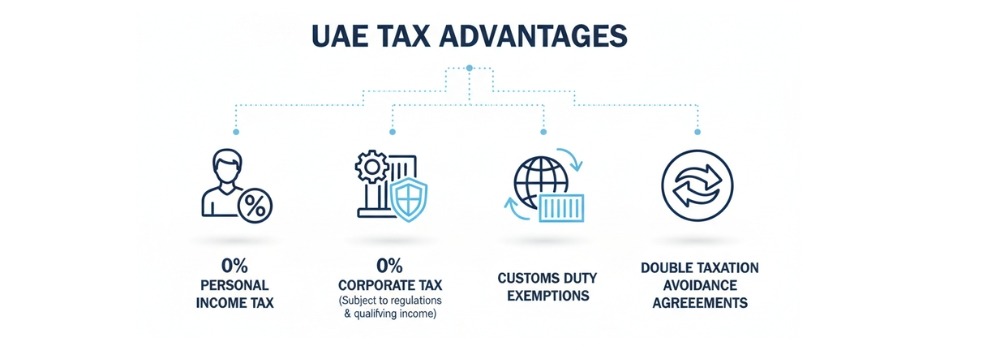
    No Personal Income Tax

    In Dubai, your personal earnings are your own. There is 0% personal income tax, which means the salary you draw from your company stays in your pocket. This applies to both the business owner and their staff, making it much easier to attract top talent from around the world.

    Understanding Corporate Tax (The 0% Rate)

    The UAE recently introduced a federal corporate tax, but Free Zone companies still have a huge advantage. You can still enjoy a 0% corporate tax rate as long as your income is “qualifying.” Generally, this means your money comes from:

    • Trading with other Free Zone companies.
    • Doing business with people outside of the UAE.
    • Certain specific activities, like manufacturing or logistics.

    Even if you have some income that doesn’t “qualify,” you usually don’t pay any tax on your first AED 375,000 of profit. It’s a simple way to help small businesses grow without a heavy tax burden.

    Customs Duty Exemptions

    If your business involves moving goods, a Free Zone business setup in Dubai can save you a fortune. When you bring goods into a Free Zone to be processed, stored, or re-exported, you are often exempt from customs duties.

    • No Import/Export Tax: You don’t pay the standard 5% duty on goods that stay within the Free Zone or go back out of the country.
    • Easy Logistics: This makes Dubai a perfect hub for trading, as you can move products globally without losing money at every border.

    Double Taxation Avoidance Agreements

    The UAE has signed over 140 agreements with other countries to make sure you don’t pay tax on the same income twice. 

    These Double Taxation Avoidance Agreements mean that if you pay tax in one country, you can often get a credit or exemption in the other. This gives international investors a lot of security and makes cross-border business much smoother.

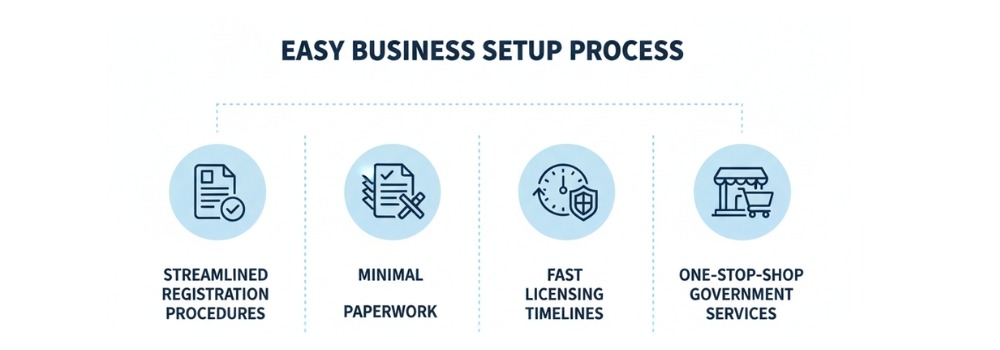
    Easy Business Setup Process

    One of the biggest reasons Dubai is a global favorite for entrepreneurs is that it removes the “red tape.” 

    The government has designed the Free Zone business setup in Dubai to be as smooth as possible, allowing you to focus on your business rather than paperwork.

    For many entrepreneurs researching how to open a business in Dubai, Free Zones offer one of the simplest and fastest paths to company formation. The streamlined procedures, clear regulations, and supportive authorities make the process straightforward even for first-time investors.

    Here is why the setup process is so simple:

    Streamlined Registration

    In 2026, the registration process is almost entirely digital. Most Free Zones use online portals where you can upload documents and sign contracts from anywhere in the world. You don’t need to spend weeks visiting different offices; the system is built to guide you through each step automatically.

    Minimal Paperwork

    Forget about carrying heavy folders of documents. For most setups, you only need a few basic items:

    • A copy of your passport.
    • A simple business plan (often just 1–2 pages).
    • Proof of your home address. The goal is to keep things easy and simple, so you aren’t stuck dealing with complex requirements before you even start.

    Fast Licensing Timelines

    If you have your documents ready, you can often get your trade license in just a few days. Some zones even offer “instant licenses” that are issued in as little as 24 to 48 hours. 

    This speed is perfect for those who want to start their operations and hire staff without waiting for months of approvals.

    One-Stop-Shop Government Services

    Free Zones act as a “one-stop shop” for everything you need. Instead of dealing with different departments for your license, your visa, and your office space, the Free Zone authority handles it all for you.

    • Integrated Services: They manage your Dubai investor visa benefits, health insurance, and even your utility connections in one place.
    • Ongoing Support: Once you are up and running, they continue to help with license renewals and employee visas through a single point of contact.

    Why it matters: This simple approach saves you time and money, making it one of the most efficient types of business setup in Dubai.

    Full Repatriation of Profits and Capital

    For international investors, the ability to move money freely is often the top priority. One of the standout benefits of free zone companies in Dubai is the guarantee that you can send 100% of your capital and profits back to your home country whenever you like.

    There are no restrictions on transferring your earnings abroad. Whether you are looking to reinvest in a global project or move your dividends to a personal account outside the UAE, the process is straightforward. 

    This transparency gives investors total peace of mind, knowing their hard-earned money isn’t “locked” within the local borders.

    Another major advantage is the currency flexibility. Business owners in a Free Zone can conduct transactions in various global currencies, which helps them avoid the costs and risks of constant currency conversion. Since there are no exchange controls, you can manage your international trade and payments with much more freedom.

    This open financial system makes a Free Zone business setup in Dubai the ideal choice for international investors. It creates a bridge between your local operations and your global financial goals, ensuring that your wealth moves as fast as your business does.

    Strategic Location & Global Connectivity

    Dubai is a natural bridge between the East and the West, making it one of the most connected cities on the planet. For any entrepreneur, a Free Zone business setup in Dubai provides a massive advantage because you are perfectly positioned to reach billions of customers. 

    From your office in a Dubai Free Zone, you have easy access to major markets across the Middle East, Africa, Asia, and Europe. This central location means you can manage a global supply chain or offer international services without being limited by your geography.

    The city is home to world-class airports and seaports that keep your business moving 24/7. Jebel Ali Port is one of the largest and most efficient shipping hubs in the world, while Dubai International Airport connects you to hundreds of cities in just a few hours. 

    These facilities are designed to handle everything from small e-commerce parcels to massive industrial shipments with total ease.

    Beyond the ports, the city offers a strong logistics and infrastructure network that is built for the future. High-speed roads, advanced telecommunications, and modern warehouse facilities are standard features of Dubai Free Zone company formation. 

    Whether you are shipping physical goods or running a digital consultancy, the local infrastructure ensures your operations never slow down. This level of connectivity is exactly why so many different types of business setups in Dubai continue to thrive year after year.

    Wide Range of Business Activities

    One of the best things about a Free Zone business setup in Dubai is that there is a place for almost every type of work. Whether you are selling physical goods, offering expert advice, or building the next big app, the system is designed to support you. You can choose from thousands of permitted activities, which makes it easy to find a category that matches exactly what you do.

    The city is home to several industry-specific Free Zones. These are dedicated hubs where like-minded businesses gather to share resources and ideas. For example, if you are in the tech world, you might look at Dubai Internet City. 

    If you are a creator, Dubai Media City is a perfect fit. There are also specialized zones for healthcare, education, gold and diamonds, and even flowers. By joining a zone that matches your industry, you get access to facilities and networks that are built specifically for your needs.

    You also enjoy great flexibility in your business operations. As your company grows, it is easy to add new activities to your license or upgrade your setup. This adaptability is one of the key benefits of free zone companies in Dubai, as it allows you to test new ideas and pivot your business without starting from scratch.

    From UAE Free Zone license types like commercial and industrial to professional and e-commerce, the options are wide open. This variety ensures that every entrepreneur, from a solo freelancer to a large corporation, can find a home that fits their goals perfectly.

    Modern Infrastructure & Facilities

    In 2026, Dubai remains a world leader by providing a workspace that is ready the moment you are. A Free Zone business setup in Dubai gives you more than just a legal license; it gives you a physical home designed for success. 

    Whether you need a massive storage hub or just a quiet place to laptop-work, the infrastructure here is built to be easy and simple to use.

    Ready-to-Use Office Spaces and Warehouses

    If your business needs a physical presence, you can find high-quality, furnished offices that are ready for move-in. Many zones offer “ready-mixed” setups where the furniture, lighting, and utilities are already set up. 

    For those in trade, specialized warehouses with temperature control and easy loading docks are available right next to major transport hubs like Jebel Ali Port. This means you can start your operations without waiting months for construction or fit-outs.

    Co-working Spaces and Flexi-Desks

    For startups and freelancers, a full office might be more than you need. That is why most Free Zones offer flexible options like co-working spaces and flexi-desks. These shared environments are great for keeping costs low while still giving you a professional business address. You get access to:

    • Comfortable workstations.
    • Professional meeting rooms to host clients.
    • Community lounges where you can meet other founders.
    • Shared printing and reception services.

    Advanced Telecom and IT Infrastructure

    Running a modern business requires a fast and reliable connection. Dubai’s Free Zones are equipped with some of the best IT systems in the world. You can expect high-speed internet and secure data centers as a standard feature. 

    This advanced setup is perfect for tech companies, digital marketers, and anyone who relies on staying connected with global clients 24/7.

    By choosing a Dubai Free Zone company formation, you are plugging into a system that handles the technical side for you. This allows you to focus on your core work while the city provides the power and connectivity to keep you moving forward.

    Networking & Business Ecosystem

    Building a business is as much about who you know as what you do. One of the hidden benefits of free zone companies in Dubai is the community you become a part of. 

    These zones aren’t just office buildings; they are active hubs where you are surrounded by thousands of international companies. This environment makes it easy to find new partners, clients, or suppliers just by walking down the hall or attending a local event.

    The city has carefully created industry clusters and innovation hubs. This means if you are in a specific field, like technology or media, you will be surrounded by people doing similar work. This “clustering” helps ideas flow faster and leads to more collaboration. 

    You gain access to a pool of global talent and companies that are all looking to grow in the same direction, which is a major advantage of Dubai Free Zone company formation.

    On top of the private sector energy, you also benefit from strong government support initiatives. The UAE government frequently launches programs to help small businesses and startups thrive. 

    From funding opportunities to workshops and networking galas, these initiatives are designed to make your journey easy and simple. 

    Whether it is through a mentorship program or a trade mission, you are never truly on your own when you choose a Free Zone business setup in Dubai.

    No Currency Restrictions

    One of the most practical benefits of free zone companies in Dubai is the total freedom you have over your money. Unlike many other global business hubs, Dubai does not place hurdles between you and your capital. 

    You can enjoy free currency exchange, which means you can hold, send, and receive money in various global currencies without extra state-imposed limits.

    This system is built on the stability of the UAE Dirham (AED), which is pegged to the US Dollar (USD). Since the rate remains fixed and predictable, you don’t have to worry about sudden drops in value affecting your business savings. 

    This stability makes it much easier to plan your long-term budget and manage international contracts with confidence.

    For any Free Zone business setup in Dubai, this lack of currency restriction is a major win. It allows you to pay global suppliers, receive payments from overseas clients, and manage your wealth without the stress of fluctuating exchange rates. It is another way the city keeps things easy and simple for the international business community.

    Confidentiality & Asset Protection

    Privacy is a core part of a professional business strategy. A Free Zone business setup in Dubai provides a secure environment where your sensitive information and hard-earned assets are protected by law. 

    This high level of privacy is a major reason why international investors choose the UAE as their base for global operations.

    Business Privacy

    When you form a company in a Free Zone, your business details are not made available for public inspection. Unlike some jurisdictions where anyone can search for a company and see who owns it, Dubai Free Zones prioritize the protection of shareholder information. 

    While you provide these details to the Free Zone authority to stay compliant, they are kept in a secure, non-public registry. This ensures that your private business matters stay private.

    Secure Regulatory Framework

    Every Free Zone operates under a secure regulatory framework designed to protect your investments. These zones have their own set of laws that follow international standards, giving you a predictable and stable environment to work in.

    • Asset Protection: Your business assets are legally separate from your personal ones, providing a layer of safety.
    • IP Protection: There are clear rules to help you register and protect your trademarks and patents.
    • Dispute Resolution: Many zones have their own courts to ensure any business disagreements are handled fairly.

    Who to Consult for a Free Zone Company in Dubai

    If you are ready to turn your vision into a reality, it is important to have the right experts by your side. HFA Consulting is a trusted partner that makes the entire process of Free Zone business setup in Dubai seamless and stress-free. 

    As leading business setup consultants in Dubai, they handle everything from choosing the right jurisdiction to managing your paperwork and licensing. Their team ensures you remain fully compliant with local rules while you focus on growing your brand in one of the world’s most dynamic markets.

    Conclusion

    Choosing a Dubai Free Zone is one of the most effective ways to build a secure and profitable business. By offering 100% ownership, zero personal income tax, and full control over your profits, these zones remove the usual barriers to international success. 

    This simple and efficient system is exactly why Dubai Free Zones are ideal for startups and global investors who want to move fast without getting tangled in paperwork. With a stable economy and world-class infrastructure, the long-term growth potential in Dubai is unmatched, providing a reliable home for your business to thrive for years to come.

    FAQ’s

    What are the disadvantages of free zone companies in Dubai?

    The main limitation is that you cannot trade directly with the Dubai mainland market without a local distributor or agent. Additionally, certain professional services may be restricted to working only within the zone or internationally.

    What does a free zone company mean in Dubai?

    A free zone company is a business registered in a specific economic area that has its own set of rules and regulations. These zones are designed to encourage foreign investment by offering 100% ownership and tax benefits.

    Do Freezone companies pay tax in Dubai?

    Most enjoy 0% personal income tax and can qualify for 0% corporate tax on their “qualifying income.” However, they must still register for corporate tax and may be subject to a 9% rate on taxable profits above AED 375,000 if the income is not qualifying.

    What is the difference between Freezone Company and LLC?

    A Freezone company allows for 100% foreign ownership but is restricted to trading within the zone or abroad. A Mainland LLC (Limited Liability Company) allows you to trade anywhere in the UAE, but may have different licensing requirements depending on the activity.

    What are the different types of business setups in Dubai?

    The three primary types of business setup in Dubai are Free Zone, Mainland, and Offshore. Within these, you can choose from various licenses such as commercial, professional, industrial, or tourism-based.

    What is the difference between Free Zone, Mainland, and Offshore companies in the UAE?

    Free Zone companies offer full ownership and tax perks but limited local market access. Mainland companies can trade anywhere in the UAE. Offshore companies are used for asset protection or holding purposes and cannot carry out business within the UAE itself.

    What is the advantage of setting up a Free Zone company in Dubai?

    The primary benefits of free zone companies in Dubai include 100% foreign ownership, full repatriation of capital and profits, 0% personal tax, and a very simple and fast setup process.

  • How To Claim Vat Refund In UAE For Business​

    How To Claim Vat Refund In UAE For Business​

    Ever feel like your business is leaving money on the table every time you pay a bill? In the UAE, that “extra” 5% you pay on office rent, supplies, and services doesn’t have to be a permanent expense for your company.

    Claiming your VAT refund is more than just a paperwork hurdle; it is a vital move to protect your cash flow. If your input tax exceeds your output tax, the government owes you, and it’s time to get that money back where it belongs.

    Let’s explore the blog to understand exactly how you can reclaim your funds and keep your business finances in top shape.

    Understanding VAT in the UAE

    Before you hit the claim button, you need to know how the system works. Taxes can be confusing. The UAE makes it pretty easy for business owners.

    The UAE has a system that’s not too hard to understand.

    What is VAT?

    VAT is a tax on the things we buy. The services we use. In the UAE, this tax is 5%. This 5 per cent tax is added at each step when things are bought and sold.

    As a business, you help the government collect taxes. You take taxes from your customers. You pay taxes to the people you buy things from. 


    The difference between the taxes you take and the taxes you pay will decide if you owe the government money or if you get money back.

    Who Needs to Register for VAT?

    Not all new businesses need to register away. The Federal Tax Authority has rules to make things fair for businesses.

    There are rules to follow:

    • Mandatory Registration: You have to register if the things you sell and the things you bring into the country are worth more than AED 375,000 in the last 12 months.
    • Voluntary Registration: You can choose to register if the things you sell or your business expenses are more than AED 187,500. This also falls under the VAT Registration Requirement.

    If you want to get a VAT refund for your company in the UAE, you need to be registered and have a Tax Registration Number. If you are not registered, you cannot get back the 5 % tax you pay for your business costs.

    Note: It is very important to remember that if you do not register when you are supposed to, you could get in trouble and have to pay penalties. It is better to follow the rules from the start.

    What is a VAT Refund for Businesses?

    In terms of a VAT refund claim, the process involves getting money back from the Federal Tax Authority. This happens when your business paid Value-Added Tax on its expenses trather han it from customers.

    Instead of this money being a “cost” to your business, the UAE government allows you to reclaim it to keep your cash flow healthy.

    Definition of Input VAT vs Output VAT

    To get a refund, you have to know what these two things mean.

    Input VAT: The tax you pay when you buy things for your business, like a laptop or office rent. You pay five % tax on these things.

    Output VAT: The tax you charge to your customers when you sell them something. You also charge them a five per cent tax on the things you sell.

    So Input VAT is the tax you pay. Output VAT is the tax your customers pay to you.

    Essentially, you are a middleman. You collect tax for the government (Output) and deduct what you’ve already paid (Input).

    When a VAT Refund Occurs 

    A VAT refund UAE situation occurs when your Input VAT is greater than your Output VAT.

    For example, if you spend heavily on new equipment (paying lots of Input VAT) but your sales for that month are lower (collecting less Output VAT), you end up with a “negative” tax balance. This balance is what the FTA owes you.

    Difference Between VAT Refund and VAT Carry Forward

    When you have a credit balance, you have two choices:

    1. VAT Refund: You submit a formal request to the FTA, and they send the cash directly to your business bank account.
    2. VAT Carry Forward: You leave the credit in your FTA account. This balance will then be used to pay off the tax you owe in the next filing period.

    Eligibility Criteria for VAT Refund in the AE

    You do not get your money back from the FTA easily. The Authority needs to see that you are eligible for a VAT refund. 

    They are very particular about the documents you need to show now that there are new rules from the 2026 reforms. These new rules say you can only claim credits for a certain period of time, which is five years.

    To get your UAE VAT refund for business without any problems you need to make sure you meet these requirements, for a UAE VAT refund:

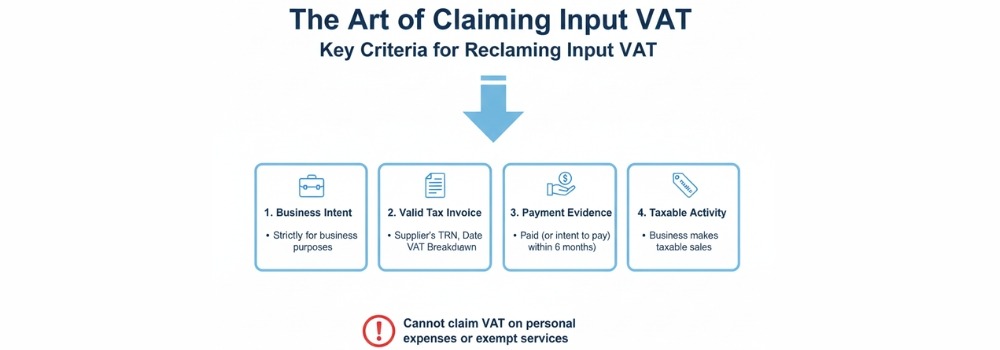
    1. Valid VAT Registration with the FTA

    You cannot claim a refund if you aren’t officially in the system. Your business must have a valid Tax Registration Number (TRN). If you are a foreign business visitor, you must use the specific “Business Visitor Refund Scheme” during its annual open window.

    2. Proper Tax Invoices

    This is where most businesses stumble. For a successful input VAT claim in the UAE, your invoices must be “FTA-compliant.” This means they must clearly show:

    • The words “Tax Invoice.”
    • Supplier’s name, address, and TRN
    • Your business name and address
    • A breakdown of the VAT amount (5%)

    3. Accurate Accounting Records

    The FTA can request an audit at any time during the refund process. You must maintain digital records of all purchase receipts, credit notes, and ledger entries. In 2026, the FTA will have even more power to deny claims if your “traceability” is weak, so keep your books spotless.

    Following proper accounting standards in UAE is essential to ensure your records are compliant and to avoid issues during audits.

    4. Timely VAT Return Filing

    You can only request a refund after you have successfully submitted your VAT return for that period. If you have any VAT return filing UAE gaps or outstanding penalties, the FTA will likely put your refund on hold until your account is cleared.

    5. Bank Account Registered with FTA

    The money doesn’t come as a check; it’s a direct transfer. You must provide a Bank Account Validation Letter (stamped by your bank) that matches your registered business name. If the names don’t match perfectly, the system will reject the payment.

    Documents Required to Claim VAT Refund

    The Federal Tax Authority (FTA) doesn’t just take your word for it; they need hard evidence. In 2026, the digital auditing process is faster than ever, but it’s also more precise. If your paperwork is missing one thing, you will have to wait a long time to get your VAT refund.

    To make sure everything goes well, you need to have these five important papers ready on your computer so you can send them in:

    1. VAT Registration Certificate

    This is your “identity card” in the tax system. It proves your business is a legal tax entity with a valid Tax Registration Number (TRN). Ensure the name on this certificate matches your trade license and bank account exactly.

    2. Tax Invoices

    You must provide clear copies of all invoices where you paid 5% tax. A valid invoice for an input VAT claim in the UAE must show the supplier’s TRN, the date of the transaction, and the specific VAT amount charged.

    3. Customs Documentation (If Applicable)

    If your business imports goods into the UAE, you likely paid VAT at the port. You will need your Official Import Documents and the Customs Declaration forms to prove that this tax was settled at the border.

    4. Financial Statements

    The FTA may ask for your trial balance, profit and loss statement, or a general ledger extract for the period you are claiming. This helps them verify that the numbers in your VAT return filing in the UAE match your actual business activity.

    5. Bank Account Details (IBAN Letter)

    The FTA only sends refunds to validated accounts. You must provide an original IBAN Letter or a bank statement stamped by your bank.

    Critical Check: The account name must be the same as the legal business name registered with the FTA. If you use a personal account for a corporate refund, the transfer will fail.

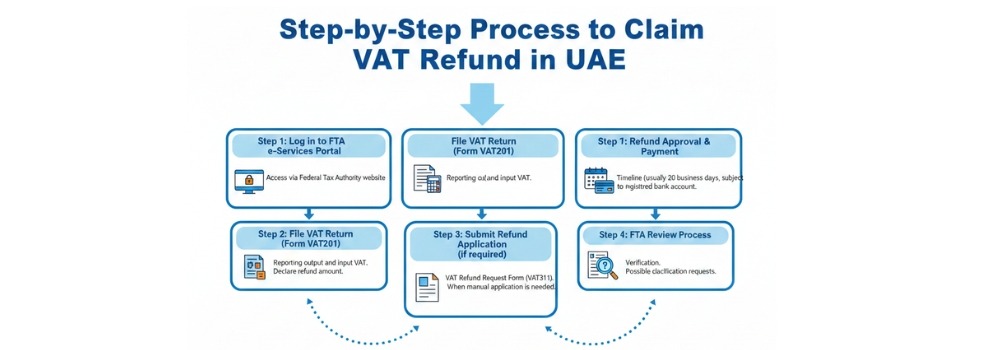
    Step-by-Step Process to Claim VAT Refund in the UAE

    Reclaiming your money is a digital journey. In 2026, the VAT refund process in the UAE is faster thanks to the EmaraTax platform, but you must follow the sequence perfectly to avoid being flagged.

    Step 1: Log in to FTA e-Services Portal

    Start by visiting the official Federal Tax Authority (FTA) website. You can log in using your registered email and password or your UAE Pass. Once inside, you’ll see your dashboard with your current “Taxable Person” account.

    Step 2: File VAT Return (Form VAT201)

    You need to file your VAT201 form before you can get a refund.

    You have to fill out this form to show what you owe.

    You will need to write down your Output VAT, which is the tax you collected from sales, and your total Input VAT, which is the tax you paid when you made purchases.

    Then you need to say if you want a refund. At the end of the form, you will see how much tax you owe overall, which is called the Net Tax amount. If this number is negative, the system will ask you what you want to do. You can. Ask for a refund or save the credit for next time. You should choose Refund.

    Step 3: Submit Refund Application (VAT311)

    Submitting the VAT201 isn’t enough to get the cash; it only records the credit. You must then:

    • Navigate to the VAT tab and select VAT Refunds.
    • Open Form VAT311 (the specific request form for a business VAT refund process in the UAE).
    • Fill in the amount you wish to reclaim. You can claim the full amount or just a portion.

    Step 4: FTA Review Process

    Once you submit your application, it goes to the “Verification” stage.

    The Audit Check is a part of this process. The FTA might send you a message asking for invoices or a trial balance.

    You should be responsive when the FTA contacts you. If the FTA sends you a request to clarify something, you need to answer within the time they give you. If you wait too long to answer, it can slow down the review of your application. The FTA will have to start the review process over again.

    Step 5: Refund Approval & Payment

    The FTA typically takes 20 business days to issue a decision. If approved:

    • You will receive an email confirmation.
    • The money is credited directly to your registered bank account, usually within 5 business days post-approval.

    VAT Refund Timeline in the UAE

    Waiting for a refund is really tough. It is even tougher when you need that money for your business plans.

    In 2026, the FTA started using an automated system, but people are still reviewing things to make sure everything is okay before they give you your refund from the FTA.

    Standard Processing Time

    When you click the submit button for your VAT refund claim, the time starts passing. Here is what usually happens next, with your VAT refund claim:

    • FTA Review: Usually takes 20 to 45 working days. During this window, the Authority verifies your numbers against your filed returns.
    • Payment Disbursement: Once approved, the funds are typically transferred to your registered bank account within 5 business days.

    Factors Affecting Delays

    If your refund is taking longer than two months, it is usually because of one of these problems.

    The main issues are:

    • Verification Requests:  If the Federal Transit Administration asks for invoices or extra information, the forty-five-day time limit often stops until you give them the documents. Your refund will wait until the Federal Transit Administration gets the information it needs from you.
    • Bank Account Mismatches: If your bank account title differs slightly from your registered TRN name, the UAE Central Bank may reject the transfer.
    • First-Time Claims: Initial refund requests often undergo a more “deep-dive” audit than subsequent claims, leading to a slightly longer wait.
    • Public Holidays: You should remember that the time frame of 20 to 45 days is talking about the days when people are at work, so it does not include weekends or the official holidays in the United Arab Emirates.

    How to Track Refund Status

    You do not have to wait in the dark. You can track your UAE VAT refund for business now through the EmaraTax portal:

    1. Dashboard View:  When you log in to the portal, your “Refunds” tab will show you a status bar. This bar will tell you if your refund is, Under Review” or “Approved”.
    2. Email Alerts: The Federal Tax Authority sends you emails whenever your refund status changes. So make sure the email address you registered in the portal is one that you check every day, so you get updates on your UAE VAT refund.
    3. Support Tickets: If your claim exceeds the standard 45 working days without any communication, you can raise a “Technical Support” ticket directly within the portal to ask for an update.

    Common Reasons for VAT Refund Rejection

    You can have the plans for your business, but sometimes things do not go as you want them to. The Federal Tax Authority made some changes in 2026. Now they use computers to check for problems, which means they can find mistakes right away.

     If you want to get your VAT refund in the United Arab Emirates without any issues, you need to know what can go wrong with the VAT refund process in the UAE, so your business VAT refund process in the UAE can keep moving.

    1. Incorrect Invoice Details

    This is the number one culprit. A “Tax Invoice” in the UAE is a legal document with specific requirements. Your claim will likely be rejected if:

    • The invoice is not titled “Tax Invoice.”
    • Your TRN is missing or incorrect.
    • The VAT amount is not shown as a separate line item.
    • The supplier’s details are outdated or invalid.

    2. Mismatch in VAT Returns

    The FTA’s system cross-references your VAT return filing in the UAE with your refund request. If you claim AED 10,000 on your refund form (VAT311) but your filed return (VAT201) only shows a credit of AED 8,000, the system will trigger an automatic rejection or a deep-dive audit.

    3. Non-Compliance with FTA Regulations

    If your business is involved in “blocked” expenses, don’t try to claim them. For example, VAT on entertainment services (like staff parties or client dinners) or personal motor vehicles is generally non-recoverable. Including these in your VAT refund claim can lead to the entire application being denied.

    4. Late Filing Penalties

    In 2026, the FTA is stricter about “clean” accounts. If you have unpaid penalties for late registration or late filing, the FTA may reject your refund request until these liabilities are settled. They may also choose to “offset” your refund against what you owe in fines.

    5. Incomplete Documentation

    When the FTA asks for “Alternative Evidence” or bank letters, they expect a specific format. Submitting a blurry scan of a receipt or a bank statement that doesn’t show your IBAN clearly is a fast track to rejection.

    VAT Refund vs. VAT Carry Forward: Which is Better?

    When you have to choose between getting your money right away and using your credit later, you need to think about how well your business is doing now and what you want to achieve in the long run. The new rule that says credits can only be used for five years, which starts in 2026, makes this decision really important.

    The following table shows you the differences between the two options to help you decide on your credits and your business:

    FeatureVAT Refund (Cash Payout)VAT Carry Forward (Credit)
    Cash Flow ImpactHigh. Boosts your bank balance immediately for reinvestment.Low. Only benefits you when you have future taxes to pay.
    ComplexityHigh. Requires filing Form VAT311 and often involves an FTA audit.Low. Automatic process with zero extra paperwork.
    Wait Time20–45 business days for review and payout.Instant. The credit is applied to your next tax return.
    Risk of ExpiryLow. Once paid, the money is yours permanently.High. Under the 2026 rules, credits expire after 5 years if unused.
    Best For…Startups, exporters, and companies with large one-time expenses.Stable companies with consistent monthly tax liabilities.

    When to Choose a Refund

    You should opt for a VAT refund claim if your business falls into these categories:

    • Exporters: Since you charge 0% VAT, you will almost always have a credit balance.
    • Large Capital Investment: If you just bought heavy machinery or a new office, the 5% you paid back is a significant sum of money.
    • Cash Flow Needs: If your business is in a growth phase and needs every Dirham for operations.

    When to Carry Forward

    Carrying forward is often the “stress-free” choice in these scenarios:

    • Small Amounts: If the refund is less than AED 1,000, the time spent on the application might not be worth the administrative cost.
    • Consistent Sales: If you know you will owe the FTA money next month, carrying the credit forward simply acts as a “pre-payment,” saving you from a bank transfer later.

    Tips to Ensure Faster VAT Refund Approval

    In 2026, the Federal Tax Authority (FTA) moved toward a “real-time” audit model. While the system is faster, it is also much less forgiving. 

    If you want your VAT refund UAE processed without the typical 45-day wait, follow these expert-backed strategies:

    1. Maintain Organised Digital Bookkeeping

    The FTA now uses advanced data analytics to cross-check your filings. If they request a sample of your invoices, they expect a professional, digital audit trail.

    • The 5-Year Rule: Since January 1, 2026, the FTA has enforced a strict five-year limit on all records. If your digital folders are messy, you risk failing a spot check and losing your input VAT claim in the UAE.

    It’s highly recommended to follow a bookkeeping checklist to ensure all invoices, receipts, and ledger entries are properly organised and compliant.

    2. Reconcile VAT Monthly (Even if You File Quarterly)

    Don’t wait until the end of the quarter to check your numbers. Reconciling your sales and purchases monthly allows you to catch errors like a missing TRN or an incorrect tax rate before they become permanent on a filed return. This ensures your VAT return filing UAE is flawless every time.

    3. Verify Supplier Integrity (Beyond the TRN)

    As of 2026, the “should have known” rule is in full effect. The FTA now expects you to perform due diligence on your suppliers.

    Action: Don’t just check if a TRN is valid on the portal; ensure the supplier actually has a physical presence and “commercial substance.” If your supplier is involved in tax evasion, the FTA can legally deny your business VAT refund process in the UAE.

    4. Respond Quickly to FTA Queries

    If the FTA sends a “Clarification Request” through the EmaraTax portal, the clock on your refund stops.

    • The 20-Day Window: You typically have a small window to provide the requested documents. If you respond within 24–48 hours with clear, organised PDFs, it signals to the tax officer that your business is compliant, often leading to faster approval.

    5. Work with a Registered Tax Consultant

    Tax laws in 2026 have become more integrated with Corporate Tax and E-invoicing mandates. A registered consultant doesn’t just “do the math”; they act as a shield. They can pre-audit your VAT refund claim to find red flags that would otherwise trigger a long and expensive FTA audit.

    Choosing the Right VAT Consultant for Your Business

    When you think about making sure your company is safe financially, HFA Consulting is the one that can help you with this. They are very good at dealing with tax things, and they know a lot about what is going on in the local area.

    Their team in Dubai is really good at helping with VAT consultancy services in Dubai and they do not just look at numbers. They try to make sure you have money, and they make sure you have all the right papers when you apply for a refund.

    If you work with HFA Consulting, you will have a team that always knows what is new, with the FTA and their rules that are changing in 2026. This means you will have a partner that really cares about your business and wants to help you avoid getting in trouble and get backas much tax money as you can.

    Conclusion

    Claiming your VAT refund is a powerful way to reinvest in your company, provided you follow the digital steps accurately and keep your documentation spotless. 

    By mastering the balance between input and output tax and staying strictly compliant with FTA regulations, you protect your business from unnecessary losses and audits. 

    While the process is more streamlined in 2026, the complexity of new deadlines and verification rules means that even a small mistake can lead to a rejection.

    If you want to ensure your application is handled with total precision, it is always a smart move to consult with experienced professionals who can secure your funds and keep your cash flow thriving.

    FAQS

    How long does it take to get a VAT refund in the UAE?

    In 2026, it normally takes around 20 to 45 business days to get a VAT refund claim processed. When the Federal Tax Authority approves your VAT refund claim, you usually get your money back in your bank account within 5 business days after the Federal Tax Authority has approved your VAT refund claim.

    Can I claim a VAT refund without being VAT registered?

    For businesses that are registered, there is nominimum amount that you have to meet for a standard VAT refund in the UAE. However, a lot of businesses choose to wait until they have an amount to claim back. For people who are visiting from countries for business, the minimum amount you can claim back is usually two thousand UAE dirhams or AED 2,000, for the Foreign Business Visitor Scheme.

    Is there a minimum amount required to claim a refund?

    For businesses that are registered, there is no amount required to apply for a standard VAT refund in the UAE. Many businesses choose to carry smaller amounts, though. The Foreign Business Visitor Scheme has a rule. To qualify, you usually need to claim a minimum of AED 2,000.

    How do I check my VAT refund status?

    You can track your application in real-time through the EmaraTax portal. Simply log in, navigate to the “VAT” tab, and select “VAT Refunds.” Your dashboard will display the current status, such as “Under Review,” “Pending Information,” or “Approved.”

    What happens if my refund is rejected?

    If your business VAT refund process in the UAE is rejected, the FTA will provide a reason for the decision. You have the right to submit a “Request for Reconsideration” within 45 business days. Correcting documentation or addressing clerical errors often resolves these issues during the appeal process.

  • Zero-Rated VAT in the UAE: Complete Guide for Businesses

    Zero-Rated VAT in the UAE: Complete Guide for Businesses

    Ever feel like VAT is a maze with no exit? In the UAE, most things come with a 5% tax tag. But did you know some businesses pay 0% and still get their money back?

    It sounds like a dream, but it’s actually a key part of the Federal Tax Authority (FTA) rules. If you’re a business owner, knowing the ins and outs of zero-rate VAT in uae isn’t just about following the law; it’s about protecting your cash flow.

    In this guide, we’ll break down exactly what zero-rated supplies are, how they differ from “exempt” items, and why your invoice format matters more than you think

    What is Zero-Rated VAT in the UAE?

    Think of zero-rate VAT in uae as a “tax-free” status that still keeps you in the game. Under the rules of the Federal Tax Authority (FTA), some goods and services are taxed at exactly 0%.

    Even though the customer pays nothing in tax, these are still considered taxable supplies. This is a massive win for your business! Why? Because it means you are still eligible to reclaim the input VAT you paid on your own business expenses (like rent, utilities, or stock).

    Essentially, you don’t charge your customers VAT, but the government still lets you get your tax money back on the costs you incurred to run your business.

    Difference Between Zero-Rated and Exempt VAT in the UAE

    This is where many business owners get a bit confused. If the customer isn’t paying any tax in either case, does it really matter which one you use?

    The answer is a big YES. The difference between zero-rated and exempt vat in uae mostly affects your wallet and how you deal with the FTA. 

    While both result in a 0% tax charge for the buyer, the “behind-the-scenes” rules for your business expenses are completely different.

    Quick Comparison Table

    FeatureZero RatedExempt
    VAT Rate0%No VAT (Not Taxable)
    Input VAT RecoveryAllowed (Get your money back!)Not Allowed (You bear the cost)
    Tax ReturnsMust be reported to the FTAReported differently/No recovery
    RegistrationIncluded in your taxable turnoverNot included in taxable turnover

    List of Zero-Rated Supplies in the UAE

    The UAE government uses the zero-rate VAT in uae to support key industries and keep the country competitive. If your business falls into one of these categories, you can charge 0% VAT while still reclaiming the tax you paid on your business costs.

    Here are the most common zero-rated supplies in uae vat:

    A. Export of Goods & Services

    Selling to customers outside the GCC? This is the most common example. Whether you are shipping physical products or providing remote consulting services to a client in Europe or the US, these transactions are typically zero-rated.

    B. International Transportation

    Think big air, sea, and land. If you are transporting passengers or goods that start or end outside the UAE, it’s a 0% rate. This also includes related services, like supplying fuel to an international aircraft.

    C. Healthcare Services

    The FTA wants to keep life-saving care affordable. Most “preventive and curative” healthcare services are zero-rated. This covers everything from doctor consultations to essential medicines and medical equipment.

    D. Education Services

    Education is a priority. Services provided by nurseries, schools, and higher education institutions owned or funded by the government are part of the list of zero rated vat in uae. This usually includes the supply of educational materials like printed books, too!

    E. Residential Real Estate (First Supply)

    Timing is everything here. The first supply (sale or lease) of a new residential building within 3 years of its completion is zero-rated. This helps developers recover their construction costs.

    Quick Check: Did you know that after those first 3 years, the same residential property usually becomes “exempt”? This is a classic example of the difference between zero-rated and exempt vat in uae.

    Conditions to Apply Zero Rating

    Think of zero rating as a “reward” for being a compliant business. It’s not enough to simply say your service is tax-free; you have to prove it. The Federal Tax Authority (FTA) is very strict about this. 

    If you can’t show the right paperwork, they might treat your sale as a 5% supply, and that money comes out of your pocket!

    To successfully apply zero-rate VAT in uae, you must meet these four key conditions:

    1. Proper Documentation

    This is your foundation. You need to keep every piece of evidence that shows the transaction qualifies for 0%. This isn’t just about the sale itself; it’s about the context. For example, if you are zero-rating a service, you need to prove the recipient is actually based outside the UAE.

    2. Tax Invoices

    Even at 0%, you are still making a taxable supply. You must issue a valid FTA tax invoice format that clearly states:

    • The VAT rate is 0%.
    • The total amount of tax is AED 0.00.
    • A brief mention of why it’s zero-rated (e.g., “Export of Goods”).

    3. Proof of Export

    If you’re shipping goods, the FTA needs more than just your word. You must keep “Official” and “Commercial” evidence.

    • Official Evidence: Customs declarations and exit certificates issued by the local Customs Department.
    • Commercial Evidence: Airway bills, bills of lading, or residency certificates of shipment.
    • The 90-Day Rule: Generally, goods must leave the UAE within 90 days of the invoice date for the zero rating to stick.

    4. Compliance with UAE VAT Law

    At the end of the day, your records must be organized and easily accessible. The law requires you to keep these records for at least 5 years. 

    Regular audits happen, and having your zero rated vat items correctly documented is the best way to stay in the FTA’s good books.

    Documentation Required

    If the FTA ever decides to audit your business, your documents are your best defense. For zero-rate VAT in uae, you can’t just claim 0% and call it a day; you need a “paper trail” that proves the goods or services actually left the country or met specific criteria.

    Think of this as your compliance toolkit. Here is the essential list of zero rated vat items documentation you must keep for at least 5 years:

    1. Export Documents (The Evidence)

    Whether you are shipping by air, sea, or road, you need official proof of movement. This includes:

    • Airway Bills (for air freight)
    • Bills of Lading (for sea freight)
    • Consignment Notes or Certificates of Shipment

    2. Customs Clearance Papers

    When goods leave the UAE, the Customs Department issues specific forms. You must retain the Customs Declaration and the Exit Certificate. 

    These are the “official” documents the FTA looks for to verify that a physical export actually took place within the required 90-day window.

    3. VAT Invoices

    Every sale needs a paper trail. Even if you aren’t collecting cash for tax, you must issue a proper tax invoice format that shows the supply is zero-rated.

    • It must include your TRN (Tax Registration Number).
    • It must clearly state the 0% VAT rate.
    • For exports, it should mention the destination country.

    4. Contracts and Purchase Orders

    Why are you sending these goods? The FTA wants to see the underlying agreement. Keep copies of your signed contracts, Letters of Intent (LOI), or Purchase Orders (PO) from your overseas clients. 

    These documents prove that the transaction was a legitimate business deal and not just a movement of goods between your own branches.

    Common Mistakes Businesses Make

    Even the most organized business owners can trip up when it comes to the Federal Tax Authority (FTA) rules. A small error today could lead to a massive headache (and a hefty fine) tomorrow.

    Are you making any of these common blunders with your zero-rate VAT in uae?

    1. Confusing Exempt with Zero-Rated

    This is the #1 mistake. Remember: if you label a sale as “exempt” when it should be “zero-rated,” you lose the right to claim back the tax you paid on your costs. 

    That’s essentially throwing money away! Understanding the difference between zero-rated and exempt vat in uae is the first step to protecting your profit margins.

    2. Incorrect Documentation

    A handshake or a simple email isn’t enough for the FTA. Many businesses fail to collect the official Exit Certificate or Customs Declaration when exporting goods. Without these, your 0% tax rate is invalid, and you might be forced to pay the 5% VAT out of your own pocket.

    3. Failure to Maintain Records

    The law is clear: you must keep your VAT records for at least 5 years. Many businesses lose track of their tax invoice format or overseas contracts after a year or two. If an auditor knocks and your folders are empty, you’re in trouble.

    4. Misclassification in ERP Systems

    Is your accounting software set up correctly? Sometimes, zero rated vat items are accidentally coded as “Out of Scope” or “Exempt” in the system. 

    If your ERP (Enterprise Resource Planning) software isn’t configured for the specific list of zero rated vat in uae, your tax returns will be wrong every single time.

    How ERP Software Helps Manage Zero-Rated VAT

    Trying to keep track of every zero-rated transaction manually is like trying to catch sand with a sieve. It’s exhausting, and things will slip through. This is where modern Enterprise Resource Planning (ERP) software becomes your best friend.

    In the UAE, the Federal Tax Authority (FTA) expects precision. Here is how a smart ERP system takes the weight off your shoulders:

    1. Automatic VAT Classification

    Stop guessing which items are 0% and which are 5%. With a localized ERP, you can pre-set tax codes for every product and service in your “Item Master.”

    • Selling to a client in Germany? The system sees the “Export” destination and automatically applies zero rate VAT in uae.
    • Invoicing for a healthcare service? The system knows it belongs on the list of zero rated vat in uae and sets the tax to zero instantly.

    2. Smart Invoice Tagging

    A common mistake is leaving the tax field blank. A good ERP ensures every invoice is tagged with the correct reason for zero-rating. 

    It will automatically add the necessary text, like “Zero-rated export” or “Supply of investment metalS,” onto your FTA tax invoice format. This keeps you compliant without you having to type a single extra word.

    3. VAT Reporting Compliance

    When it’s time to file your VAT 201 return, you shouldn’t be digging through piles of paper. An ERP system gathers all your transactions and populates the “Zero-Rated” box for you.

    • It separates your zero-rated supplies in uae vat from your exempt ones.
    • It calculates exactly how much Input VAT you can reclaim, ensuring you get every dirham back that you’re entitled to.
    • It maintains a digital audit trail (for the required 5 years) so you are always ready for an FTA inspection.

    Penalties for Incorrect VAT Treatment

    Think of VAT compliance as a protective shield for your business. In the UAE, the Federal Tax Authority (FTA) is supportive of businesses, but they are also very serious about the rules. Getting your zero-rate VAT in uae wrong isn’t just a minor paperwork error; it can lead to heavy financial hits.

    As of 2026, the UAE has updated its penalty framework to be more transparent, but the costs of “guessing” are still high.

    Fines Imposed by the Federal Tax Authority

    If you misclassify a service or fail to keep the right records, you could face several types of penalties:

    • Late Registration: If you cross the AED 375,000 threshold and forget to register, you’re looking at an AED 10,000 fine right out of the gate.
    • Incorrect Tax Returns: Submitting a return with wrong info (like claiming a 0% rate on a 5% item) can cost you AED 1,000 for the first time, jumping to AED 2,000 if it happens again.
    • Late Payment Penalties: If you owe tax and miss the deadline, the FTA now applies a flat 14% annual interest rate (calculated monthly) on the unpaid amount.
    • Failure to Issue Invoices: Not issuing a proper FTA tax invoice format can result in a fine of AED 2,500 per instance.

    The Importance of Compliance

    Why does this matter? Beyond just avoiding fines, staying compliant protects your cash flow. If the FTA denies your zero-rated status during an audit because your paperwork is missing, you will be forced to pay that 5% VAT yourself. For a large export deal, that could wipe out your entire profit margin!

    The best way to stay safe? Keep your list of zero rated vat in uae updated, use a reliable ERP system, and always double-check your proof of export.

    Who Is the Right VAT Consultant in the UAE?

    Choosing the right partner can make the difference between a seamless refund and a heavy fine. For businesses looking to simplify their tax journey, HFA Consulting stands out as a leading choice, offering a team of FTA-registered experts who specialize in navigating complex tax environments. 

    Their comprehensive vat consultancy services in the UAE cover everything from strategic health checks and registration to audit representation and advanced ERP integration, ensuring your business stays 100% compliant while you focus on growth.

    Conclusion

    Understanding the ins and outs of zero-rate VAT in uae is more than just a legal requirement; it is a powerful tool for your business’s financial health. By correctly identifying zero-rated supplies in UAE VAT, you aren’t just saving your customers money; you are unlocking the ability to reclaim the tax you’ve paid on your own business expenses. That is a direct boost to your cash flow!

    However, the line between success and a penalty often comes down to the details. Misclassifying an item or losing a single customs declaration can turn a 0% tax benefit into a 5% out-of-pocket cost. 

    Whether you are navigating the difference between zero-rated and exempt vat in uae or ensuring your zero rated vat items are documented perfectly, precision is everything.

    Don’t leave your compliance to chance. To stay 100% safe, consider partnering with a professional or implementing a robust ERP system that automates your FTA tax invoice format. Taking these steps today ensures that when the FTA audits your books, you can breathe easy knowing every dirham is accounted for.

    FAQS

    What is zero-rated VAT in the UAE?

    Zero rate VAT in uae is a tax category where the VAT rate is set at 0%. Unlike exempt items, these are still considered taxable supplies. This allows businesses to fulfill their tax obligations without charging the customer while remaining eligible for tax refunds from the Federal Tax Authority (FTA).

    Is export zero-rated in the UAE?

    Yes, the export of goods and services to countries outside the GCC is one of the most common zero-rated supplies in UAE VAT. To apply this, businesses must maintain specific “Official” and “Commercial” evidence, such as customs declarations and bills of lading, to prove the goods left the UAE within the required 90-day window.

    Can businesses claim input VAT on zero-rated supplies?

    Absolutely. This is the primary benefit of the zero-rate VAT in uae status. Because these supplies are technically “taxable” (just at a 0% rate), the law allows you to reclaim the VAT you paid on business-related expenses like rent, office equipment, and raw materials.

    What is the difference between exempt and zero-rated VAT?

    The main difference between zero-rated and exempt vat in uae is the ability to recover costs. Businesses selling zero-rated items can reclaim their input VAT, whereas those selling exempt items (like residential local leases) cannot. Zero-rated sales also count toward your mandatory registration threshold, while exempt sales do not.

    Is healthcare zero-rated in the UAE?

    Yes, most preventive and curative healthcare services are part of the list of zero rated vat in uae. This includes services provided by healthcare professionals and the supply of essential medicines or medical equipment, ensuring that vital care remains affordable for residents.

  • FTA Invoice Format in the UAE: Complete Guide 2026

    FTA Invoice Format in the UAE: Complete Guide 2026

    Ever wondered if a tiny mistake on your bill could cost you thousands of dirhams? In the UAE, business moves fast, but the Federal Tax Authority (FTA) moves even faster when it comes to compliance. Since VAT became a part of daily life, keeping your paperwork in order isn’t just a “good idea”; it’s a legal must-have to keep your business running smoothly.

    If you’re still using old templates or scratching your head over the latest rules, you’re in the right place. An incorrect invoice can lead to hefty penalties and even stop your customers from claiming their tax back. Let’s break down the FTA tax invoice format so you can stay safe, professional, and audit-ready in 2026.

    What Is an FTA-Compliant Tax Invoice?

    In the simplest terms, an FTA-compliant tax invoice is a legal document that proves a taxable sale took place in the UAE. 

    Under UAE VAT law, it isn’t just a piece of paper; it’s the official record the government uses to track the 5% VAT. If your document doesn’t have the words “Tax Invoice” clearly printed on it, the FTA doesn’t consider it valid.

    So, when do you actually need to hand one over? As a VAT-registered business, you are required by law to issue a tax invoice whenever you sell goods or services. Usually, you have 14 days from the date of the supply to get that invoice into your customer’s hands.

    Standard vs. Simplified: Which One Do You Need?

    The FTA knows that a massive corporate deal shouldn’t have the same paperwork as a quick coffee run. That is why they created two specific versions of the FTA tax invoice format:

    • Simplified Tax Invoice: This is the “quick” version. It is used for retail sales to everyday consumers or for B2B transactions where the total value is under AED 10,000. It requires fewer details, mostly just the seller’s info, the date, and the VAT amount.
    • Standard Tax Invoice: This is the “full” version. You must use this for any B2B sale over AED 10,000. It is much more detailed and must include the buyer’s name, address, and their 15-digit TRN.

    Using the correct tax invoice format, FTA guidelines ensure that your clients can actually claim back the VAT they paid you. If you give a “Simplified” invoice for a 50,000 AED deal, your client’s accounting department will likely send it right back!

    Mandatory Requirements for FTA Invoice Format

    Getting the details right isn’t just about looking professional; it’s about following the law. If you are issuing a standard tax invoice (for B2B transactions over AED 10,000), there is a strict checklist you must follow. Missing even one of these could lead to an audit or a fine.

    A. Standard Tax Invoice Must Include:

    To stay 100% compliant with the FTA-approved invoice format, ensure your template includes:

    • The Title: The words “Tax Invoice” must be clearly and prominently displayed.
    • Supplier Information: Your full legal business name, physical address, and your 15-digit Tax Registration Number (TRN).
    • Recipient Information: The name and address of the customer. If they are VAT-registered, you must also include their TRN.
    • Identifying Numbers: A unique, sequential invoice number to keep your records organized.
    • Important Dates: The date the invoice was issued and the “Date of Supply” (the actual day the goods or services were delivered, if different from the issue date).
    • Product/Service Details: A clear description of what was sold, the unit price, and the quantity.
    • The VAT Breakdown: You must show the 5% VAT rate separately for each item, along with the total VAT amount.
    • Currency Compliance: The total amount payable must be expressed in UAE Dirhams (AED). If you are invoicing in a foreign currency, you must show the conversion rate used (from the UAE Central Bank) and the final amount in AED.
    • Discounts: If you offered a discount, it must be clearly stated on the invoice to show how the final VAT was calculated.

    Quick Tip: If your sale involves the Reverse Charge Mechanism (often for imports or specific construction services), you must include a statement on the invoice clearly mentioning that the “customer is liable to account for VAT.”

    B. Simplified Tax Invoice (for Small Transactions)

    Not every sale requires a multi-page document. The FTA allows for a “Simplified Tax Invoice” to keep things moving quickly for retail businesses and smaller deals. This is the standard receipt you usually get at a grocery store or a coffee shop.

    When can you use it? You are eligible to issue a simplified invoice in two specific cases:

    1. B2C Sales: When the customer is an individual (not a business) or is not registered for VAT.
    2. Small B2B Sales: When the customer is VAT-registered, but the total value of the sale is AED 10,000 or less.

    Even though it’s “simplified,” it still has to follow a specific FTA-approved tax invoice format. If you miss a field, it’s just a piece of paper, not a legal tax document.

    Required Fields for Simplified Invoices

    To help you stay compliant, here is a quick breakdown of exactly what needs to be on your simplified receipt:

    FeatureRequirement Details
    Document TitleThe words “Tax Invoice” must be clearly visible at the top.
    Seller InfoYour legal business name, address, and your 15-digit TRN.
    DateThe date the invoice was issued.
    Line ItemsA clear description of the goods or services provided.
    Total AmountThe total amount payable (Gross amount).
    VAT AmountThe specific amount of VAT charged (5%) must be shown.

    FTA Invoice Format Sample Structure

    Visualizing the layout is the best way to ensure your FTA tax invoice format is correct. Think of your invoice as having three main “zones”: the Header (Who you are), the Body (What you sold), and the Footer (The final math).

    If you place your Tax Registration Number (TRN) in a tiny font at the bottom, you’re asking for trouble. It should be bold, clear, and easy for any auditor to find at a single glance.

    The Standard Layout Example

    Here is how a professional, FTA-approved tax invoice format looks when structured correctly:

    SectionContent Breakdown
    Top HeaderTAX INVOICE (Must be the main title)
    Seller InfoYour Company Name, Address, and TRN: 100xxxxxxxxxxxx
    Buyer InfoCustomer Name, Address, and Customer TRN (Mandatory for Full Invoice)
    Invoice MetaInvoice Number (e.g., INV-2026-001) and Issue Date
    Line ItemsDescription, Unit Price, Quantity, and Taxable Amount per item
    Tax ColumnVAT Rate (5%) and VAT Amount per line item
    Footer (Math)Total Excluding VAT, Total VAT Amount, and Total Payable (AED)

    Understanding the Calculation Format

    The FTA is very specific about how you show the money. You can’t just show a final “Total” and call it a day. Your FTA UAE tax invoice format must clearly “show the work.”

    The Golden Formula:

    1. Unit Price x Quantity = Net Amount (Taxable Value)
    2. Net Amount x 5% = VAT Amount
    3. Net Amount + VAT Amount = Gross Total (Total Payable)

    Important Note on Currency: If your business deals with international clients, you must still show the VAT amount in UAE Dirhams (AED). Use the official exchange rate provided by the UAE Central Bank for that specific day to stay compliant.

    How to Check Your TRN Placement

    The best practice is to place your TRN right under your company name at the very top. This confirms immediately that you are a registered taxpayer. If you are issuing a full invoice to another business, their TRN should be placed directly under their address. This “Double TRN” setup is the hallmark of a high-quality, professional invoice.

    Common Mistakes to Avoid

    Even a small slip-up on your paperwork can flag your business for an audit. The FTA is strict about the FTA-approved tax invoice format, and “I didn’t know” isn’t a valid excuse when the fines start rolling in. Are you making any of these common blunders?

    1. The “Invisible” TRN

    This is the most frequent mistake. Your Tax Registration Number (TRN) is your business’s official ID. If it is missing, illegible, or even worse, incorrect, the invoice is legally invalid. A missing TRN means your customer cannot claim their VAT back, which is a fast way to lose a client.

    2. Messy VAT Math

    Math is hard, but the FTA expects perfection. A common error is calculating VAT on the final total instead of per line item, or rounding the numbers incorrectly. In an FTA tax invoice format, every fil (cent) counts. If your totals don’t match your line items, you’re asking for a penalty.

    3. Jumping the Invoice Sequence

    Your invoice numbers must be unique and sequential (e.g., INV-001, INV-002). If you have gaps in your numbering or repeat a number, it looks like you are hiding income or deleting sales. Keep your records in a straight line to keep the auditors happy.

    4. Charging VAT Without a TRN

    This is a serious legal offense. You cannot issue a “Tax Invoice” or collect 5% from customers unless you have an official TRN from the FTA. If you are still waiting for your registration, you should issue a regular bill, not a tax invoice.

    5. Mixing Tax Rates Incorrectly

    In the UAE, some items are 5% (Standard-rated), some are 0% (Zero-rated), and some are Exempt. If you sell a mix of these, your FTA UAE tax invoice format must clearly label which item falls under which category. You can’t just lump them all together and hope for the best!

    Pro Tip: Always double-check that your invoice date matches the actual “Date of Supply.” If you ship goods on Monday but date the invoice for the following month, you might be accidentally shifting your tax liability to the wrong period.

    Penalties for Non-Compliance

    Think of the FTA as a partner who values honesty but has zero tolerance for poor record-keeping. If your FTA-approved invoice format is lacking or your math is off, the financial consequences can be swift and painful. 

    In 2026, the UAE updated its Tax penalty framework to be more structured, but the costs for being careless are still very high.

    1. Administrative Fines

    The FTA doesn’t just give warnings; it issues fines. Under the latest 2026 regulations (Cabinet Decision No. 129 of 2025), here are the typical costs of a mistake:

    • Missing or Incorrect Invoices: Failing to issue a proper tax invoice or credit note can cost you AED 2,500 per instance.
    • Late Tax Payments: If you don’t pay your VAT on time, you’ll face a monthly penalty equivalent to 14% per annum on the unpaid amount.
    • Record-Keeping Errors: Failing to keep the required records (like your invoice copies) can lead to a fine of AED 10,000, which doubles to AED 20,000 if it happens again within 24 months.

    2. VAT Reassessment Risks

    If an auditor finds that your tax invoice format FTA standards were ignored, they won’t just fine you; they might reassess your entire tax history. This means the FTA could decide you owe more tax than you originally reported.

    Even worse, if your invoice is invalid, your customers cannot claim their 5% VAT back. Imagine having to tell a major client they just lost thousands of dirhams because your invoice was missing a TRN. That is a relationship-killer!

    3. Audit Exposure

    A history of messy paperwork is like a “check me” sign for the FTA. Once you are flagged for a simple mistake in your FTA Dubai latest invoice format, you are much more likely to be selected for a full tax audit

    A full audit is time-consuming, stressful, and involves a deep dive into every single dirham that moved through your business over the last five years.

    Pro Tip: The best way to sleep at night is to use VAT software Dubai that automatically locks in the correct format. It’s much cheaper to pay for good software than to pay a single FTA fine!

    Tools & Software for Generating FTA-Compliant Invoices

    In 2026, manually creating invoices is like trying to drive a car with a square wheel; it’s slow, bumpy, and eventually, something will break. With the UAE’s move toward mandatory e-invoicing, choosing the right tools isn’t just about convenience; it’s about survival.

    The right software acts as a “safety net,” ensuring your FTA-approved invoice format is perfect every time, without you having to double-check every decimal point.

    Top Accounting Software Options in the UAE

    The market is full of great choices, but here are the heavy hitters that businesses in Dubai and across the Emirates trust:

    • Zoho Books: Highly popular for its local focus and direct integration with the FTA portal for filing returns.
    • TallyPrime: A classic favorite for its speed and reliability, especially for businesses with heavy inventory.
    • QuickBooks Online: Known for being incredibly user-friendly and great for small businesses on the move.
    • Xero: Perfect for startups and those who want a clean, modern interface with great cloud features.
    • Wafeq: A newer, local favorite designed specifically for Middle Eastern tax laws and e-invoicing.

    The Massive Benefits of Automation

    Why should you bother with automated systems? Because “human error” is one of the biggest reasons for FTA fines. Automation offers:

    1. Real-Time Compliance: As rules change (like the 2026 e-invoicing updates), cloud software updates automatically. You don’t have to study the law; the software already knows it.
    2. Faster Payments: Automated systems can send “gentle nudges” to customers with overdue bills. Faster invoices lead to faster cash flow.
    3. Audit-Ready Records: Instead of digging through folders, you can generate a full audit report with three clicks.
    4. Perfect Math: No more rounding errors. The software calculates the 5% VAT per line item instantly.

    Why Cloud-Based Tools are Winning

    The days of being tied to a single office computer are over. Cloud-based FTA UAE tax invoice format tools allow you to:

    • Issue an invoice from your phone while at a client’s office.
    • Keep your data safe with bank-level encryption (no more losing files if a laptop breaks).
    • Collaborate with your accountant in real-time, even if they are in a different city.

    Did You Know? The UAE is shifting toward a “paperless strategy.” By using cloud-based tools, you are future-proofing your business for the upcoming mandatory digital exchange of invoices.

    Who Should Consult a VAT Specialist for FTA Invoice Compliance?

    If you are managing a business with complex international transactions, high sales volume, or a mix of standard and zero-rated supplies, you should definitely seek professional advice to avoid costly errors. 

    Partnering with a reliable firm like HFA Consulting ensures that your business stays ahead of the latest 2026 regulations and avoids the steep administrative fines associated with improper documentation. 

    By utilizing expert vat consultancy services in Dubai, you can streamline your accounting workflows, accurately manage the new e-invoicing mandates, and maintain a perfectly compliant financial record that protects your profits from unexpected FTA audits.

    Conclusion

    Managing the world of VAT doesn’t have to be a headache. As we move through 2026, the UAE is becoming a global leader in digital tax transparency. Sticking to the FTA tax invoice format isn’t just about following rules; it’s about protecting your hard-earned cash and your professional reputation. 

    Whether you are running a small neighborhood cafe or a large international trading firm, your invoices are your first line of defense against costly mistakes.

    By keeping your TRNs visible, your math spot-on, and your records organized through modern VAT software in Dubai, you can stop worrying about audits and start focusing on growth. 

    The Federal Tax Authority values transparency, and a clean, FTA-approved tax invoice format shows them and your clients that you are a serious, compliant professional.

    FAQs

    Is it mandatory to include TRN on every invoice?

    Yes, it is absolutely required. If you are VAT-registered, you must include your 15-digit Tax Registration Number (TRN) on every document. For standard B2B invoices, you must also include the buyer’s TRN. Failing to do this makes the invoice invalid and can lead to a fine of AED 5,000 per document.

    What is the VAT rate in the UAE?

    The standard VAT rate is 5%. While some specific items are zero-rated or exempt, most goods and services follow this 5% rule. Always ensure your tax invoice format FTA template clearly calculates this 5% amount in UAE Dirhams (AED).

    When should a simplified tax invoice be issued?

    You can use a simplified invoice if the sale is made to an individual consumer (B2C) or if the sale is to a business (B2B) and the total value is AED 10,000 or less. This version requires fewer details about the buyer compared to a standard invoice.

    Can I issue an invoice without being VAT registered?

    No, you cannot. You are prohibited from issuing a “Tax Invoice” or charging VAT unless you have an official TRN. Doing so is a serious legal violation. If you aren’t registered, you can only issue a standard commercial bill without any tax charges.

  • Documents Required for VAT Registration in the UAE

    Documents Required for VAT Registration in the UAE

    Are you sick to death of getting bogged down in the UAE tax compliance process? The moment you hit that VAT registration milestone is a huge one for your business, but let’s be real, the paperwork is a total nightmare if you don’t have your act together. 

    Whether you’re past the mandatory threshold or you’re taking the plunge early to give your brand a bit of credibility, the very first question that needs answering is: what on earth do you need to send over to the Federal Tax Authority (FTA)?

    Getting your VAT registration paperwork sorted is the key to a hassle-free application that doesn’t end in rejection. From your trade licences to who owns the place, having a checklist at the ready means you avoid getting into a perpetual loop of the “we need a bit more information” email, you know the one? 

    Ready to clear some of that clutter and get that TRN without losing your mind? Alright then, let’s get down to the nitty-gritty of the documents you really need for VAT registration in the UAE so you can get back to what matters – running your business properly.

    Understanding VAT Registration in the UAE

    In the UAE, Value Added Tax (VAT) is a 5% indirect tax applied to the consumption of goods and services. Since its introduction, it has become a cornerstone of the nation’s fiscal policy, ensuring a stable revenue stream for public services.

    But what does it actually mean for your business? Essentially, VAT Registration is the process by which a business notifies the Federal Tax Authority (FTA) that it is active in the taxable market. 

    Once registered, the business acts as a tax collector for the government, charging VAT on sales and reclaiming VAT paid on business expenses.

    The Tax Registration Number (TRN)

    Upon successful registration, the FTA issues a Tax Registration Number (TRN). This unique 15-digit identifier is your business’s “tax identity.” You must include your TRN on all:

    • Tax Invoices
    • Credit Notes
    • VAT Returns
    • Official correspondence with the FTA

    VAT Registration Thresholds

    Knowing when to register is critical to avoid heavy penalties (which can reach AED 10,000 for late registration). 

    The requirements depend on your “taxable turnover,” which includes standard-rated supplies, zero-rated supplies, and imported goods/services.

    1. Mandatory Registration

    You must register for VAT if:

    • Your taxable supplies and imports exceeded AED 375,000 in the previous 12 months.
    • You expect your taxable supplies and imports to exceed AED 375,000 in the next 30 days.

    2. Voluntary Registration

    You can choose to register if:

    • Your taxable supplies or taxable expenses exceeded AED 187,500 in the past 12 months.
    • This is often beneficial for startups, as it allows you to recover Input VAT and output (the tax you pay to suppliers) even before you have significant sales.

    3. Group VAT Registration

    For business owners running multiple entities, tax Group VAT Registration is a strategic move. 

    It allows two or more “legal persons” to register as a single taxable entity if they are residents in the UAE and share common control (e.g., one person or a group of partners owns all companies).

    • The Benefit: Transactions between companies within the same tax group are generally “out of scope” for VAT, simplifying your accounting and improving cash flow.

    Core Documents Required for VAT Registration in the UAE

    Getting your paperwork right is the difference between a quick approval and a long, frustrating delay. To ensure your application with the Federal Tax Authority (FTA) goes off without a hitch, you need to gather specific legal and financial records. 

    Here is exactly what you need to have ready on your desktop before you start the online application.

    Business Identity and Legal Status

    The foundation of your application is your Trade License Copy. Whether you operate in the UAE difference between freezone and mainland, this document proves your business is a legal entity authorized to trade. 

    Along with the license, you must provide the Memorandum of Association (MOA) or a Partnership Agreement. These legal documents are essential for LLCs and partnerships because they outline the ownership structure and define who holds the authority within the company.

    Identification of Key Personnel

    The FTA requires clear Passport and Emirates ID Copies for all business owners, partners, and shareholders. 

    If you are a resident, your Emirates ID must be valid and scanned clearly on both sides. For international investors or partners who do not reside in the UAE, a high-quality passport copy is mandatory to verify their identity and involvement in the business.

    Communication and Banking Essentials

    You cannot complete the registration without verified Contact Information. This includes an active UAE mobile number and a professional, monitored email address, as the FTA will send all future tax correspondence and your TRN certificate here. 

    Additionally, you must provide your Bank Account Details, specifically an official IBAN letter from your bank. This letter must clearly state the company’s name (matching the trade license), the bank name, and the branch to facilitate future tax refunds or payments.

    Financial Proof and Turnover Records

    Perhaps the most scrutinized part of your application is the Financial Documents. You must provide concrete turnover proof for the last 12 months to show you have met the mandatory or voluntary thresholds. 

    This typically includes audited or unaudited financial statements, as well as a collection of sample sales and purchase invoices. These documents prove that your business is active and justify your request for a Tax Registration Number.

    Customs and International Trade

    If your business involves moving goods across borders, a Customs Code is often required. This is specifically for import and export businesses that are already registered with UAE Customs. 

    Providing this code links your tax profile with your import/export activities, ensuring that VAT on imported goods is correctly accounted for through the reverse charge mechanism.

     Business Activity Details

    To complete your application, the FTA needs to understand the “what” and the “how much” of your operations. This isn’t just a formality; it determines your tax category and confirms that you actually qualify for a TRN.

    Description of Taxable Supplies 

    You must provide a clear and specific description of the goods or services your business sells. Avoid vague terms like “trading” or “consultancy.” Instead, use precise language that aligns with your trade license, such as “wholesale of mobile electronic components” or “IT managed services for healthcare providers.” 

    The FTA uses this to see if your activities are standard-rated (5%), zero-rated (0%), or exempt from VAT altogether. If your business has multiple revenue streams, list the primary activity first, followed by any secondary services.

    Expected Turnover for Next 30 Days 

    The FTA doesn’t just look at where you’ve been; they look at where you’re going. You are required to provide an estimate of your taxable supplies and imports for the next 30 days. 

    This is a crucial metric for businesses that are just starting or have recently signed a major contract that will push them over the AED 375,000 mandatory threshold. To support this figure, you should have backup documents ready, such as:

    • Signed sales contracts or service agreements.
    • Confirmed purchase orders (POs) from clients.
    • Lease agreements for new commercial outlets.

    Additional Documents (If Applicable)

    Depending on your business structure or location, the Federal Tax Authority (FTA) may require specific “supplementary” paperwork to validate your tax status. Providing these correctly from the start prevents your application from being flagged for manual review.

    For Free Zone Companies

    If your business is based in a UAE Free Zone (such as DMCC, DIFC, or JAFZA), your Free Zone License is the primary document required to verify your legal standing. Unlike mainland companies, you must also provide a valid Lease Agreement for your physical office or warehouse within that zone. 

    In compliance with UAE Free Zone Tax Regulations, If your Free Zone entity is involved in the movement of goods, you must include your Customs Registration details. This ensures the FTA can track imports and apply the correct VAT treatment for “Designated Zones” versus non-designated areas.

    For Sole Establishments

    For a Sole Establishment, the business and the individual are legally the same. Therefore, the Owner’s Personal Documents, including a high-resolution scan of the Emirates ID and Passport, carry more weight.

     You must also provide clear Proof of Business Activities, such as recent bank statements in the owner’s name that show business-related transactions or copies of signed contracts with clients. 

    This helps the FTA distinguish between personal income and taxable business turnover.

    For Group VAT Registration

    When registering multiple entities under a single Tax Registration Number, you must submit Related Company Documents for every member of the group. 

    This includes the trade licenses and MOAs for each subsidiary. The most critical requirement here is the Proof of Common Ownership. You must demonstrate that one person, or a group of the same partners, owns or controls more than 50% of each company. 

    This is usually proven through a shareholder certificate or an organizational chart clearly showing the relationship between the parent company and its affiliates.

    Step-by-Step VAT Registration Process in the UAE

    Piloting the Federal Tax Authority (FTA) portal is straightforward if you have your digital folder ready. The UAE has modernized the process through the EmaraTax platform, making it faster and more user-friendly. Here is the exact path to securing your TRN.

    Step 1: Create an Account on the FTA Portal

    Your journey begins at the official Federal Tax Authority e-Services portal. You will need to sign up using a valid email address and create a strong password. 

    Once you verify your email, you can log in to your dashboard. For a more seamless experience, many businesses now use UAE Pass to log in, which automatically verifies your identity and speeds up the initial setup.

    Step 2: Complete the VAT Registration Form (VAT101)

    Once logged in, look for the option to “Register for VAT.” This opens the VAT101 form. You will be asked to enter comprehensive business and financial details, including your legal name (in both English and Arabic), your trade license information, and your turnover figures. 

    Accuracy is non-negotiable here; ensure the “Date of Registration” you select aligns with when you actually crossed the threshold to avoid late-registration fines.

    Step 3: Upload Required Documents

    This is where your preparation pays off. You must upload all required documents as clear, high-resolution PDF or JPEG files. The portal will have specific slots for your trade license, passport copies, and financial statements. 

    If your files are blurry or the edges are cropped, the FTA may reject the application, causing a delay of several weeks. Ensure each file is named clearly (e.g., “Trade_License_2026.pdf”) to make the reviewer’s job easier.

    Step 4: Submit Application

    After a final review of your data, hit the submit button. Your application enters the Review Process, where an FTA officer checks your documents against UAE tax law.

    Typically, this takes anywhere from 20 to 40 business days, though it can be faster if your documentation is perfect. Keep an eye on your email, as the FTA may request “Further Information” if they find any discrepancies in your turnover proof.

    Step 5: Receive Your TRN Certificate

    Congratulations! Once approved, you will receive an official Approval Notification via email. Your 15-digit Tax Registration Number (TRN) will be active immediately. 

    You can then log back into the portal to download your VAT Certificate. This document should be printed and displayed prominently at your place of business, and your TRN must now be added to every tax invoice you issue moving forward.

    Common Mistakes to Avoid During VAT Registration

    Even a tiny error on your application can trigger a rejection or, worse, a fine. The Federal Tax Authority (FTA) is meticulous, so you must be too. To keep your registration on track, steer clear of these frequent pitfalls:

    • Incorrect Turnover Calculation: Many business owners forget that “taxable turnover” isn’t just your profit. It includes standard-rated sales, zero-rated exports, and imported goods under the reverse charge mechanism. Leaving any of these out will result in an incorrect total.
    • Uploading Expired Documents: Ensure your trade license and Emirates ID are valid for at least another month. The FTA’s automated system often auto-rejects files that have passed their expiry date, even if the renewal is in progress.
    • Mismatch in Financial Data: The numbers on your turnover declaration must match your uploaded invoices and bank statements exactly. If you claim AED 400,000 in sales but your invoices only total AED 350,000, your application will likely be flagged for a manual review.
    • Incomplete Documentation: Skipping “optional” looking fields or failing to provide the Memorandum of Association (MOA) for an LLC is a recipe for delay. Every stakeholder listed on the license must have their identification documents uploaded.
    • Wrong Business Activity Classification: Using an activity description that doesn’t match your trade license can confuse. Stick to the wording used by your licensing authority (like DED or your Free Zone) to ensure consistency.

    How Long Does VAT Registration Take in the UAE?

    Time is money, especially when you are waiting for a TRN to start invoicing your clients. While the digital process is fast, the review period depends entirely on the quality of your submission.

    Typical Approval Timeline

    In 2026, the standard processing time for a VAT application is between 5 and 20 working days. If your application is “Clean” (meaning all documents are perfect and numbers align), you could see an approval in just one week. However, the FTA technically has up to 20 business days to provide an initial response.

    Factors That May Delay Approval

    • Requests for Clarification: If the FTA officer finds a discrepancy, they will send a “Request for Further Information” (RFI). This pauses the clock until you respond.
    • Peak Seasons: During major tax deadlines or at the end of the financial year, application volume increases, which can slow the manual review process.
    • Complex Structures: Group registrations or companies with foreign shareholders often take longer because the FTA conducts more thorough background checks on the ownership chain.

    VAT Registration Fees in the UAE

    Understanding the costs associated with VAT registration is essential for budgeting. While the process is designed to be accessible, there are two main types of costs you should consider:

    Government Fees 

    As of 2026, the Federal Tax Authority (FTA) does not charge a fee for the VAT registration process itself. 

    Creating an account on the EmaraTax portal, submitting your VAT101 form, and receiving your digital TRN certificate are all free services provided by the UAE government. 

    This is part of the nation’s initiative to support business growth and simplify digital compliance.

    Professional Service Charges. 

    Many business owners choose to hire a tax consultant or certified accountant to handle their application. While not mandatory, professional help ensures that your turnover calculations are accurate and your documents are “FTA-ready.” 

    Fees for these services typically range from AED 2,000 to AED 5,000, depending on the complexity of your business structure (e.g., if you are applying for Group VAT Registration).

    Penalties for Late VAT Registration

    To ensure clarity regarding the 2026 UAE VAT legal framework, here is a comprehensive breakdown of the penalties and compliance rules formatted as a table.

    2026 VAT Penalty & Compliance Framework

    Based on Federal Tax Authority (FTA) laws, including Cabinet Decision No. 75 of 2023 and the 2026 unified tax interest updates.

    CategoryViolation DescriptionPenalty Amount (2026 Law)
    Late RegistrationFailure to submit a VAT registration application within 30 days of hitting the threshold.AED 10,000 (Fixed Administrative Penalty)
    Late Tax PaymentFailure to pay the tax due by the specified deadline (calculated from the date registration should have occurred).14% per annum interest (Calculated monthly at approx. 1.17%)
    Late Return FilingFailure to submit a Tax Return within the timeframe specified by the FTA.AED 1,000 for the first time; AED 2,000 for repetition within 24 months.
    Voluntary DisclosureSubmitting a disclosure to correct errors in a previous return before an FTA audit begins.1% monthly penalty on the tax difference from the original due date.
    Post-Audit DisclosureCorrecting errors after being notified of an FTA audit or during the audit process.15% fixed penalty + 1% monthly interest on the tax difference.
    Record KeepingFailure to maintain required financial records, invoices, and ledgers (Digital or Physical).AED 10,000 for the first time; AED 20,000 for repetition.
    E-Invoicing (New)Failure to issue compliant electronic invoices for businesses mandated under the 2026 Digital Tax Initiative.AED 100 per invoice (Capped at AED 5,000 per month).
    Tax EvasionIntentional failure to register or pay tax with the purpose of defrauding the FTA.Up to 3x the tax amount plus potential criminal prosecution.

    Key 2026 Compliance Thresholds

    Threshold Type12-Month Rolling TurnoverAction Required
    Mandatory RegistrationAED 375,000Must apply within 30 days of the month-end.
    Voluntary RegistrationAED 187,500May apply to recover input tax on expenses.
    De-registrationBelow AED 187,500Must apply to de-register within 20 days of the trigger.

    Consulting Experts for VAT Registration in the UAE

    For businesses navigating the complexities of the 2026 tax laws, it is highly recommended to engage with a professional firm like HFA Consultant to ensure full compliance with the Federal Tax Authority’s latest mandates.

    These specialists provide end-to-end support, from assessing your mandatory registration triggers and managing the EmaraTax portal submissions to advising on the newly implemented e-invoicing standards.

    By utilising professional VAT consultancy services in Dubai, companies can effectively mitigate the risk of the AED 10,000 late registration penalty and ensure that all backdated tax calculations and voluntary disclosures are handled with technical precision to safeguard the business audit firms UAE.

    Conclusion

    To ensure a seamless transition into the UAE’s tax system, businesses must prepare a comprehensive suite of documents, including the Trade License, Passport, and Emirates ID copies of owners or partners, the Memorandum of Association (MOA), and detailed financial statements verifying the 12-month rolling turnover. 

    Maintaining accurate documentation is not merely a formality but a critical defense against the AED 10,000 late registration penalty and the 14% annual interest on unpaid tax liabilities as mandated by the 2026 regulations. 

    Given the increased complexity of the EmaraTax portal and the newly integrated e-invoicing standards, it is highly recommended to consult VAT experts to navigate the registration process correctly, thereby mitigating audit risks and ensuring long-term fiscal compliance.

    FAQs 

    Is a bank account mandatory for VAT registration?

    Yes, a valid IBAN is required in the EmaraTax portal to complete your registration profile. While the FTA may occasionally process an application if a corporate account is still under application, having a functional bank account is essential for 2026 compliance to facilitate tax payments and receive potential refunds.

    Can I register without reaching the threshold?

    Yes, you can apply for Voluntary Registration if your taxable supplies or expenses exceed AED 187,500. This is a common strategy for startups in 2026 to recover “Input VAT” on initial business costs like office rent, equipment, and professional services before reaching the mandatory limit.

    Do freelancers need VAT registration?

    Freelancers are treated as taxable businesses under UAE law. You must register for VAT if your annual turnover from freelance services exceeds AED 375,000. Given the 2026 integration of bank data and tax portals, freelancers are advised to monitor their 12-month rolling income closely to avoid late penalties.

    What if my VAT application is rejected?

    If rejected, you must address the specific reasons cited by the FTA, usually related to document clarity or turnover proof, and resubmit. Under 2026 rules, you have 40 business days to file a “Reconsideration Request” if you believe the rejection was a mistake; otherwise, you may face late registration fines.

    Can I amend VAT registration details later?

    Yes, but you must notify the FTA of any changes to your trade license, address, or ownership within 20 business days. In 2026, failure to update these records in the portal results in an administrative penalty of AED 5,000 per instance to ensure the national tax database remains accurate.

  • How to Get a Tax Residency Certificate in the UAE

    How to Get a Tax Residency Certificate in the UAE

    Are you living or running a business in Sharjah, UAE, but still worried about getting taxed back home? It’s a common headache. You’ve done the hard work of setting up in a tax-friendly environment, yet foreign tax authorities might still come knocking.

    That is exactly where a Tax Residency Certificate (TRC) comes in. Think of it as your official “get out of jail free” card that proves you are a legal tax resident of the UAE, protecting your hard-earned money from being taxed twice.

    But how do you actually get one without drowning in paperwork? Whether you’re a freelancer, an employee, or a business owner, having this piece of paper is a defining moment.

    It opens the power of the UAE’s massive network of double taxation treaties, making sure you keep what you earn. From gaining instant credibility with international banks to saving thousands in potential tax leaks, the TRC is the ultimate tool for financial peace of mind.

    What is a Tax Residency Certificate?

    If you’ve ever felt like the rules of international money are written in a different language, you aren’t alone. One term you’ll hear constantly in the Emirates is the Tax Residency Certificate (TRC). But what is it, really?

    In simple terms, it is an official document issued by the UAE authorities (specifically the Federal Tax Authority) confirming that a person or a company is a legal tax resident in the UAE. Think of it as your official “ID card” for taxes. It’s the paper that tells the rest of the world that you belong to the UAE tax group system.

    Purpose: Why Do You Need It?

    You might be wondering, “If I live here, isn’t that enough?” Unfortunately, most foreign tax offices need more than just a copy of your visa or a photo of you at the beach. They need government-backed proof to stop sending you tax bills.

    The TRC serves two main purposes:

    • Proving Residency: It acts as the ultimate evidence for foreign tax departments, showing that you are a resident here for tax purposes and not just a visitor.
    • Accessing DTAA Benefits: The UAE has signed Double Taxation Avoidance Agreements (DTAA) with over 130 countries. These are essentially “handshake deals” between nations to ensure you don’t get taxed twice on the same income. The TRC is the tool that triggers these benefits, allowing you to claim exemptions or lower tax rates abroad.

    Essentially, the TRC is your shield. It keeps your money where it belongs with you, rather than letting it leak away to a country you no longer live in.

    Who Can Apply for a TRC in the UAE?

    Wondering if you qualify? The UAE has made it easier than ever to prove your tax status, but there are a few boxes you need to tick first. Generally, if you call the UAE home or run a business here, you are likely eligible.

    For Individuals: Is the UAE Your Main Hub?

    If you are an expat, a GCC national, or a UAE citizen, you can apply for this certificate. However, it isn’t just about having a visa; it’s about how much time you actually spend in the country. To qualify, you typically need to meet one of these residency tests:

    • The 183-Day Rule: You have been physically present in the UAE for at least 183 days over 12 months.
    • The 90-Day Rule: You have been in the UAE for 90 days or more, hold a valid residency visa, and either have a permanent place to live (like a rental or owned home) or a job/business here.
    • Primary Residence: You can show that the UAE is your primary place of residence and the center of your financial and personal interests.

    For Companies: Are You Established Here?

    Businesses can also apply to protect their corporate income. Whether you are a Mainland company or based in a Free Zone, you are eligible as long as you meet these criteria:

    • Operational History: Your company must have been active and established in the UAE for at least one year.
    • Management & Control: You must show that the business is actually managed and controlled from within the UAE (not just a “paper company”).
    • Physical Office: You need a physical office space and a valid trade license.

    Note: Offshore companies are generally not eligible for a TRC because they lack a physical presence in the country.

    Understanding the Difference Between Freezone and Mainland

    It’s important to know the difference between Freezone and Mainland companies, as it can affect your eligibility, tax obligations, and operational flexibility. Mainland companies can trade anywhere in the UAE, while Freezone companies have certain restrictions but may benefit from tax incentives and full foreign ownership.

    Eligibility Criteria

    Are you wondering if you qualify? While the UAE is famous for its tax-friendly environment, the Federal Tax Authority (FTA) has specific rules to ensure only true residents get a certificate. It’s not just about having a visa; it’s about proving your “economic heart” is in the Emirates.

    For Individuals: The 183-Day Gold Standard

    If you’re an expat, a GCC national, or a UAE citizen, you can apply. However, the FTA corporate looks closely at your physical presence.

    • The 183-Day Rule: To be considered a tax resident, you must physically stay in the UAE for at least 183 days within a calendar year (or a consecutive 12-month period). Every partial day counts, even if you just land before midnight!
    • Legal Standing: You must hold a valid residency visa and a current Emirates ID.
    • Alternative Options: If you haven’t hit 183 days, you might still qualify under the 90-day rule if you have a permanent home (like an Ejari-registered apartment) and a local job or business.

    For Companies: Proving Your Presence

    Businesses can also secure a TRC to protect their global profits, but “paper companies” won’t make the cut.

    • Incorporation & Licensing: Your company must be legally incorporated and hold a valid license (Mainland or Free Zone tax regulations) for at least one year.
    • Financial Transparency: You must maintain proper accounting records. Most applications require audited financial statements or at least six months of certified bank statements to show the business is active.
    • Management & Control: The FTA needs to see that the big decisions are made here. This means having a physical office; virtual offices are generally not accepted for TRC purposes.

    Essentially, the criteria are there to show you are a real part of the UAE’s economy. If you meet these, you are ready to move on to the documentation stage.

    Step-by-Step Process to Obtain a TRC

    Getting your certificate doesn’t have to be a headache. The UAE has moved the entire process online through the EmaraTax portal, making it faster and more transparent. Here is how you can get it done.

    For Individuals: Securing Your Personal TRC

    If you are an individual resident, the process is straightforward but requires attention to detail:

    1. Prepare Your Documents: Gather your passport, residency visa, Emirates ID, and a 6-month bank statement. You’ll also need your tenancy contract (Ejari) and an entry/exit report from the immigration department to prove you’ve spent enough time in the country.
    2. Apply Online: Head to the Federal Tax Authority (FTA) portal. Create a profile using your UAE Pass, select “Tax Residency Certificate,” and fill in the required details.
    3. Pay Upfront: As of late 2025, you generally pay the full fee at the time of submission. For individuals not registered for tax, this is usually around AED 1,000, plus a small AED 50 submission fee.
    4. Receive Your TRC: Once the FTA reviews your file (usually within 5–7 business days), you can download your digital certificate. If you need a physical stamped copy for a foreign government, you can request one for an extra AED 250.

    For Companies: Proving Corporate Residency

    The corporate path is slightly more rigorous to ensure the business is genuinely active in the UAE:

    1. Gather Corporate Records: You will need your trade license, Memorandum of Association (MOA), and audited financial statements. Don’t forget the passport and Emirates ID copies for shareholders and managers.
    2. Submit via EmaraTax: Log in to the business’s tax profile. Ensure you have your Corporate Tax TRN (Tax Registration Number) ready, as this is now mandatory for most applications.
    3. Pay the Fees: For companies not yet registered for corporate tax, the fee is approximately AED 1,750. If you are already a tax registrant, the fee is significantly lower, usually around AED 500.
    4. Download the Certificate: After a review period of about 7–12 working days, your certificate will be issued digitally.

    Documents Required for TRC

    Applicant TypeKey Documents Required
    IndividualPassport & Visa, Emirates ID, 6-month Bank Statement, Tenancy Contract (Ejari), Immigration Entry/Exit Report.
    CompanyTrade License, MOA, Audited Financial Statements, Shareholder IDs, 6-month Corporate Bank Statements.

    Benefits of a Tax Residency Certificate (TRC)

    Why go through the effort of applying for a TRC? It’s not just about compliance; it’s about protecting your wealth and making your financial life significantly easier. Here are the three main reasons this document is a must-have:

    1. Avoid Being Taxed Twice

    The biggest win is the protection you get from Double Taxation Avoidance Agreements (DTAA). The UAE has a massive network of these treaties with over 130 countries. 

    When you hold a TRC, you have the legal proof needed to tell your home country (or any other country where you earn income) that you are already a tax resident in the UAE. 

    This can save you from paying double tax on dividends, interest, and royalties, keeping more money in your pocket.

    2. Boost Your Global Credibility

    In the eyes of international authorities and partners, a TRC is a badge of legitimacy. It shows that you aren’t just a “paper company” or a temporary visitor. For businesses, this is crucial when bidding for international contracts or working with global vendors. 

    It confirms that you are a serious entity, fully recognized by the UAE Federal Tax Authority, which builds trust and opens doors to higher-level partnerships.

    3. Smarter Banking and Cross-Border Moves

    If you’ve ever tried to open a foreign bank account or send a large sum of money across borders, you know the scrutiny involved. Banks are more cautious than ever about money laundering and tax evasion.

    • Easier Approvals: Presenting a TRC clarifies your tax status immediately, often speeding up the process for opening accounts abroad.
    • Reduced Withholding Tax: For businesses, a TRC can trigger lower withholding tax rates at the source, meaning you get your payments faster and with fewer deductions.

    Essentially, the TRC acts as a “financial passport,” ensuring your transactions flow smoothly without getting stuck in red tape or extra fees.

    Common Challenges When Applying for a TRC

    While the process is digital and efficient, it isn’t always a walk in the park. Small mistakes can lead to big delays or even a rejected application. 

    Since the UAE updated its rules in late 2025, the stakes are higher because application fees are now often non-refundable.

    1. Missing or Incorrect Documents

    The most frequent hurdle is simply not having the right paperwork in the right format. Common slip-ups include:

    • Incomplete Bank Statements: Providing only a few months instead of the full six-month history required.
    • Expired Ejari: Using a tenancy contract that has lapsed or isn’t properly registered with the authorities.
    • Mismatched Info: Ensuring the name on your trade license, bank account, and utility bills matches perfectly. Even a small typo can trigger a “request for more information,” pushing your timeline back by weeks.

    2. Falling Short of Residency Rules

    Many people assume that simply having a residency visa is enough. However, the Federal Tax Authority (FTA) looks at your actual physical presence.

    • The Day Count: If you haven’t hit the 183-day mark (or the 90-day mark with a permanent home and job), your application will likely be denied.
    • Travel Logs: Applicants often forget to include a clear “Entry/Exit Report” from the immigration department, which is the only proof the FTA accepts for your time spent in the country.

    3. Delays and Portal Glitches

    With the rollout of the EmaraTax portal updates for 2026, some users experience technical hiccups.

    • TRN Confusion: A common challenge for businesses is selecting the wrong Tax Registration Number (TRN) during the start of the application. If you select your Corporate Tax TRN instead of your VAT TRN (if you have one), the system might show an “ineligible” error or apply a higher fee.
    • Government Processing Times: While the standard turnaround is 5–10 business days, peak seasons (like the end of the financial year) can see these timelines stretch as the authorities deal with a high volume of requests.

    Who to Consult for a Tax Residency Certificate in the UAE

    If you want to skip the confusion and ensure your application is handled the first time correctly, getting professional advice is the smartest move. You can turn to HFA Consulting, a team of experts dedicated to making the entire process effortless for both individuals and businesses. 

    As experienced tax consultants in Dubai, they understand the fine print of the 183-day rule and the latest FTA portal updates for 2026. By letting them audit your documents and manage your submission, you save valuable time and significantly reduce the risk of a rejected application, giving you the peace of mind that your tax status is fully protected.

    Conclusion

    Securing a Tax Residency Certificate is an essential move for anyone living in the UAE or planning to open a Business in Dubai with international ties. It is the most effective way to protect your global earnings from being taxed twice while building instant credibility with foreign authorities and banks. 

    By following the correct steps from verifying your 183-day stay to ensuring your documents are crisp and up to date, you can enjoy a smooth application process through the EmaraTax portal. 

    Remember, maintaining accurate financial records and staying on top of your residency requirements are the keys to a quick approval. Strong financial discipline, including proper basic bookkeeping for small business practices, ensures your records are always ready for review and fully compliant. With your TRC in hand, you can focus on growing your wealth and operations with the full confidence that your tax status is legally recognized and secure.

    FAQs

    Who is eligible to apply for a Tax Residency Certificate in the UAE?

    Eligibility is open to both individuals and businesses. Individuals generally need to be physically present in the UAE for at least 183 days in a year, though you may qualify with 90 days if you have a permanent home and a local job. Companies must be incorporated in the UAE for at least one year and demonstrate that their “effective management” happens within the country.

    How long does it take to get a Tax Residency Certificate?

    The Federal Tax Authority (FTA) usually processes applications within 5 to 7 working days for individuals and 7 to 12 working days for companies. Once your documents are approved and the final fees are paid, your digital certificate is typically issued within a few additional days.

    What documents are required to apply for a Tax Residency Certificate?

    For individuals, you’ll need your passport, residency visa, Emirates ID, a 6-month bank statement, a registered tenancy contract (Ejari), and an official immigration report of your entry and exit dates. Companies are required to provide their trade license, Memorandum of Association, audited financial statements, and a physical office lease agreement.

  • Input VAT And Output VAT Explained: A Complete Guide

    Input VAT And Output VAT Explained: A Complete Guide

    Managing a business in a VAT-active economy like the UAE means you aren’t just selling products; you’re essentially acting as a temporary guardian for the government’s tax revenue. At its core, Value Added Tax (VAT) is a consumption tax levied at every stage of the supply chain, from the raw material provider to the final retailer, ensuring that tax is collected in proportion to the value added at each step.

    If you’ve ever felt confused by your tax returns, the secret lies in one simple equation: the difference between input and output VAT. While Output VAT is the tax you collect from customers on your sales, Input VAT is the tax you pay to your suppliers. 

    The magic happens in the middle: if you’ve paid more tax on your business expenses than you’ve collected from sales, you might be eligible for a VAT refund. Understanding this flow is the key to maintaining healthy cash flow and staying compliant with the Federal Tax Authority (FTA).

    Understanding Input VAT: The Asset in Your Expenses

    Input VAT is often the unsung hero of a business’s cash flow. While most people view taxes as a drain on resources, Input VAT actually represents a potential recovery of funds. 

    If you’re registered for VAT, every time you spend money on your business, you’re likely building up a “tax credit” that can be used to offset what you owe the government.

    What exactly is Input VAT?

    Input VAT is the Value Added Tax added to the price when you purchase goods or services for your business. 

    It is called “Input” because it relates to the items coming into your company, such as raw materials, office equipment, electricity, or even professional legal advice.

    Essentially, you are paying this tax to your suppliers. However, unlike a standard consumer who pays VAT as a final cost, a VAT-registered business can usually treat this as a deductible expense against its tax liabilities.

    When Does Input VAT Arise?

    Input VAT isn’t triggered just by “spending money”; it arises specifically during transactions that involve taxable supplies. You will encounter Input VAT in the following scenarios:

    • Local Purchases: Buying stationery, stock, or software from a vendor within your country.
    • Imported Goods: When you bring products across the border, VAT is usually charged at the point of entry (though in places like the UAE, this is often handled via a “reverse charge mechanism”).
    • Operating Expenses: Your monthly utility bills (water, electricity, and internet) and commercial rent typically carry Input VAT.
    • Capital Assets: Buying a new delivery van or expensive machinery for your warehouse.
    • Commercial Property: When purchasing or renting business premises, VAT on commercial property may apply, and it’s important to track this carefully to claim Input VAT correctly.

    The Art of Claiming Input VAT

    You don’t get the money back automatically; you have to “claim” it. To successfully reclaim Input VAT from the tax authorities, you must meet strict criteria:

    1. Business Intent: The purchase must be used strictly for business purposes. You cannot claim the VAT on your personal grocery bill just because you own a company.
    2. Valid Tax Invoice: This is the golden rule. You must possess a legal tax invoice that shows the supplier’s Tax Registration Number (TRN), the date, and a clear breakdown of the VAT amount.
    3. Payment Evidence: You must have actually paid (or be intended to pay) for the goods within a specific timeframe (usually 6 months in most jurisdictions).
    4. Taxable Activity: You can only claim Input VAT if your business makes taxable sales. If your business only provides “exempt” services (like certain financial or residential real estate services), you might not be able to claim Input VAT.

    Real-World Example: The Calculation

    Let’s look at how this works for a boutique coffee shop in Dubai.

    Imagine the shop buys specialty coffee beans from a local wholesaler.

    • Net Cost of Beans: 5,000 AED
    • VAT (5%): 250 AED
    • Total Paid to Supplier: 5,250 AED

    In this scenario, the 250 AED is your Input VAT.

    Later, when it’s time to file the tax return, the shop will use this 250 AED to reduce the total amount of tax they need to send to the FTA.

    Output VAT: The Revenue Side of Taxation

    If Input VAT is the tax you pay out, Output VAT is the tax you bring in. While it might feel like extra profit when you see it on your sales reports, it’s important to remember that this money belongs to the tax authorities. 

    Think of your business as a temporary custodian; you collect it from your customers at the point of sale and hold it until your next UAE VAT return filing, which is when you report and remit the collected Output VAT to the FTA. Timely and accurate filing ensures compliance and helps avoid penalties.

    Managing Output VAT with precision is the hallmark of a professional, compliant business. It’s not just about adding a percentage to your price tag; it’s about understanding your legal obligation to the state.

    What is Output VAT?

    Output VAT is the Value Added Tax you charge on the sale of your goods or services. It is “output” because it relates to the products or services leaving your business and heading to the consumer.

    Whether you are a wholesaler selling bulk electronics or a consultant providing marketing strategies, if your business is VAT-registered, you are legally required to add this tax to your invoices.

    In the UAE, the standard rate for Output VAT is 5%. This tax is calculated on the sales price of the item before any tax is added (the “net” price).

    When Does Output VAT Arise?

    Output VAT isn’t a one-size-fits-all charge; it is triggered by specific business activities known as “taxable supplies.” You will typically see Output VAT arise in these moments:

    • Standard Sales: Every time you sell a taxable product (like clothes, electronics, or food) to a customer.
    • Service Fees: When you charge for professional services, such as accounting, legal advice, or maintenance work.
    • Asset Disposals: If your business sells off old equipment, furniture, or a company vehicle, you must usually charge Output VAT on that sale.
    • Deemed Supplies: In some cases, if you take business inventory for personal use or give away high-value gifts, the tax law may “deem” this a sale, requiring you to account for Output VAT.

    Calculating Output VAT: The Formula

    Calculating Output VAT is straightforward, but accuracy is non-negotiable. To find the amount you need to collect, you apply the tax rate to the total value of the goods or services provided.

    The basic formula for a standard 5% VAT rate is:

    Output VAT = Net Sales Amount (AED) X 0.05

    If you have already quoted a “VAT inclusive” price to a customer and need to work backward to find the tax portion, the math changes slightly:

    VAT Amount = Total Price (AED) − (Total Price (AED) ÷ 1.05)

    Real-World Example: Output VAT in Action

    Let’s look at a digital marketing agency based in Abu Dhabi. The agency signs a contract with a new client for a social media campaign.

    • Service Fee (Net): 10,000 AED
    • VAT Rate: 5%
    • Output VAT Calculation: 10,000 × 0.05 = 500 AED
    • Total Invoice Amount: 10,500 AED

    In this scenario, the agency receives 10,500 AED from the client. While the agency keeps the 10,000 AED as revenue, the 500 AED is the Output VAT.

    When the agency prepares its tax return at the end of the quarter, that 500 AED will sit on the “Liability” side of the balance sheet. 

    If the agency had no business expenses (Input VAT) to claim, they would owe the full 500 AED to the Federal Tax Authority (FTA).

    Difference Between Input and Output VAT

    The relationship between these two figures determines your final tax position. Here is a high-level comparison to help you categorize your transactions in AED:

    BasisInput VATOutput VAT
    MeaningTax paid on purchasesTax charged on sales
    Who PaysBusiness to supplierCustomer to business
    Accounting TreatmentAsset (claimable)Liability (payable)
    Effect on VAT PayableReduces VAT payableIncreases VAT payable

    The Balancing Act:

    • If Output VAT > Input VAT: You pay the difference to the FTA.
    • If Input VAT > Output VAT: You are in a VAT refund position.

    VAT Payable vs. VAT Refundable

    When you reach the end of your tax period in the UAE, the journey of tracking input and output VAT converges into one final result: your net tax position. This is the moment you determine whether you owe the government a payment or if you are entitled to a VAT refund.

    In the UAE, the Federal Tax Authority (FTA) requires businesses to settle this balance by submitting a VAT return, usually on a quarterly basis. Understanding which side of the fence you land on is essential for managing your business’s cash flow and ensuring you don’t leave money on the table.

    Understanding the Outcomes

    Two main scenarios occur when you balance your books:

    1. VAT Payable (The Liability)

    If your Output VAT (the tax you collected from sales) is higher than your Input VAT (the tax you paid on expenses), you have a surplus of tax money that belongs to the government.

    • The Result: You must pay this difference to the FTA.
    • Output VAT (AED) − Input VAT (AED) = VAT Payable

    2. VAT Refundable (The Recovery)

    If your Input VAT is higher than your Output VAT, it means you have paid more tax to your suppliers than you collected from your customers. This often happens to startups with high initial setup costs or companies that export goods (which are zero-rated).

    • The Result: You are eligible for a VAT refund.
    • Input VAT (AED) − Output VAT (AED) = VAT Refundable

    Practical Illustration: A Step-by-Step Guide

    To make this crystal clear, let’s follow a month in the life of a furniture manufacturer in Sharjah. This practical illustration shows exactly how the numbers move from a purchase to a sale, ending in a final computation.

    Step 1: The Purchase Transaction (Input VAT)

    The manufacturer buys premium timber from a local supplier to build dining tables.

    • Cost of Timber (Net): 20,000 AED
    • VAT at 5%: 1,000 AED
    • Total Paid: 21,000 AED
    • Result: The business now has 1,000 AED in Input VAT to claim.

    Step 2: The Sale Transaction (Output VAT)

    The manufacturer builds and sells five luxury dining tables to a local showroom.

    • Sale Price (Net): 30,000 AED
    • VAT at 5%: 1,500 AED
    • Total Received: 31,500 AED
    • Result: The business has collected 1,500 AED in Output VAT, which must be reported.

    Step 3: The Net VAT Computation

    At the end of the tax period, the accountant calculates the final position by subtracting the tax paid from the tax collected.

    ItemAmount (AED)
    Total Output VAT (from Sales)1,500
    Total Input VAT (from Purchases)-1,000
    Net VAT Position500 (Payable)

    Why Proper VAT Management Matters

    Managing input and output VAT isn’t just about moving numbers from one column to another. In a modern economy, especially within the UAE’s rigorous regulatory framework, your VAT records are essentially a health report for your business. Neglecting this area doesn’t just lead to messy books; it can lead to severe legal and financial consequences.

    Here is why professional VAT management is the backbone of a sustainable business.

    1. Compliance with Tax Laws

    The primary reason for meticulous VAT management is simple: it’s the law. When you register for VAT, you enter into a legal agreement with the state. 

    This requires you to charge the correct rate (5% in the UAE), understand the different types of VAT in UAE, issue valid tax invoices, and file your returns within strict deadlines. Proper management ensures that your “Input” claims are legitimate and your “Output” collections are fully reported, keeping you on the right side of the law.

    2. Avoiding Penalties and Audits

    Tax authorities, such as the Federal Tax Authority (FTA) in the UAE, HM Revenue & Customs (HMRC) in the UK, or the Bureau of Internal Revenue (BIR) in the Philippines, use sophisticated data-matching technology to spot inconsistencies.

    If your input and output VAT figures don’t align with your bank statements or supplier reports, you trigger a “red flag that could result in a tax penalty. This is especially critical for VAT returns for startups in the UAE, where accurate reporting from the outset helps avoid fines and builds a strong compliance record.

    • Fines: Late filings or incorrect data can result in penalties starting from thousands of dirhams.
    • Audits: An unexpected tax audit can halt business operations for weeks as officials scrutinize every receipt. Proper management keeps your “audit trail” clean and ready.

    3. Maintaining Accurate Financial Records

    VAT management forces a level of discipline that benefits your entire company. When you track every filing of Input VAT, you are essentially tracking every business expense.

    • Cash Flow Visibility: Knowing your VAT payable or refundable position helps you set aside the right amount of cash for the end of the quarter.
    • Profitability Analysis: It allows you to see your true margins. If you aren’t accounting for the VAT you pay on overheads, your “net profit” might be lower than you realize.

    4. The Role of Tax Authorities

    Tax authorities are not just collectors; they are regulators of the economy. Entities like the FTA or HMRC provide the framework that ensures a level playing field. By enforcing VAT rules, they ensure that your competitors aren’t gaining an unfair advantage by skipping taxes. 

    Understanding their role helps you view VAT as a standard cost of doing business in a global market rather than an arbitrary hurdle.

    Common Mistakes in VAT Accounting

    Even the most seasoned entrepreneurs can trip up on the complexities of tax law. When it comes to input and output VAT, a single misplaced digit or a forgotten receipt can lead to a domino effect of financial errors. 

    In the UAE, where the FTA (Federal Tax Authority) maintains a high standard for documentation, avoiding these common blunders is essential for smooth filing and accurate VAT accounting in the UAE. Proper bookkeeping, organized invoices, and careful reconciliation are key to ensuring your VAT records are complete and compliant.

    1. Claiming Non-Business Expenses

    One of the most frequent errors is attempting to claim Input VAT on personal purchases. Whether it’s a family dinner or a personal laptop, if the expense isn’t used for “conducting business,” it isn’t claimable.

    • The Risk: The FTA views this as tax evasion.
    • The Fix: Maintain a strict “wall” between personal and professional finances. If an item is for mixed use (like a mobile phone), only claim the portion used for business.

    2. Missing Invoices

    You might have paid the VAT, but if you don’t have the paperwork, it didn’t happen. To claim Input VAT, you must possess a valid Tax Invoice that includes the supplier’s TRN, the date, and the specific VAT amount in AED.

    • The Risk: Losing out on thousands of dirhams in potential credits because you lost a receipt or accepted a “pro-forma” invoice instead of a final tax invoice.
    • The Fix: Implement a digital filing system where invoices are scanned and uploaded the moment they are received.

    3. Incorrect VAT Rate Application

    While 5% is the standard rate for input and output VAT in the UAE, it isn’t the only rate. Applying 5% to a “zero-rated” export or an “exempt” financial service is a common mistake that throws off your entire return.

    • The Risk: Overcharging customers (making you less competitive) or under-reporting tax (leading to fines).
    • The Fix: Regularly review the nature of your products. Are they standard-rated, zero-rated (like international exports), or exempt (like certain residential land)?

    4. Late Filing and Payment

    Procrastination is the most expensive mistake in VAT accounting. Missing a filing deadline or failing to transfer the VAT payable balance on time triggers immediate penalties.

    • The Risk: In the UAE, late filing penalties can be substantial, and they often increase the longer the payment remains outstanding.
    • The Fix: Set calendar alerts at least 10 days before your tax period ends. Aim to file early to allow for any technical glitches on the government portal.

    Choosing the Right VAT Consultant for Your Business

    Selecting a partner to manage your tax affairs is one of the most critical decisions you will make for your company’s long-term stability. While the digital landscape in the UAE makes it easier to track transactions, the nuance of evolving laws requires a specialized touch to avoid costly errors. 

    When looking for VAT consultancy services in Dubai, you need a team that doesn’t just process paperwork but understands the strategic flow of your specific industry. 

    This is where HFA Consulting excels, providing a proactive approach that bridges the gap between complex FTA regulations and your daily operations. 

    By choosing a consultant with deep local expertise, you ensure that your input and output tax reconciliations are always audit-ready, allowing you to focus on scaling your business with complete peace of mind.

    Conclusion

    Understanding the internal mechanics of input and output VAT is not just a matter of compliance; it is a fundamental pillar of business intelligence. By clearly distinguishing between the tax you pay on expenses (Input) and the tax you collect on sales (Output), you gain the ability to manage your cash flow effectively and identify opportunities for a VAT refund. 

    The final takeaway for every entrepreneur is that while businesses act as the essential collectors and conduits for these funds, Value Added Tax is a consumption tax ultimately borne by the final consumer. 

    Handling this cycle with precision, from accurate record-keeping to timely filing, ensures your business remains a healthy, transparent, and profitable part of the economic supply chain.

    FAQs

    What is Value Added Tax (VAT)?

    Value Added Tax (VAT) is a consumption tax charged on goods and services at each stage of production and distribution. In the UAE, VAT is charged at a standard rate of 5% on most goods and services.

    What is the difference between Input VAT and Output VAT?

    Input VAT is the tax a business pays to suppliers when purchasing goods or services. Output VAT is the tax a business collects from customers when selling goods or services. The difference between these two determines how much VAT a business needs to pay or claim back.

    How is Input VAT calculated?

    Input VAT is calculated by applying the 5% VAT rate to the cost of business purchases. For example, if you purchase goods worth 2,000 AED, the Input VAT would be 100 AED.

    How is Output VAT calculated?

    Output VAT is calculated by applying the 5% VAT rate to the selling price of goods or services. For example, if you sell goods worth 5,000 AED, the Output VAT collected would be 250 AED.

    How do you compute VAT payable?

     The formula is: Total Output VAT – Total Input VAT = VAT Payable. If input VAT exceeds output VAT, the difference is a refundable credit.

    If Output VAT is higher than Input VAT, the difference must be paid to the Federal Tax Authority (FTA). If Input VAT is higher than Output VAT, the business may be eligible for a VAT refund.

  • Accounting Standards In The UAE: A Complete Guide

    Accounting Standards In The UAE: A Complete Guide

    Ever feel like your company’s financial records are a puzzle with half the pieces missing? You’re not alone. Many business owners in the UAE start just trying to keep their heads above water, but as the business grows, “keeping the books” turns into a complex maze of regulations. 

    Without a clear set of rules, how do you even know if your profit is actually profit? That’s where accounting standards come in; they are essentially the universal language of business that ensures everyone is playing by the same rules.

    In a global powerhouse like the UAE, these standards aren’t just “nice to have”; they are your ticket to credibility. Whether you are dealing with VAT compliance, seeking a bank loan, or attracting international investors, having standardized reports proves your business is transparent and professional. 

    Since the UAE is a massive hub for trade and innovation, following these guidelines keeps you competitive and ready for an audit at a moment’s notice. It’s the difference between guessing your way through your finances and having a roadmap to success.

    What Are Accounting Standards?

    At its simplest, accounting standards are a set of common rules and guidelines that businesses follow when they report their financial results. Think of them as the “grammar and punctuation” of the business world. 

    Without these rules, one company might record a sale the moment a deal is signed, while another waits until the cash is in the bank, making it impossible to compare the two fairly. These standards ensure that every business is speaking the same financial language.

    This consistency is especially important in Accounting for E-commerce Businesses, where transactions happen quickly and across multiple platforms.

    Purpose

    The main goal of these standards is to keep things honest and clear. They serve three major roles:

    • Transparency: They make sure companies aren’t hiding “fine print” or debt in places where investors can’t see it.
    • Accuracy: They provide a step-by-step manual for your bookkeeper so that your profit and loss statements reflect the real world, not just a best-case scenario.
    • Compliance: They help you meet the legal requirements set by the government, which is especially important for staying on the right side of the law in the UAE.

    Regulatory Framework for Accounting in the UAE

    Government Role

    The UAE regulatory framework takes financial transparency seriously. To maintain its status as a top-tier global business hub, the government provides strict oversight through federal laws. The Ministry of Economy and the Ministry of Finance work together to set the overall direction for Financial Reporting Standards

    Their goal is simple: to make sure every dirham is accounted for and that the UAE economy remains stable, trusted, and attractive to international investors. These regulations also influence the Types of Accounting Services businesses require, from bookkeeping and financial reporting to auditing and tax compliance.

    Key Authorities

    While the ministries set the big-picture rules, specific authorities handle the day-to-day enforcement. If you are running a business, these are the names you need to know:

    • Federal Tax Authority (FTA): They manage everything related to VAT and FTA Corporate Tax.
    • Securities and Commodities Authority (SCA): They oversee public joint-stock companies and the markets.
    • Central Bank of the UAE: If you’re in the financial or banking sector, they are your primary watchdog.
    • Free Zone Authorities: For those in zones like DIFC (regulated by the DFSA) or ADGM (regulated by the FSRA), these bodies have their own specific reporting requirements.

    Compliance Importance

    Compliance isn’t “one size fits all” in the UAE. Depending on where your license is held, your rules might look a little different:

    Especially when you understand the difference between Freezone and Mainland business structures.

    FeatureMainland CompaniesFree Zone Companies
    Primary RegulatorDepartment of Economy & Tourism (DET)Individual Free Zone Authority
    Audit RequirementRequired if revenue exceeds AED 50 millionUsually mandatory for license renewal
    Tax RulesStandard Corporate Tax and VATPotential tax holidays (if “Qualifying”)
    Market AccessCan trade anywhere in the UAEPrimarily international or within the zone

    Staying compliant isn’t just about avoiding fines, it’s about keeping your trade license active. Many free zones won’t let you renew your license without a fresh, audited financial statement. For mainland companies, keeping clean books is your best defense during a routine tax audit

    Accounting Standards Followed in the UAE

    The UAE doesn’t just use any random system; it follows the global “gold standard.” This ensures that a business in Dubai can be easily understood by an investor in New York or a bank in Singapore.

    International Financial Reporting Standards (IFRS)

    IFRS is a set of accounting rules used by over 140 countries. It focuses on providing a “true and fair” view of a company’s finances. Instead of just following rigid formulas, it uses principles to ensure the substance of a transaction is recorded, not just the paperwork.

    The UAE adopted IFRS to solidify its position as a global financial hub. By using these standards, the country makes it easier for foreign companies to set up shop here and for local companies to attract international investment.

    Who must follow the full IFRS?

    • Listed Companies: Any business on the Dubai Financial Market (DFM), Abu Dhabi Securities Exchange (ADX), or NASDAQ Dubai.
    • Financial Institutions: All banks and insurance companies.
    • Large Private Entities: While not always strictly mandated for every small shop, most large mainland and free zone companies use it to satisfy audit and bank requirements.

    IFRS for SMEs

    Since full IFRS can be incredibly complex and expensive to maintain, the IFRS for SMEs was created. It is a simplified version (about 90% smaller in volume) designed for private companies that don’t have “public accountability” (meaning they aren’t listed on a stock exchange).

    Eligibility for SMEs: In the UAE, you are generally eligible to use this simplified version if:

    • You do not have shares or debt traded in a public market.
    • You are not a bank or insurance company holding money for the public.

    For Tax Purposes: The Federal Tax Authority (FTA) allows businesses with a revenue of AED 50 million or less to use IFRS for SMEs for their corporate tax filings.

    Key Differences from Full IFRS:

    • Simplified Reporting: Many of the complex disclosure requirements are removed.
    • Cost Savings: It requires fewer frequent updates and is easier to measure assets.
    • Goodwill: Under full IFRS, you test goodwill for “impairment” every year. Under IFRS for SMEs, you simply amortize (spread the cost) over its useful life (usually 10 years).

    .

    FeatureFull IFRSIFRS for SMEs
    Target CompaniesPublicly traded / Large CorpsPrivate Small/Medium Businesses
    ComplexityHigh (3,000+ pages of rules)Simplified (approx. 250 pages)
    Reporting FrequencyUpdates can happen annuallyUpdates only every 3–5 years
    CostsHigher (requires specialist staff)Lower (more manageable for small teams)

    Applicability by Business Type

    Not every company in the UAE has the same homework when it comes to accounting. Your rules depend largely on where you are registered and how much you earn. Here is how it breaks down for different business types:

    Mainland Companies

    If your trade license is issued by the Department of Economy and Tourism (DET) in your respective emirate (like Dubai or Abu Dhabi), you are a mainland company.

    • Standard: You are generally expected to follow IFRS.
    • Audit Rule: Under the UAE Commercial Companies Law, mainland companies must have their accounts audited annually by a licensed auditor.
    • Tax Connection: For Corporate Tax filings, you must use these standards to prove your taxable income is accurate.

    Free Zone Companies

    Businesses in zones like JAFZA, DMCC, or DDA have their own sets of rules governed by their specific Free Zone Authority.

    • Audit Requirements: Most free zones require an annual audit to renew your trade license.
    • Tax Benefits: To maintain a 0% Corporate Tax rate as a “Qualifying Free Zone Person,” keeping IFRS-compliant books is absolutely mandatory.
    • Flexibility: While some zones are strict, others may allow simplified reporting for very small setups, though IFRS remains the default expectation.

    Multinational Corporations (MNCs)

    For the big players operating across borders, the rules are non-negotiable.

    • Full IFRS: MNCs must use full IFRS to ensure their UAE branch or subsidiary “talks” perfectly to the global headquarters.
    • Pillar Two Rules: Large groups with global revenues exceeding EUR 750 million (approx. AED 3.15 billion) face even tighter reporting rules under the new global minimum tax standards.
    • Consolidation: They must provide detailed reports that allow their parent company to consolidate all profits and losses into one global statement.

    SMEs and Startups

    The UAE is very supportive of smaller businesses and offers “SME Relief” to keep your costs down.

    • IFRS for SMEs: If your revenue is below AED 50 million, you are generally permitted to use the simplified “IFRS for SMEs” framework.
    • Cash Basis Accounting: For very small startups with revenue below AED 3 million, the FTA even allows “Cash Basis” accounting, recording money only when it actually hits your bank account, which is much simpler than the standard “Accrual” method.
    Business TypeCommon StandardMandatory Audit?
    Mainland LLCIFRSYes
    Free Zone (QFZP)IFRSYes (to keep 0% tax)
    Small StartupCash Basis / SME IFRSUsually No (unless license requires)
    Global MNCFull IFRSYes

    Key Accounting Requirements in the UAE

    Running a business in the UAE means keeping your financial house in order. With the introduction of Corporate Tax and stricter global transparency rules, the “wait and see” approach to accounting is a thing of the past. Here is what you need to stay compliant.

    Financial Statements Preparation

    Every company must prepare a complete set of financial statements at least once a year. These documents tell the story of your business’s health and are required for tax filings and bank reviews. Your package must include:

    • Balance Sheet: A snapshot of what you own (assets) and what you owe (liabilities).
    • Profit & Loss (P&L): A summary of your revenue and expenses.
    • Cash Flow Statement: A report showing how money actually moves in and out.
    • Notes to the Accounts: Crucial details that explain the “how” and “why” behind your numbers.

    Bookkeeping and Record-Keeping Rules

    You can’t just keep receipts in a shoebox. The UAE Federal Tax Authority (FTA) has specific rules about how you track your data:

    • Accuracy: Records must demonstrate your financial standing at any given time.
    • Retention Period: Under the Commercial Companies Law, you must keep records for 5 years. However, the Corporate Tax Law is stricter, requiring you to hold onto them for 7 years.
    • Language: While you can keep daily records in English, the FTA has the right to request an Arabic translation at any time.

    Audit Requirements

    Is an audit mandatory for everyone? Not necessarily, but it is becoming the standard for many especially when it comes to a small business audit UAE. You must have an audit if:

    • Your annual revenue exceeds AED 50 million.
    • You are a Qualifying Free Zone Person (to benefit from the 0% tax rate).
    • Your specific Free Zone authority requires it for license renewal (common in DMCC, JAFZA, etc.).
    • You are a listed company or a branch of a foreign corporation.

    Reporting Timelines

    Missing a deadline is an expensive mistake in the UAE. Penalties for late filings can be steep and facing a UAE Corporate Tax Penalty can significantly impact your business finances and reputation

    • Corporate Tax Return: Must be filed within 9 months from the end of your financial year. For example, if your year ends on December 31, 2025, your deadline is September 30, 2026.
    • VAT Returns: Typically due on the 28th day of the month following the end of your tax period (usually quarterly).
    • Audit Submissions: Free zone deadlines vary, but many require the audit report within 3 to 6 months after your year ends.

    Impact of UAE Corporate Tax on Accounting Standards

    With the rollout of the UAE Corporate Tax regime, accounting is no longer just about tracking your profit; it’s a legal necessity. Your financial statements are now the starting point for calculating how much tax you owe the government.

    Relationship Between Standards and Corporate Tax

    In the UAE, the “Accounting Income” you report in your financial statements is the foundation for your “Taxable Income.” The law (Federal Decree-Law No. 47) specifically requires that your accounts be prepared using IFRS or IFRS for SMEs.

    Basically, the Federal Tax Authority (FTA) trusts these international standards to provide a true picture of your business. If your accounting isn’t up to standard, your tax return could be rejected, leading to audits and heavy fines.

    Importance of Accurate Records for Compliance

    Tax compliance is only as good as your bookkeeping. Accurate records are vital because:

    • Evidence in Audits: During a tax audit, the FTA will ask for invoices, bank statements, and ledgers to prove that the numbers on your tax return are real.
    • Calculating Adjustments: Not all business expenses are tax-deductible. You need clear records to “add back” items such as 50% of entertainment expenses or fines to your profit before calculating tax.
    • Meeting the 7-Year Rule: Under the Corporate Tax law, you must keep all financial records and supporting documents for at least 7 years.

    Alignment of IFRS with UAE Tax Laws

    While IFRS gives you the “Accounting Profit,” the UAE Tax Law provides specific rules to reach the “Taxable Profit.” Here is how they align:

    • Accrual Basis: Both IFRS and the UAE Tax Law prefer the accrual method (recording income when earned, not just when cash hits the bank).
    • Fair Value Adjustments: IFRS often requires valuing assets at market price. However, the UAE Tax Law allows you to choose a “realisation basis,” meaning you don’t pay tax on those “on-paper” gains until you actually sell the asset.
    • Standardization: Using IFRS ensures that all businesses in the UAE use a consistent language, making it easier for the FTA to verify filings across industries.
    FeatureIFRS AccountingUAE Corporate Tax
    Main GoalShow financial health to stakeholdersDetermine the correct tax liability
    RevenueRecorded when “earned.”Recorded when “earned” (Accrual)
    Fines/PenaltiesDeducted as an expenseNot deductible (Must be added back)
    EntertainmentFully deductible (usually)Only 50% deductible

    Common Challenges for Businesses

    Running a business in the UAE is exciting, but it’s not without its hurdles. Even the most successful entrepreneurs hit roadblocks when it comes to the “boring” side of business. Here are the most common challenges you might face and how to tackle them.

    Lack of Accounting Knowledge

    Let’s be honest: you started your business to follow a passion, not to spend hours looking at a ledger. Many business owners struggle with:

    • Mixing Finances: Using one bank account for both personal coffee and business inventory makes it impossible to track true profit.
    • Incorrect Tax Filings: Misunderstanding what counts as a “taxable supply” can lead to unintentional errors.
    • DIY Errors: Using simple spreadsheets instead of FTA-compliant software often leads to data entry mistakes that snowball over time.

    Transition to IFRS

    If you’ve been using “cash-basis” accounting (recording money only when it hits your account), switching to IFRS can feel like learning a new language.

    • The Complexity Gap: Moving to the accrual method requires tracking when service is delivered, not just when it’s paid for.
    • Asset Valuation: IFRS requires you to value your assets more precisely, which can be a technical headache if you aren’t an accounting pro.
    • System Upgrades: Your old software might not support the detailed reporting IFRS requires, forcing a potentially costly upgrade.

    Compliance for New Businesses

    When you’re just starting, the sheer number of “to-dos” is overwhelming. Between getting your trade license and finding a space, compliance often slips through the cracks:

    • Registration Deadlines: Did you know there are strict windows for Corporate Tax and VAT registration? Missing these can lead to automatic fines of AED 10,000 or more.
    • Free Zone vs. Mainland: Understanding which specific rules apply to your location is a common pain point for new arrivals.

    Managing Audits and Documentation

    An audit shouldn’t be a scary event, but it often is because of poor record-keeping.

    • The “Shoebox” Problem: Scrambling to find a receipt from 18 months ago during a tax audit is a nightmare.
    • 7-Year Rule: Remembering to keep every single digital and physical record for seven years is a massive organizational challenge.
    • Lack of Audit Trails: Auditors need to see who approved a payment and when. If your processes are manual (like via WhatsApp or verbal cues), you won’t have the proof they need.

    Benefits of Following Proper Accounting Standards

    Keeping your finances in order isn’t just about avoiding trouble; it’s about unlocking the full potential of your company. When you move beyond basic spreadsheets and adopt professional standards, you start seeing your business in a whole new light.

    Benefit AreaKey AdvantagesBusiness Impact
    Legal ComplianceAvoid heavy fines, secure license renewals, and meet all FTA requirements.Zero Penalties: Stay 100% legal and protected from government checks.
    Financial Decision-MakingTrack profit in real-time, identify wasteful spending, and predict future budgets accurately.Smarter Growth: Make moves based on real numbers rather than guesses.
    Investor ConfidenceBuild professional credibility, gain faster bank loan approvals, and increase company valuation.Easier Funding: Attract partners and capital with transparent records.
    Audits & Tax FilingsReduce auditor fees, ensure quick VAT and Tax submissions, and catch errors early.Stress-Free Tax: Turn months of “cleanup” work into minutes of filing.

    Role of Professional Accountants and Firms

    Why try to do everything yourself when you can have an expert in your corner? As your business grows, the numbers get bigger, and the rules get stricter. Relying on professional help is often the smartest move a business owner can make to ensure nothing falls through the cracks.

    Importance of Hiring Professionals

    Having a professional accountant is like having a seasoned guide in a complex city. They understand the “why” behind every regulation and can spot potential issues before they turn into expensive fines. 

    Instead of spending your weekends trying to figure out if your expenses are tax-deductible, a professional handles the technical details so you can focus on your actual work. They bring a level of accuracy that a simple spreadsheet just can’t match, giving you the confidence that your records are audit-ready at all times.

    Penalties for Non-Compliance

    Staying on the right side of the law is much cheaper than the alternative. In the UAE, the authorities have moved toward a system of high transparency, and they have little patience for businesses that ignore the rules. If you skip out on your accounting duties, the costs can pile up faster than you might think.

    Legal and Financial Risks

    The biggest risk of non-compliance is the direct hit to your bank account. The Federal Tax Authority (FTA) and other regulators use a structured penalty system to encourage timely reporting. 

    Beyond just the money, legal risks include the suspension of your trade license. Without a valid license, your entire operation comes to a grinding halt. You can’t process visas, renew office leases, or legally sell your products.

    Possible Fines and Consequences

    Fines in the UAE are designed to be a serious deterrent. For example, failing to keep proper financial records can result in an initial fine of AED 10,000, which jumps to AED 50,000 for repeat offenses. 

    Late registration for Corporate Tax carries a heavy price tag, and filing incorrect returns can lead to percentage-based penalties that eat away at your actual profits. In extreme cases of tax evasion, business owners can face court cases and even more severe legal restrictions.

    Impact on Business Reputation

    Money can be earned back, but a damaged reputation is much harder to fix. When a company is flagged for non-compliance, it sends a red flag to everyone you do business with.

    • Banks: They may freeze your accounts or refuse to provide loans if they see you aren’t following the law.
    • Suppliers: Major vendors might stop offering you credit terms, demanding “cash on delivery” instead.
    • Partners: High-level investors and partners will walk away from a deal the moment they see your books aren’t in order during due diligence.

    How Firms Ensure Compliance

    Accounting firms stay updated on the latest changes from the Federal Tax Authority and the Ministry of Economy, so you don’t have to. They act as a shield for your business by implementing systems that automatically follow IFRS or UAE Corporate Tax laws. 

    By conducting regular internal reviews, these firms ensure that every transaction is recorded correctly and that your filings are submitted well before the deadline. This proactive approach turns compliance from a stressful race into a smooth, routine process.

    Services Offered

    Professional firms provide a full suite of support tailored to your business size. This includes daily bookkeeping to keep your transactions organized and annual audits that provide the official stamp of approval required by free zones and banks. 

    They also handle complex financial reporting, VAT returns, and Corporate Tax registration. Whether you need a simple monthly check-up or a deep dive into your financial strategy, these services are designed to keep your business healthy and transparent.

    Choosing the Right Accounting Consultant in the UAE

    Finding the right partner is the final step in securing your company’s financial future. You need a team that doesn’t just crunch numbers but truly understands the local laws and the specific needs of your industry. 

    By partnering with a firm like HFA Consulting, you gain access to experts who specialize in navigating the complexities of the local market. Choosing professional accounting and bookkeeping services Dubai ensures that your records remain accurate, your taxes are filed on time, and your business stays fully compliant with every new regulation.

    Conclusion

    Adopting proper accounting standards is the most effective way to protect your business and ensure its long-term success in the UAE’s competitive market. These rules provide the transparency and accuracy needed to satisfy government regulators, secure bank funding, and make informed decisions that drive growth.

    Instead of viewing compliance as a burden, see it as a powerful tool that builds professional credibility and keeps your operations running smoothly without the fear of heavy fines.

    By staying proactive and keeping your financial records in perfect order, you position your brand as a trusted leader ready for any opportunity the future holds.

    FAQs

    What are the main accounting standards used in the UAE?

    The UAE primarily follows International Financial Reporting Standards (IFRS), with no separate UAE GAAP. Smaller businesses commonly use IFRS for SMEs, a simplified version accepted by the Federal Tax Authority (FTA) and most free zone authorities.

    Who must comply with UAE accounting standards?

    All registered businesses, including mainland and free zone companies, must maintain proper financial records. Publicly listed companies, banks, and insurance providers are required to use full International Financial Reporting Standards (IFRS) , while private companies and IFRS for SMEs must also comply for legal and tax purposes.

    How do accounting standards affect corporate tax in the UAE?

    Accounting standards form the basis of corporate tax calculations. The UAE Corporate Tax Law requires taxable income to be calculated using financial statements prepared under IFRS or IFRS for SMEs, ensuring accurate revenue and expense reporting.

    What are the consequences of not following accounting standards?

    Non-compliance with accounting standards such as International Financial Reporting Standards (IFRS) or Generally Accepted Accounting Principles (GAAP) can result in financial penalties starting from AED 10,000, trade license suspension, and regulatory fines. It may also lead to legal action and mandatory audits.